

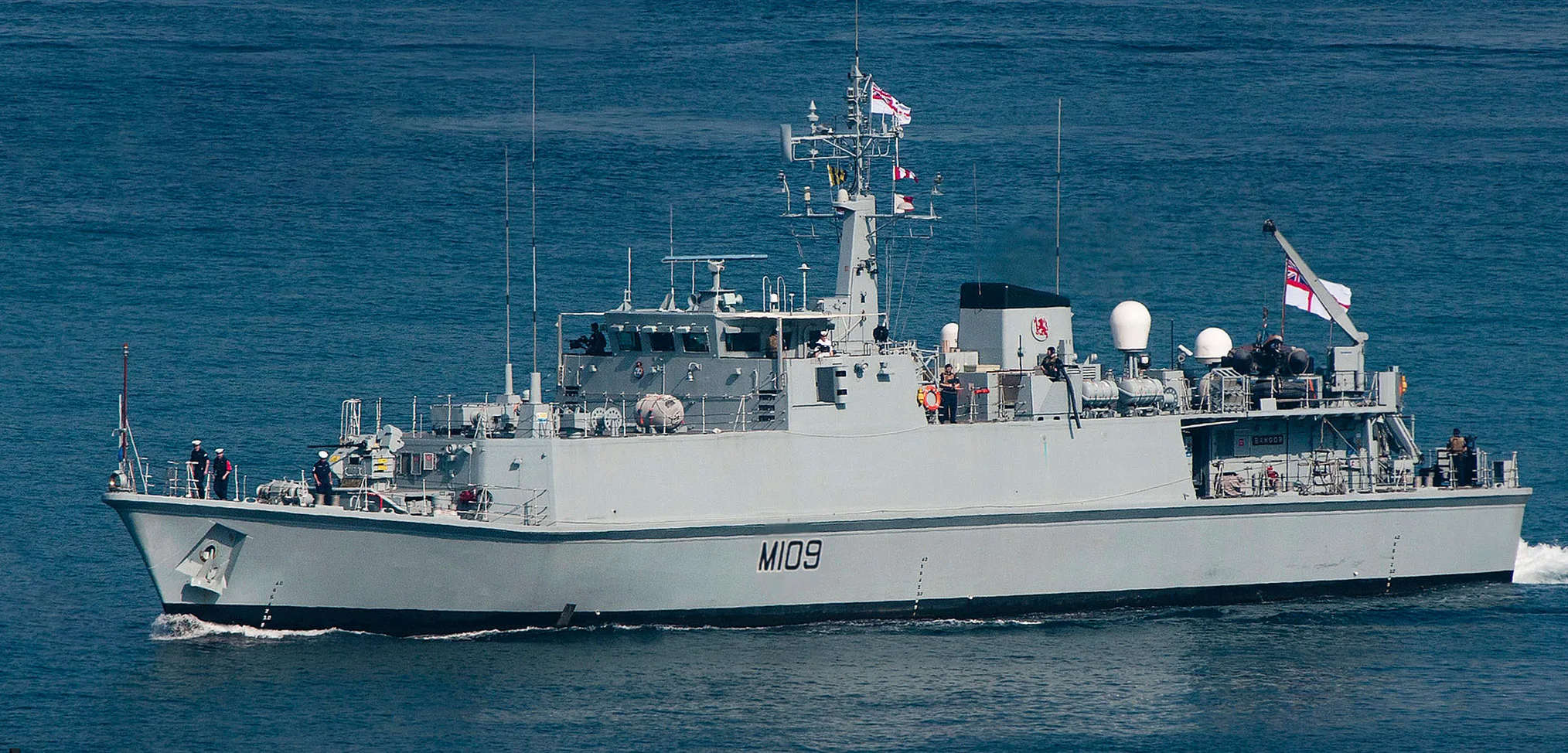
Despite previous announcements that all the RN’s Sandown-class Mine Countermeasures Vessels would be decommissioned by 2026, it has been decided to extend the life of the last remaining ship, HMS Bangor. Here we consider this decision and wider MCM developments.
A sort of homecoming
On 19th January 20204, HMS Chiddingfold collided with HMS Bangor while going astern in Bahrain harbour. Chiddingfold was largely unscathed, but her starboard quarter drove hard into Bangor’s port side, causing serious damage above the waterline. With the impending Sandown-class out-of-service date approaching, most would not have expected Bangor to have much of a future. However, the ship has been repaired in Bahrain and will be returned to the UK shortly for a further 5 years in commission.
The reason for the reprive is the need for the RN to have an assured deep water mine hunting capability. (The Sandowns are optimised for deep water while the Hunts are optimised for shallower conditions.) She will return to her base on the Clyde and act primarily in ensuring the safety of the nuclear deterrent submarines, but will also give the RN a platform that can supplement RFA Proteus in the seabed warfare mission. This is a very sensible solution to cover the move to autonomous minewarfare capability, as the rest of the Sandown-class were decommissioned with undue haste and the Hunt-class now numbers just 5 active vessels.
HMS Chiddingfold completed more than five years deployed in the Persian Gulf before her return to the UK in April 2025, not under her own power, but transported on the chartered commercial heavy-lift ship MV Rolldock Storm. Moving an MCMV by this method is a complex undertaking and requires a big effort to isolate, empty and preserve equipment for the 5-week journey. The evolution proved successful as this method reduces wear on the ship, limits exposure to risk during extended passages, and mitigates for the shortage of crew and support teams. With the concept now validated, HMS Bangor will soon be brought home, with HMS Middleton to follow in early 2026, travelling the same way. Both ships will be returned to operations once offloaded and after a short maintenance period.
Hunt class optimisation
The Hunt Class Optimisation Programme is reshaping how the remaining Hunt-class MCMVs are maintained during the final years of their service. Instead of relying on the traditional long docking periods, the scheme introduces shorter and more focused maintenance windows that aim to keep ships available for operations while still addressing essential engineering work. This aligns with BAE Systems’ ‘Total Availability Programme’, a concept which has seen a similar approach to support schedules being applied to the Aircraft Carriers and Type 45s. (In essence, nothing new, more in line with commercial shipping practice or the old RN regime of self-maintenance periods (SMP), assisted maintenance periods (AMP) and Docking and Essential Defects (DED)).
This revised method has already delivered measurable gains. The first Capability Insertion Periods (CIP) carried out in 2024 avoided roughly six months of downtime and reduced projected costs by about £3 million. Targeted upgrades, including the renewal of refrigeration systems, have improved energy efficiency and day-to-day reliability, while work to modernise Junior Rates’ living spaces has had a marked effect on comfort. Expanded high-speed Wi-Fi access across the vessels has also helped to improve connectivity and morale at sea. Improved data links using Low Earth Orbit (LEO) satellites, such as StarLink/Shield, to increase bandwidth will also become increasingly important for tactical information sharing during dispersed MCM operations.
PODS and MCM
HMS Ledbury has been fitted with a Persistent Operational Deployed System (PODS) TEU container on her quarterdeck. This represents a significant advance in bringing uncrewed underwater vehicle operations directly onto Hunt-class decks. Its introduction is helping to build the practical knowledge needed as the RN transitions its mine countermeasures approach toward a more distributed, autonomous and data-driven model. The system will continue to shape thinking for the Mine Hunting Capability (MHC) programme by providing real-world experience as new tools are selected, trialled and matured ahead of entering service.
HMS Ledbury is now starting to operate UUVs directly from the PODS modular mission units, which broadens the range of sensors and uncrewed systems a platform can deploy, enabling the ship’s companies to manage and integrate their own autonomous tools more routinely within traditional mine warfare operations.
During national tasking earlier in the year, Ledbury embarked a specialist team and deployed several REMUS UUVs to conduct extensive underwater surveys. REMUS are equipped for wide-area seabed reconnaissance, identifying potential threats with a high degree of accuracy. Their use dramatically increased the area that could be swept in a short period. Over the course of just over a fortnight, Ledbury supported more than 100 SEAFOX ROV mine disposal system runs while the REMUS vehicles completed roughly 375 nautical miles of survey lines. SEAFOX was employed to reacquire and classify objects detected by the autonomous vehicles, creating a complementary workflow between broad-area search and precise target prosecution.
This parallel approach to hunting and neutralising underwater hazards proved particularly effective where time was critical, such as generating rapid assurance for nationally important infrastructure. As the REMUS units scanned ahead, Ledbury repositioned to deal with promising contacts using SEAFOX or clearance divers, allowing multiple lines of effort to unfold at once and maintaining a high tempo throughout.
The operation also highlighted practical issues that still need to be addressed. Accommodating additional autonomous systems operators aboard the Hunt-class hulls is not straightforward due to a lack of space. Several avenues are being explored, including training Mine Warfare specialists to operate uncrewed systems or temporarily adding personnel from other branches who already possess the required technical skills. These options would give commanding officers more flexibility without diluting the core mine warfare expertise onboard. The experience also reinforced that early-stage survey and data collection do not always have to be performed by dedicated MCM vessels. All kinds of other naval or platforms of opportunity equipped with appropriate sensors can contribute to the initial detection phase, allowing MCM crews to concentrate on final identification and disposal of threats.
Brocklesby battling back
HMS Brocklesby’s current Docking Support Period (SP(D)) has been exceptionally difficult, with the ship so far having been out of action for 2 years and 8 months, well beyond the original schedule. The project has suffered from major delay, partly a result of a lack of suitable parts for ageing systems, combined with infrastructure issues that postponed the ship’s re-float. Bringing the ship back to operational condition has required sustained effort from a broad range of organisations working alongside the crew. The SP(D) approach demands continuous collaboration between Ship’s Staff and the prime contractor, BAES, rather than the more traditional model where work is carried out largely by the yard alone. This has meant joint responsibility for managing stores, coordinating maintenance activity and addressing a long list of defects.
Teams have had to overcome persistent technical and logistical challenges as they worked to regenerate a platform now more than forty years old. Assurance bodies, including FOST, MCTA, and the Navy Safety Centre, have also played an important role by inspecting departments, reviewing documentation and ensuring both the crew and the ship meet the standards required to operate safely ashore and eventually at sea. The ship’s company moved back on board in mid-November ahead of the ship rejoining the active fleet next year.

The MCMVs are not assigned permanent crews but 10 teams rotate across vessels as operational needs demand. The popular Dual Crewing Model (DCM) has now been extended to RN MCMVs operating in the Very High Readiness duty roles to provide greater sustainability and availability. Work is also underway to help retention through improvements to the ‘lived experience’ for the whole MCM cadre.
As part of the wider effort to sustain the class, HMS Chiddingfold has not been officially decommissioned but laid up in ‘extended readiness’, essentially as a parts donor for her sister ships. With the retention of HMS Bangor, this means the RN’s MCMV fleet will effectively be 6 active vessels, all soon to be based back in the UK, along with HMS Stirling Castle. The force concentration marks a prioritisation of NATO missions ahead of the long-standing commitment to the Gulf region. Compared with the past, a very modest force but limited resources are being well managed and best positioned to bridge the gap during the transition to fully autonomous mine countermeasures.
