

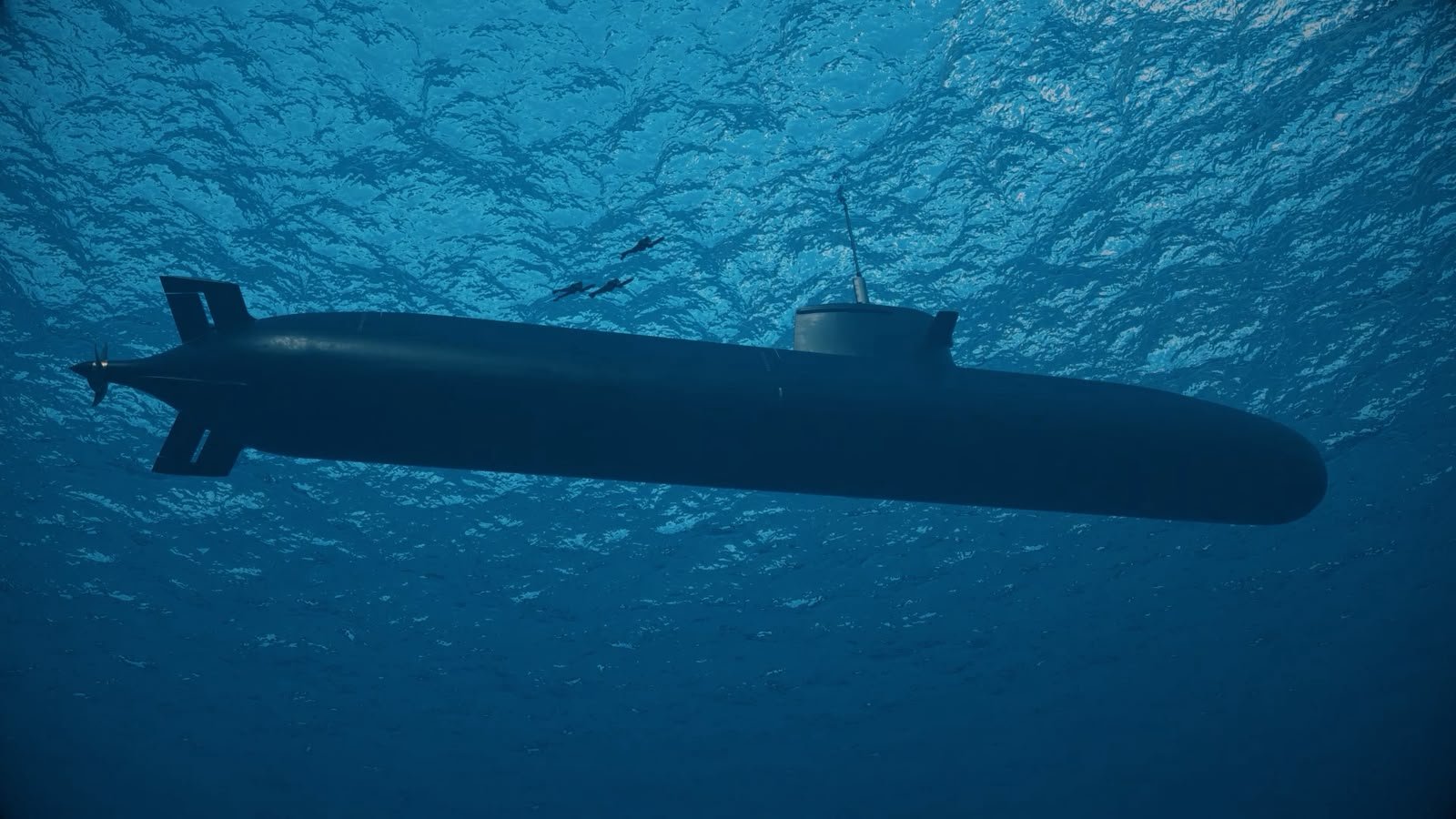
Naval Group presented its latest attack submarine design, the Blacksword Barracuda, at Euronaval 2026. Selected for the Netherlands’ Orka-class programme, the conventionally powered submarine is also being offered to Greece.
At Euronaval 2026, Naval Group showcased its latest conventionally powered attack submarine design, the Blacksword Barracuda (BSB). Derived from the French Navy’s Suffren-class (Barracuda) nuclear-powered attack submarines (SSN), the design has been selected by the Royal Netherlands Navy for its Orka-class programme and is now being pitched to Greece.
Designed for frontline navies, the Blacksword Barracuda combines ocean-going endurance with multimission flexibility, covering anti-submarine warfare (ASW), anti-ship warfare (ASuW), deep strike, special operations, and intelligence gathering.
Under the motto “Superiority at Sea, in All Seas,” and drawing on engineering and combat system developments from France’s nuclear submarine programme, Naval Group is positioning the BSB as a conventional platform offering performance traits typically associated with nuclear submarines, specifically high transit speeds, extended range, low acoustic and magnetic signatures, and a heavy payload capacity for extended deployments far from home bases.

Blacksword Barracuda: Design, Endurance, and Payload
The design builds on technologies and engineering expertise developed through France’s nuclear submarine programme, with the combat system also incorporating developments from this field.
Its hydrodynamic architecture and signature-reduction technologies combine very low acoustic and magnetic signatures with high manoeuvrability. The diving planes are positioned on the sail, while the submarine features an X-shaped stern configuration, identical to that of its nuclear-powered counterpart.
The Blacksword Barracuda measures 82 metres in length, with a beam of 8.2 metres. A high degree of automation allows it to operate with a crew of just 35 personnel. It can accommodate up to 43 personnel, with an additional 16 berths available for special forces personnel or mission specialists. Its surfaced displacement is approximately 3,300 tonnes, increasing to more than 3,500 tonnes when submerged at full load.
The submarine offers an at-sea endurance of up to 70 days, with the actual duration depending primarily on logistical factors, including food supplies, fuel and crew endurance. It can remain submerged for up to 15 days without recharging its batteries. Naval Group quotes a maximum speed of approximately 20 knots and a maximum range of 15,000 nautical miles.
The combat system and onboard infrastructure can be configured to customer requirements, supporting the deployment of both unmanned underwater vehicles (UUVs) and unmanned aerial vehicles (UAVs). Its sensor suite includes:
- Bow-mounted cylindrical sonar array
- Planar flank arrays and a towed array
- Intercept array and mine/obstacle avoidance sonar
- Self-noise monitoring system, echo sounder, and underwater communications
- CANTO acoustic countermeasure system for torpedo defence

For firepower, the BSB is equipped with six 533mm torpedo tubes and can carry up to 30 heavy weapons, a notably large payload for a conventional submarine. Compatible munitions include F21 heavy torpedoes, Exocet SM40 anti-ship and land-attack missiles, Naval Cruise Missiles (NCM), naval mines, and unmanned vehicles. Paired with a rapid-reloading system, this capacity allows commanders to execute multiple mission profiles on a single patrol without returning to port to rearm.
The Advantages of Lithium-Ion Batteries
Naval Group is offering the BSB with a diesel-electric propulsion plant paired with large lithium-ion battery banks developed alongside Saft, a subsidiary of TotalEnergies. This is a new battery technology that continues to evolve rapidly. The company considers this technology the future of conventional submarine propulsion, citing several significant advantages over Air-Independent Propulsion (AIP) systems paired with traditional lead-acid batteries.
These include shorter charging times, longer service life, greater energy storage capacity and improved safety, all contributing to increased submerged endurance. Lithium-ion batteries offer higher energy density and significantly greater power availability, enabling more aggressive manoeuvres, higher underwater speeds and faster changes in tactical position, regardless the state of charge of the battery..
The French approach also simplifies logistics and support, as crews can recharge the batteries at sea without relying on the specialised shore infrastructure required by certain AIP systems. Furthermore, lithium-ion batteries avoid several drawbacks associated with conventional lead-acid batteries, including sulfation, gradual degradation over time and the risk of hydrogen gas generation during charging, offering additional advantages in submarine operation and maintenance.
Naval Group also highlights the modular, “plug-and-play” design of its lithium-ion battery systems, which allows operators to replace or upgrade battery modules throughout the submarine’s service life.

Blacksword Barracuda for Greece’s Submarine Programme
Naval Group considers the Hellenic Navy’s technical requirements for its new submarine programme to reflect an ambition to acquire advanced, multimission submarines capable of supporting regional sea-control operations. The company believes its Blacksword Barracuda can meet these requirements and is proposing a four-submarine programme to replace Greece’s ageing Type 209 fleet (1 x Type 209/1100, 2 x Type 209/1200, 1 x Type 209/1500 AIP).
The industrial proposal includes partnerships with Skaramangas Shipyards and METLEN. Depending on Athens’ preferred acquisition model, all four submarines could be built in Greece, or a hybrid approach could see the lead boat constructed in France with the remaining three assembled locally. Naval Group also plans to establish a domestic through-life maintenance and support ecosystem to reduce reliance on foreign facilities.
Naval Group argues that lithium-ion propulsion would lower maintenance demands compared to AIP systems. A relevant factor for the Hellenic Navy, which currently operates five AIP-equipped submarines (four Type 214s and one modernised Type 209).
Interoperability represents another potential advantage. Naval Group considers that the transition from existing German-origin submarine systems to French technology would primarily require training and operational adaptation rather than present major technical challenges. The company draws a parallel with the Hellenic Navy’s transition to French FDI frigates, following decades of operating German-designed Hydra-class and Dutch-designed Elli-class ships. Selecting another French combat system could therefore offer opportunities for greater commonality across the fleet, although submarine-specific integration and training requirements would remain.

From an operational perspective, Naval Group draws on the French Navy’s worldwide submarine experience to develop a design that combines multimission capabilities with very low acoustic and magnetic signatures, extended range, long submerged endurance and substantial weapons capacity. These characteristics would allow the Hellenic Navy to employ the submarine across a broad spectrum of missions, from anti-submarine and anti-ship warfare to intelligence gathering, special operations and land attack. Its ability to carry a substantial weapons load and undertake multiple tasks during a single deployment could also reduce the need to return to port for replenishment, providing greater operational flexibility across the Eastern Mediterranean and beyond.
The proposed design would not only be capable of performing the missions that Hellenic Navy submarines have carried out over the past decade, but would also be designed to meet emerging operational requirements. These include future missions such as seabed warfare and counter-unmanned aerial systems (C-UAS) operations, positioning the submarine to address evolving threats and operational demands.
Finally, Naval Group is confident that its proposal will offer Greece the best value for money when the country requests final pricing, while also providing opportunities for substantial Hellenic industrial participation throughout the programme.
Source: navalnews.com. Summarised by TBH Center; all rights to the original reporting remain with the publisher.
