

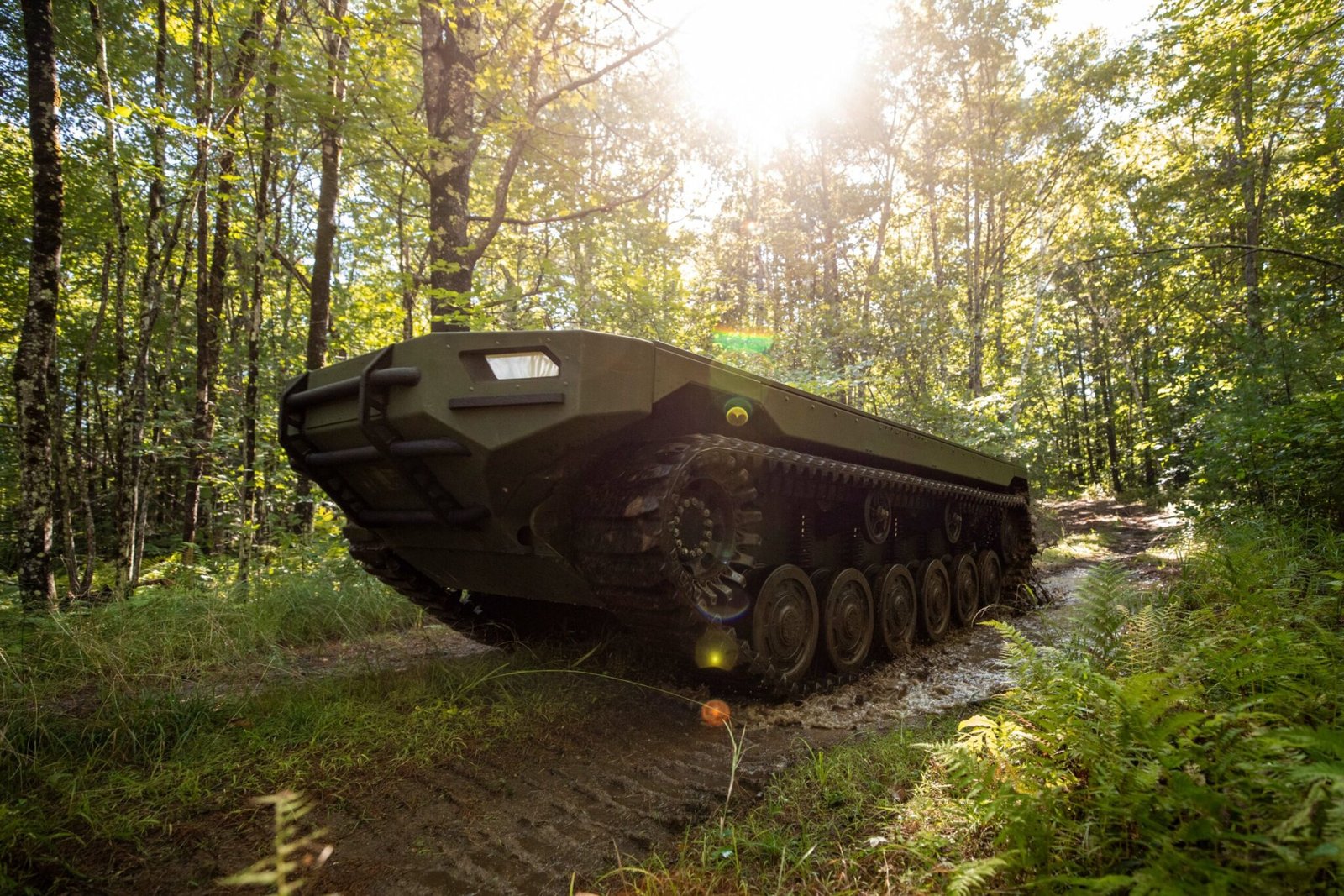

The US Marine Corps Warfighting Laboratory is acquiring two RIPSAW M3 unmanned ground vehicles (UGVs) from Textron Systems and its subsidiary Howe & Howe in a contract announced on 5 November 2026. The purpose is to evaluate the capabilities and effectiveness of the RIPSAW and UGVs in general as sensor payload platforms and in various logistics support roles.
The M3 RIPSAW is a fully tracked platform with a 2273 kg (5,000-pound) payload capacity, 5.85 square meters (63 square feet) of flat deck space, and the ability to generate 10 kW of onboard power. Equipped with a hybrid electric drivetrain and novel suspension, the RIPSAW has a top speed of 48 kmph (30 mph). It has a range of over 290 km (180 miles). Its compact size allows it to be transported internally, including in heavy-lift helicopters. Textron also offers a RIPSAW A3 version with a swim speed of 4.3 nmph (5 mph). The M3 is a modular design intended to be readily configured to various mission applications. Its open systems architecture further supports this.
According to Textron, the M3 vehicles will serve as experimentation and integration testbeds that may integrate various payloads and sensors, demonstrate mission sets, and inform additional robotics requirements.
This M3 evaluation is the latest in a series of UGV acquisitions and field evaluations of available systems. These have included formal field evaluations as early as 2023. Systems considered include the Rheinmetall Mission Master SP A-UGV, tracked THeMIS, and wheeled Hunter WOLF UGVs Applications considered included driverless resupply, coastal/shoreline traverse, casualty evacuation (CASEVAC), command post operations centre, and logistics support. However, to date, the Marines have not yet pursued a large purchase.
by Stephen W. Miller
