

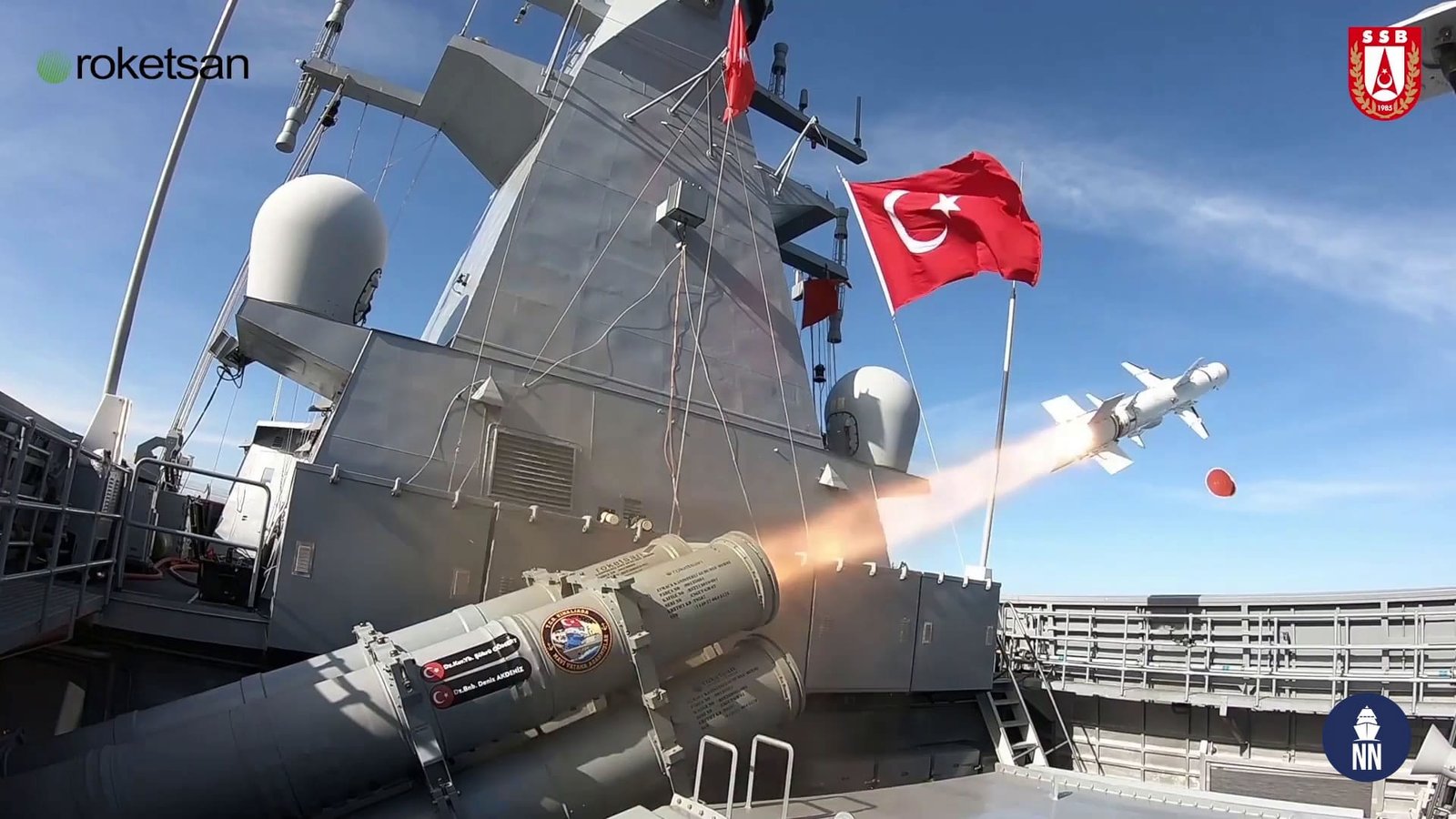
While Malaysia announced this week that Roketsan’s ATMACA is now the preferred replacement for Kongsberg’s Naval Strike Missile (NSM) on the Royal Malaysian Navy’s Littoral Combat Ships (LCS), sources with knowledge of the matter tell Naval News that integrating the Turkish missile into the ships’ French combat management system still needs to be discussed and could require a standalone console setup.
Albert Lee story, additional reporting by Xavier Vavasseur and Tayfun Ozberk
Defense Minister Datuk Seri Mohamed Khaled Nordin said on November 12 that Kuala Lumpur will negotiate with Türkiye to finalize the purchase. Speaking to reporters, Khaled stated that the ATMACA was deemed superior to competing French and Italian anti-ship missiles on both cost and delivery timelines.
According to Khaled, Malaysia has received assurances that the ATMACA is compatible with Naval Group’s SETIS combat management system fitted aboard the LCS vessels. He added that the missiles could be delivered “ahead of schedule” thanks to Malaysia’s existing order of 24 ATMACAs for the Littoral Mission Ship Batch 2 program. The New Straits Times quoted Khaled as noting that this prior order means Malaysia will not have to pay the full cost of introducing an entirely new missile system.
However, two sources with knowledge of the matter, speaking to Naval News on condition of anonymity, indicated that key technical aspects of the integration have yet to be settled. One source said that details regarding the ATMACA’s physical integration aboard the ships and into the combat management system must still be negotiated and agreed upon during the upcoming talks.
A second source explained that integrating a Turkish missile into a French combat management system raises a number of issues. According to the source, one viable (and the simplest) option would be to field the ATMACA as a standalone solution. Under this configuration, dedicated firing consoles would be fitted inside the ship’s Combat Information Center (CIC), without integrating the missile system into Naval Group’s SETIS CMS.
Tayfun Ozberk, a former Turkish Navy officer and regular contributor to Naval News, said ATMACA is a modern anti-ship missile already in service with the Turkish Navy and would be well suited to operations in the Asia-Pacific region. He noted that there are several options for operating the missile aboard the LCS vessels, including integration with their French combat management system.
“The ships on which ATMACA has been integrated to date generally use Turkish-developed combat management systems, such as GENESIS or ADVENT. Integration with SETIS would require cooperation from France’s Naval Group and DGA, including agreement on the necessary technical interfaces,” Ozberk said.
“Even without integration into SETIS, ATMACA could still be operated as a standalone system using a dedicated console in the Combat Information Center. During its early testing, the missile was fired from TCG Kınalıada using a standalone console. The missile’s own capabilities would remain available in this configuration, although the ship’s crew might need to make additional organizational arrangements. Integration with the combat management system would nevertheless make the missile easier to employ as part of the ship’s overall combat system.”

Khaled also announced that Malaysia is moving to establish a dispute resolution committee with Norway over Oslo’s decision in March to block NSM exports to Malaysia, following unsuccessful initial negotiations.
The selection of the ATMACA comes after Malaysia’s Auditor General flagged the NSM dispute as a major risk for further delays to the LCS program, pushing LCS 1 Maharaja Lela’s projected delivery date from December 2026 to April 2027.
Shipbuilder Lumut Naval Shipyard stated that removing the NSM launchers already installed on Maharaja Lela has contributed to the delay, citing the need to maintain an unbroken chain of custody for the equipment in compliance with international arms export control regulations.
Maharaja Lela is currently undergoing sea trials, with Lumut Naval Shipyard recently releasing footage of live-fire tests using its Bofors 57mm main gun. According to Khaled, overall construction progress across the five Littoral Combat Ships stood at 80.72% as of September 25—9.19% behind the planned target.
Other program risks highlighted by the Auditor General include the lack of finalized contracts for the ships’ remaining armament and countermeasures, including VL-MICA surface-to-air missiles, 57mm ammunition for the Bofors gun, and the integrated decoy launching system. Without those contracts in place, the Auditor General warned that proceeding with the original December handover target would have resulted in delivering an incomplete ship lacking full weapons capabilities and crew training.
