

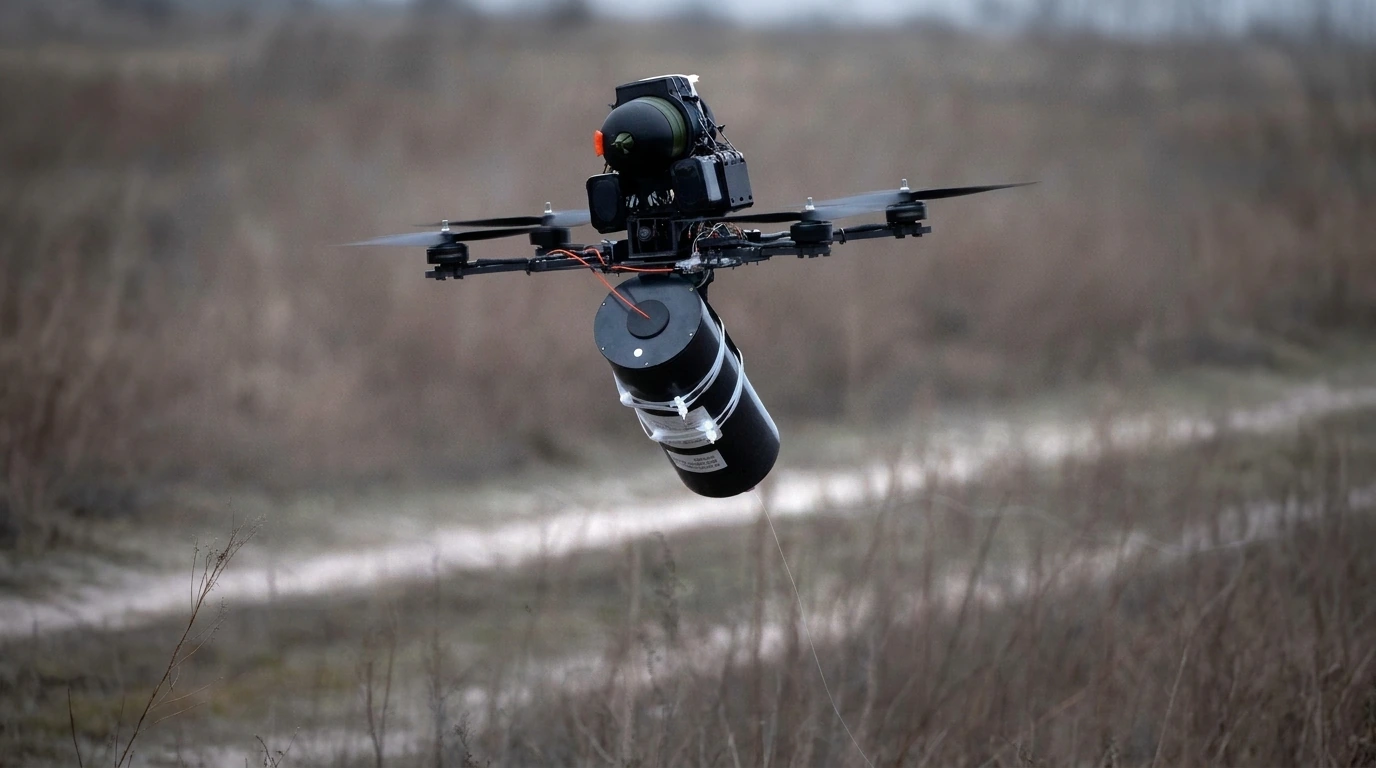
Imagine a drone flying across a battlefield while enemy electronic warfare systems struggle to interrupt its communication. Radio signals are being jammed, GPS reception is unreliable, and conventional FPV drones are losing their connection.
Yet this aircraft keeps receiving commands and transmitting live video. Its secret isn’t a more powerful antenna or sophisticated satellite technology. It’s a remarkably thin cable trailing behind it.
This is the principle behind the fiber-optic drone, a technology that is changing how military forces approach unmanned aerial warfare.
Unlike conventional drones that rely on radio frequencies to communicate with their operators, fiber-optic drones use a physical optical cable to carry control commands and video signals. The cable gradually unwinds from a spool attached to the aircraft as it moves through the air. Information travels through the fiber as pulses of light rather than wireless radio transmissions.
The result is a communication system with a significant advantage: conventional radio-frequency jamming cannot directly disrupt signals traveling through the cable.
This capability has attracted considerable attention during the Russia-Ukraine war, where electronic warfare has become a major challenge for drone operators. Both sides have explored fiber-optic FPV systems to maintain reliable connections in heavily contested environments.
However, the technology isn’t without trade-offs. Cable weight, limited spool capacity, physical damage, and battery endurance all influence how these aircraft perform.
So, how does this unusual communication system actually work? Why is it difficult to jam, and what makes it different from an ordinary FPV drone?
Let’s examine the technology, starting with the basics, then explore its growing role in modern warfare.
What Are Fiber Optic Drones?
A fiber optic drone is an unmanned aerial vehicle (UAV) that uses a physical optical cable to communicate with its remote operator. Instead of sending control commands and camera footage through radio waves, it transmits information as pulses of light traveling through a thin fiber-optic strand.

Think of it as a flying computer connected to its operator by an extremely long data cable. The aircraft can move freely while the cable gradually unwinds from a compact spool carried onboard.
Most military fiber-optic drones are built around the familiar first-person-view (FPV) design. They typically feature a flight controller, electric motors, a camera, a battery, and an optical communication system. The major difference is how information moves between the aircraft and its ground station.
How Does a Fiber Optic Drone Differ From a Conventional FPV Drone?
The distinction comes down to communication. Conventional FPV drones depend on wireless radio-frequency links for transmitting commands and video. These signals travel through the surrounding environment, making them vulnerable to certain forms of electronic interference.
Fiber-optic models replace that wireless connection with a physical data link. Their operators receive camera footage through the cable and send control inputs along the same communication pathway.
This arrangement offers an important advantage in environments where radio communications are heavily disrupted.
What Makes the Fiber-Optic Cable Special?
The cable itself is surprisingly small. It contains extremely fine glass or plastic fibers designed to carry information using light signals.
Unlike ordinary electrical wiring, optical fiber does not depend on electrical current traveling through a conductor to transmit data. This makes it resistant to electromagnetic interference affecting conventional communication cables.

One important distinction: the cable carries information, not electrical power. The drone still relies on its onboard battery to operate its motors, camera, and electronic systems.
Fiber-optic drones are also different from traditional tethered UAVs, which receive electrical power through a physical connection to the ground.
That distinction matters. One uses a cable for communication; the other may use it for continuous power and data transmission.
In short, a fiber optic drone combines familiar FPV aircraft technology with a different communication method. It’s a relatively straightforward idea with significant consequences for modern military operations.
How Do Fiber Optic Drones Work?
The interesting part of a fiber optic drone isn’t necessarily its motors, camera, or flight controller. It’s the communication system connecting the aircraft to its operator. Instead of relying on wireless radio transmissions, the drone uses a physical optical cable to exchange information throughout its flight.
The process begins before takeoff, when the operator connects the ground station to the drone’s fiber-optic communication system. A lightweight spool containing the cable is attached to the aircraft. As the drone moves, the cable gradually unwinds behind it.
How Does the Fiber-Optic Communication System Work?
Fiber-optic technology works by transmitting information through pulses of light. Inside the communication equipment, electrical data is converted into optical signals using specialized electronic components.

These light signals travel through the fiber and reach a receiver at the opposite end. The receiver converts them back into electrical data that the connected equipment can interpret.
The same principle works in both directions. Camera footage travels from the drone toward the operator, while control information travels from the ground station toward the aircraft.
Here’s how the main components fit together:
| Component | Primary function |
| Fiber-optic spool | Stores the cable carried by the drone |
| Optical transmitter | Converts electrical information into light signals |
| Optical receiver | Converts incoming light signals into electrical data |
| Flight controller | Processes commands and manages aircraft stability |
| FPV camera | Captures live video for the operator |
| Ground station | Provides the operator’s control interface |
How Does the Drone Maintain Its Connection During Flight?
Unlike a conventional FPV drone, the aircraft doesn’t need to maintain a wireless communication link with its operator. The physical cable provides a continuous pathway for exchanging information.
As the aircraft travels, its onboard spool releases additional fiber. This allows the drone to move farther away while maintaining its connection, provided the cable remains intact and within its available length.
An important detail often overlooked is that the cable doesn’t pull the aircraft forward or provide electricity. It simply carries data.
The onboard battery remains responsible for powering the aircraft. Meanwhile, the fiber-optic connection handles communication.
This separation is what makes the technology particularly interesting. The drone can continue receiving commands and transmitting video even when conventional radio communications are heavily disrupted.

However, the physical connection introduces a different set of limitations. Cable weight, mechanical damage, and available spool capacity all influence performance.
It’s a trade-off between wireless freedom and communication reliability.
Why Are Fiber Optic Drones Resistant to Electronic Warfare?
One of the biggest reasons military forces are interested in fiber optic drones is their ability to maintain communication in environments filled with electronic interference. On a modern battlefield, keeping a drone connected can be just as challenging as flying it toward its destination.
Conventional FPV drones typically depend on radio-frequency signals to exchange commands and video footage. Electronic warfare systems can exploit this dependency by transmitting interference that disrupts the communication link.
Fiber-optic drones approach the problem differently. Their communication signals travel through a physical cable rather than the surrounding air.

Why Can’t Conventional Radio Jammers Easily Disrupt Fiber-Optic Drones?
Radio-frequency jammers work by transmitting electromagnetic interference that overwhelms or disrupts wireless communication signals. When a conventional drone depends on radio waves, this interference can prevent its operator from maintaining control.
An optical fiber doesn’t transmit information through radio waves. Instead, it carries light signals inside a protected physical medium.
Consequently, conventional RF jamming cannot directly interfere with the communication traveling through the cable.
This creates a significant difference between the two technologies:
| Feature | Conventional FPV Drone | Fiber Optic Drone |
| Communication medium | Radio waves | Optical fiber |
| RF jamming vulnerability | High, depending on equipment | Low for the fiber link |
| Wireless control signal | Yes | No |
| Wireless video transmission | Yes | No |
| Dependence on physical cable | No | Yes |
For military operators, this means a drone may maintain its communication link even when surrounding radio frequencies are heavily contested.
Are Fiber Optic Drones Completely Immune to Jamming?
Not entirely. This is an important distinction.
Although their optical communication links are resistant to conventional RF jamming, other onboard systems can remain vulnerable. For example, a drone using satellite navigation may still experience GPS interference or spoofing.
The aircraft also depends on its physical cable remaining intact. A damaged connection can interrupt communication just as effectively as losing a conventional wireless link.
Furthermore, electronic warfare isn’t limited to radio jamming. Detection, navigation disruption, and other counter-drone technologies can still create problems.
Fiber-optic technology therefore doesn’t make a drone invulnerable. It removes one particularly important weakness: dependence on wireless communication.
And in an environment where electronic warfare constantly challenges conventional drone operations, that difference can be substantial.
How Far Can Fiber Optic Drones Fly?
A fiber optic drone can travel several kilometers while maintaining a physical communication connection with its operator. However, its maximum operating distance depends heavily on cable length, battery capacity, aircraft design, and flight conditions.
Unlike conventional FPV drones, which depend primarily on wireless signal coverage, fiber-optic models have a more obvious physical limitation: the amount of cable available on their onboard spool.
How Does Fiber-Optic Cable Length Affect Drone Range?
The cable spool determines how much communication fiber the aircraft can carry. Military fiber-optic drone systems have been developed with different cable lengths, including commonly reported configurations of 10, 15, 20, and 25 kilometers.

Some newer systems have reportedly extended these figures further, although specifications vary between manufacturers and models.
Longer cables potentially allow the aircraft to operate farther from its ground station. But there’s a catch. More cable generally means additional weight, which can affect flight endurance and maneuverability.
Consider the following illustrative comparison:
| Cable length | Potential operating distance | Main consideration |
| 10 km | Up to approximately 10 km | Lower cable weight |
| 15 km | Up to approximately 15 km | Moderate spool capacity |
| 20 km | Up to approximately 20 km | Increased cable weight |
| 25 km | Up to approximately 25 km | Greater payload demands |
These figures represent cable capacity, not guaranteed flight range. Actual performance depends on the aircraft’s ability to carry the spool and maintain sufficient battery power.
What Other Factors Affect Fiber-Optic Drone Range?
Cable length is only one piece of the puzzle.
Battery endurance matters just as much. The aircraft must have enough stored energy to operate its motors, camera, flight controller, and communication equipment throughout its flight.
Weight also plays a major role. A heavier spool increases the workload on the motors, potentially reducing flight time and overall efficiency.
Then there’s the environment. Trees, buildings, uneven terrain, and other physical obstacles can create situations where the trailing cable becomes difficult to manage.
Weather conditions may introduce additional challenges, particularly when wind increases the aircraft’s power requirements.
Ultimately, a longer fiber-optic cable doesn’t automatically produce a better drone. Manufacturers must balance communication distance against weight, endurance, and handling characteristics.
That’s the engineering challenge behind extending the range of these aircraft.
How Are Fiber Optic Drones Used in Modern Warfare?
Fiber optic drones have moved from an unusual engineering concept to a significant feature of modern battlefield operations. Their growing popularity reflects a broader change in military technology: when wireless communication becomes unreliable, physical connections can offer an alternative.
The Russia-Ukraine war has provided a particularly important example. Both countries have increasingly incorporated unmanned aircraft into their operations, while electronic warfare systems have made conventional drone communications more difficult to maintain.
Fiber-optic technology offers a different approach. Instead of competing with enemy radio signals, these aircraft maintain communication through a physical cable.

Why Have Russia and Ukraine Adopted Fiber Optic Drones?
The widespread use of electronic warfare has been a major factor behind their development. Radio-controlled drones can lose their communication links when exposed to sufficiently powerful interference.
For operators, losing a connection can mean losing control and valuable information. Fiber-optic systems help address this problem by removing the wireless communication link from the equation.
Russian forces have deployed fiber-optic FPV drones in several battlefield environments, particularly where conventional drones face significant electronic interference. Ukrainian forces have also developed and fielded their own systems to counter similar challenges.
This competition illustrates an important development in military technology. The advantage increasingly comes from adapting communication systems to battlefield conditions, rather than simply building faster aircraft.
What Military Roles Can Fiber Optic Drones Perform?
Their communication characteristics make fiber-optic drones useful in several military applications.
Reconnaissance and surveillance: Cameras can transmit live footage through the optical cable, allowing operators to observe areas without depending on conventional wireless video transmission.
Operations in electronically contested environments: These aircraft can maintain their optical communication links where radio-frequency interference would otherwise disrupt conventional FPV systems.
Operations around physical obstacles: Optical communication doesn’t depend on radio signals traveling directly through open air. This can provide advantages in environments where buildings, trees, or terrain obstruct wireless transmissions, although the physical cable introduces its own restrictions.
Tactical battlefield support: Their ability to maintain a stable communication connection makes them another option within a broader military drone fleet.
The important distinction is that fiber-optic technology changes how a drone communicates, not necessarily what the aircraft can physically accomplish. Its military value comes from combining familiar UAV capabilities with a communication method that addresses a growing battlefield problem.
What Are the Advantages and Disadvantages of Fiber Optic Drones?
Fiber optic drones offer an impressive solution to one of modern warfare’s biggest challenges: maintaining reliable communication under electronic interference. However, their technology introduces several physical limitations that conventional wireless drones don’t necessarily face.
They’re not automatically better in every situation. The real advantage depends on where and how they’re used.

What Are the Main Advantages of Fiber Optic Drones?
The biggest benefit is resistance to conventional radio-frequency jamming. Because communication travels through an optical cable, enemy jamming systems cannot directly disrupt the data link by overwhelming wireless signals.
Other advantages include:
- Reliable communication: The physical connection provides a dedicated pathway for transmitting control commands and video.
- Reduced RF dependence: Operators don’t need conventional wireless control and video links.
- Improved performance under interference: The optical communication link remains usable in environments where radio transmissions are heavily disrupted.
- Clear video transmission: Fiber-optic systems can provide stable data transmission without relying on a conventional wireless video connection.
- Reduced radio-frequency emissions from the communication link: This removes one potential source of detectable wireless transmissions.
What Are the Disadvantages of Fiber Optic Drones?
The technology comes with meaningful trade-offs.
The onboard spool adds weight, reducing the aircraft’s available payload capacity and potentially shortening its flight endurance. Cable length also places a physical limit on how far the drone can travel while maintaining its connection.
There’s another problem: the cable itself can become damaged, tangled, or obstructed by surrounding objects.
Consider how these limitations compare:
| Feature | Conventional FPV Drone | Fiber Optic Drone |
| RF jamming resistance | Vulnerable | Highly resistant |
| Communication method | Wireless | Physical cable |
| Cable weight | None | Additional weight |
| Operating distance | Limited by link and battery | Limited by cable and battery |
| Cable damage risk | Not applicable | Present |
| Flight flexibility | Generally higher | Restricted by cable |
Ultimately, fiber-optic drones exchange some wireless flexibility for a more interference-resistant communication system.
That makes them particularly valuable in electronically contested environments, but less attractive when unrestricted movement and minimal aircraft weight are priorities. Neither design wins every contest. The operating environment determines which technology makes more sense.
Are Fiber Optic Drones the Future of Modern Warfare?
Fiber optic drones represent more than another variation of the familiar FPV aircraft. Their growing use highlights how military technology evolves when traditional communication methods become unreliable.
As electronic warfare continues to influence battlefield operations, military forces are looking for ways to maintain control over unmanned aircraft without depending entirely on radio-frequency transmissions. Fiber-optic communication offers one practical answer.
However, these aircraft aren’t likely to replace conventional drones completely.

How Could Fiber Optic Drone Technology Develop?
Future improvements will likely focus on reducing the physical limitations associated with optical cables.
Lighter fiber-optic materials and more compact spool designs could help reduce the additional weight carried by the aircraft. This would potentially improve flight endurance and allow manufacturers to develop more capable platforms.
Communication equipment may also become smaller and more efficient. Better optical transmitters and receivers could support improved data transmission while reducing onboard power requirements.
Another important development is the growing diversity of military drone designs. Rather than relying on a single communication method, armed forces can maintain different UAV configurations for different operating environments.
Conventional FPV drones remain useful when flexibility and unrestricted movement matter. Fiber-optic models offer another option when wireless communication faces serious interference.
Will Fiber Optic Drones Replace Conventional FPV Drones?
Probably not. Their physical limitations make complete replacement unlikely.
The communication cable adds weight, restricts movement, and introduces another potential point of failure. These disadvantages become particularly important when aircraft must operate across complicated terrain or cover long distances.
Conventional wireless drones still offer greater freedom of movement because they don’t need to carry a trailing cable.
The more realistic future is a combination of technologies. Military forces will continue developing different drone platforms according to their communication requirements, endurance, and intended roles.
Fiber-optic drones have demonstrated that even a relatively simple change in communication technology can influence battlefield effectiveness.
Their importance isn’t that they solve every problem facing military UAVs. It’s that they provide an alternative when one of the most widely used technologies, wireless communication, becomes a weakness.
And as electronic warfare continues evolving, that alternative is likely to remain relevant.
