

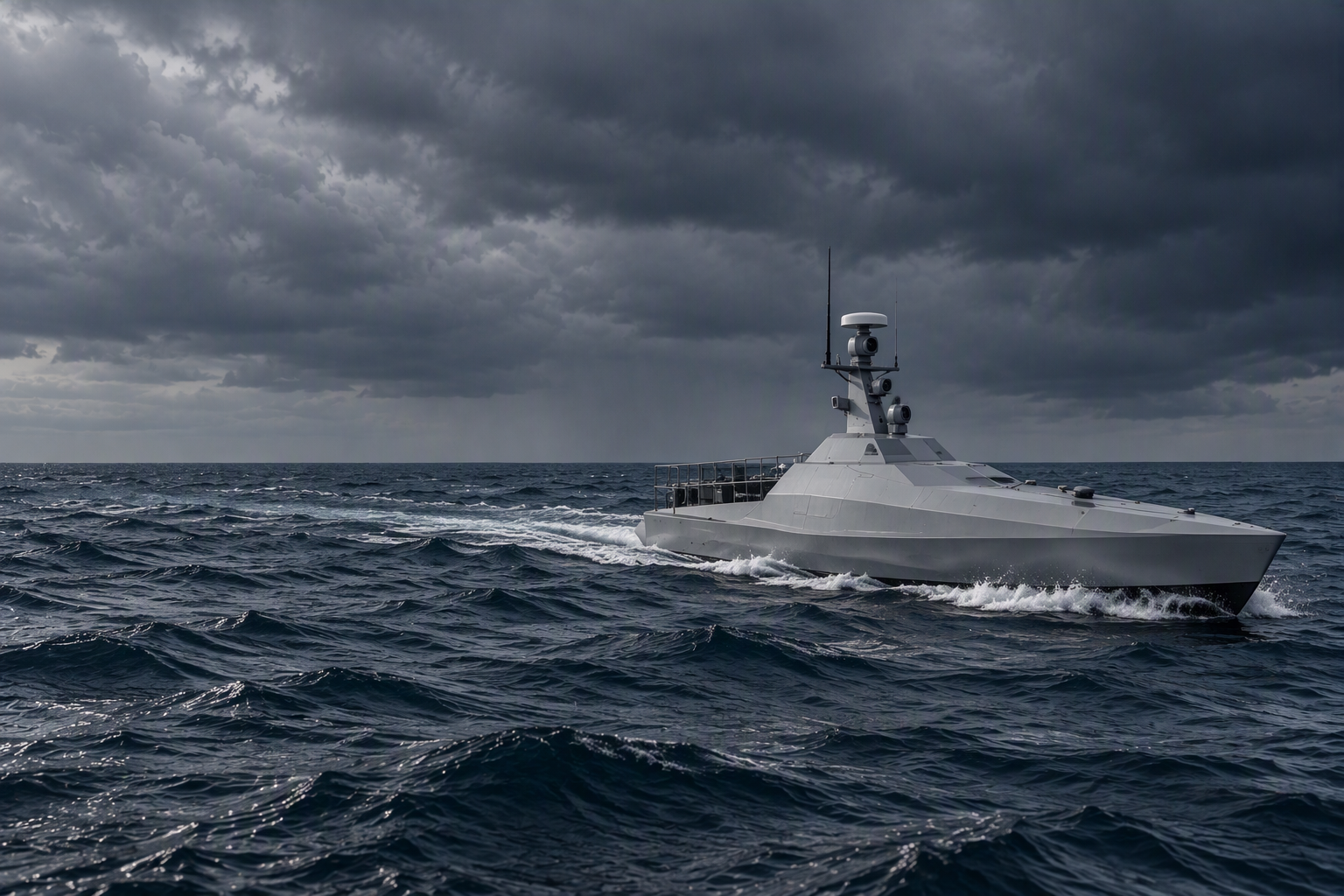

Uncrewed surface vessels (USVs) allow navies to deploy far more platforms, covering wider areas, distributing sensors and keeping sailors further from danger. They can reduce purchase and operating costs, but removing the crew increases the demands on onboard systems. A smaller, cheaper vessel may therefore need inertial navigation at least as capable as that of a much larger conventional warship.
When there is no navigator onboard
If a driver’s satnav fails, the driver can still recognise landmarks and read the road. Autonomous vehicles can similarly use cameras, lidar or radar to measure movement relative to their surroundings. At sea, however, such external references are far more limited. Cameras and radar remain useful for obstacle detection, while Doppler velocity logs or celestial navigation can provide additional references in certain conditions.
A USV must navigate through this environment without anyone on board to resolve uncertainty. Remote operators can supervise, but communications may be interrupted and immediate intervention cannot always be assumed. On a crewed vessel, a navigator can identify inconsistencies between different sources or question an implausible position. On an uncrewed vessel, more of that responsibility must be handled by the navigation system itself.
Maintaining navigation without GNSS
Global navigation satellite systems (GNSS) provide accurate positioning, but their signals can be jammed or spoofed. Other external references, including positioning services using Iridium satellites, can add resilience, but an independent, continuous measurement of the vessel’s movement remains essential.
An inertial navigation system (INS) uses gyroscopes and accelerometers to track rotation and acceleration, calculating orientation, velocity and position from an initial reference without requiring external radio signals. Its position estimate gradually drifts, so it works alongside other sensors and positioning sources. Higher inertial performance extends the time during which navigation can remain accurate enough when external references are unavailable or unreliable.

Beyond position
Position is only part of the story. An inertial system also measures attitude: how the vessel rolls, pitches and turns. This information remains essential even when satellite positioning is fully available.
Accurate attitude data helps stabilize directional satellite antennas as the vessel moves in the waves. For a remotely supervised USV, this connection carries instructions to the vessel and mission data back to operators. The same motion reference also supports onboard sensors: a sonar surveying the seabed, for example, must compensate for platform movement to produce usable, accurately located data.
As the functions of “sense, decide, effect” are increasingly distributed across crewed and uncrewed vessels, reliable navigation helps ensure that data collected by one platform can be used by another. Crewed vessels already depend on these capabilities. Uncrewed operation can impose tighter requirements on continuity and automatic checking, because there is no crew aboard to compensate when information becomes unreliable.
From large warships to uncrewed platforms
These requirements are already shaping naval USV programs. Exail was recently selected by a leading navy to provide its high-performance Marins INS for an important USV program, illustrating the level of navigation performance that can be required even by smaller uncrewed platforms.
The same evolution is behind the development of Marins M1, Exail’s latest FOG-based INS, designed to bring high-end inertial navigation performance to smaller crewed and uncrewed naval platforms, where compactness, ease of integration and cost are key considerations.

Rethinking the cost equation
This puts the apparent economic paradox into perspective. The relevant comparison is not simply between the cost of the navigation system and that of the vessel carrying it. Navigation is one of the capabilities that helps make the uncrewed operating model possible.
Remote supervision, maintenance and shore support still cost money, and navigation equipment does not replace a crew on its own. But a smaller autonomous vessel can justify highly capable inertial equipment precisely because it has fewer people on board to compensate when navigation information becomes unreliable. As navies deploy uncrewed platforms more widely, smaller and potentially less expensive vessels will not necessarily mean lower navigation requirements.
