

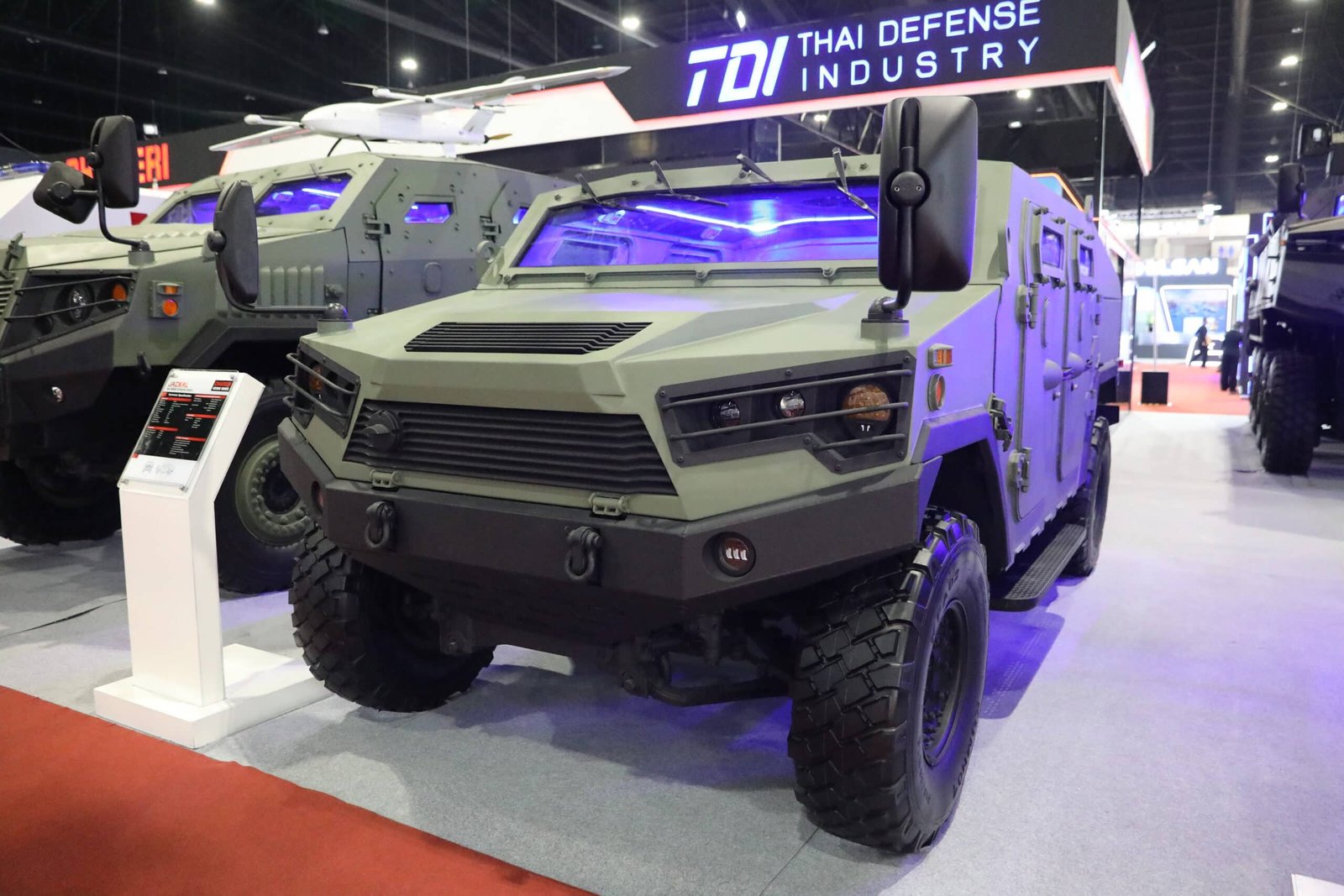
The Malaysian Army has ordered a fleet of vehicles to support the future arrival of CAESAR 155mm truck-mounted howitzers. This CASEAR support vehicle contract encompasses five vehicle types.
Platforms across four of the categories are believed to be based on Mercedes-Benz 6×6 chassis. These include a total of 18 long-wheelbase 155mm ammunition resupply vehicles, three forward repair vehicles, a medium recovery vehicle and two fire control coordinating vehicles.
The fifth vehicle type in the package is the Jackal forward reconnaissance vehicle developed by Thai firm Chaiseri. The Jackal 4×4 high-mobility vehicle can perform convoy escort, forward observation and reconnaissance for the Malaysian artillery regiment.
The contract for the Jackals, reportedly for 34 vehicles, was signed on 20 October 2026. The signatories were the Thai Defence Industry (TDI)-Chaiseri joint venture and Shafleena Venture from Malaysia.
Advanced Defence System (ADS) will perform final fit-out on the Jackals before eventual handover to the Malaysian Army. TDI-Chaiseri will commence deliveries next year, with production to be split between Malaysia and Thailand.
Unveiled at the Defense & Security exhibition in November 2025, the 5.2-tonne Jackal is known to have been adopted by the Thai military, with examples appearing near the fractious Thai-Cambodian border.
Powered by a 228hp engine and capable of carrying a 1,250kg payload, the Jackal is more capable than the commercial-vehicle-based 4x4s popular with Southeast Asian militaries.
Through its local partner ADS, KNDS will deliver 18 Renault-based, right-hand-drive CAESAR Mk 1 self-propelled howitzers to the Malaysian Army via a contract signed on 16 June 2026.
This made Kuala Lumpur the 15th CAESAR customer, and full delivery is to occur within four years. ADS will perform final fit-out and localisation at its facility in Pagoh, Johor.
Malaysia and Thailand have a history of cooperation. Indeed, Chaiseri previously supplied 20 customised First Win 4×4 protected vehicles to the Malaysian Army, where the platform is known as the Lipan Bara. That contract had been signed in 2015.
by Gordon Arthur
