

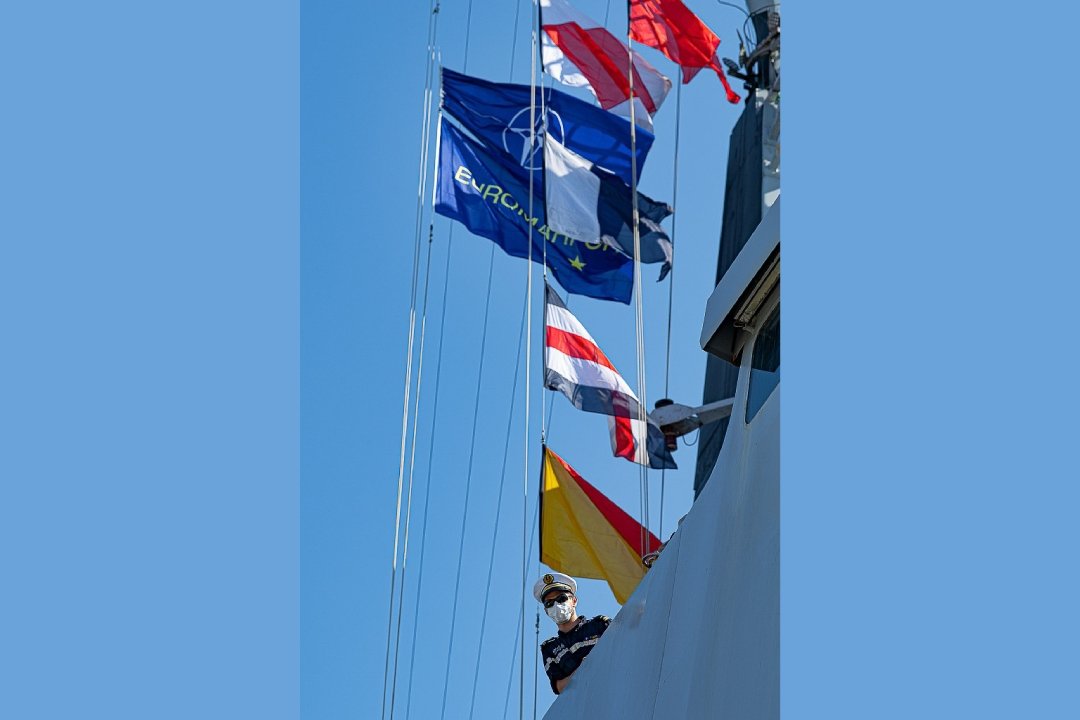

The reported presence of drones near a French armed forces exercise in Toulon, southern France, earlier in October has underlined the ongoing incursion risk for NATO countries and the need for continued alliance development of credible, capable response options, especially counter-uncrewed air systems (c-UAS).
Such response options are needed to confront threats to NATO interests from uncrewed systems; however, uncrewed aerial vehicles (UAVs) pose particular challenges.
According to the regional press office at the French Navy’s Maritime Area and District Command for the Mediterranean, unauthorised UAVs were detected in the no-fly zone around military sites being used for Exercise ‘Typhoon’, a large-scale joint force activity.
In a statement, the press office said it activated planned security measures after counter-drone devices were triggered. It added that no sensitive infrastructure had been threatened, and noted too that an investigation into the incident was underway.
The statement did not indicate that a rogue actor was responsible for the incident.
However, such incidents are now commonplace across NATO’s area of responsibility (AOR). Many occur in and around the Baltic region and along what is now called the alliance’s ‘eastern front’, stretching from Finland along the Baltic State borders and down through Poland. The first high-profile UAV incursion (in political and public terms) against NATO interests occurred in the Baltic Sea region in September 2025.
NATO’s naval power and presence are key tools the alliance uses to leverage deterrence and defence effect across its AOR. Thus, surveillance of NATO naval activities by other parties is expected.
Yet an overt drone presence presents a challenge, in surveillance and wider security terms, that NATO is now tackling as a priority.
The NATO Naval Armaments Group (NNAG), which advises the alliance on research, development, and production of maritime warfare capabilities, for example, is prioritising the identification and delivery of counter-uncrewed air system (c-UAS) operational outputs. This prioritisation follows a recent survey NNAG conducted with alliance member states to assess operational capability gaps at national and NATO naval levels.
Alongside incidents of UAV incursions over critical national infrastructure sites ashore across Western Europe, one-way (OWA) UAVs have also been widely used at sea in the ongoing Gulf, Red Sea, and Ukraine conflicts. These conflicts have shown how quickly a naval ship’s loadout of expensive, high-end air-defence effectors can be depleted by a mass of inbound, relatively inexpensive UAVs
Because NATO does not typically buy equipment on behalf of its member states, NNAG will look to harness its alliance-wide requirement to deliver a c-UAS capability as a national programme. Several NATO member states – including Denmark, Germany, Italy, the Netherlands, and the UK – are developing c-UAS programmes that could be used as a structure around which to build out NATO capability.
Building a c-UAS capability requires not only affordable effectors, but also radar systems optimised to detect small targets, including those launched from close in. With NATO’s European navies operating more than 30 different frigate types, a containerised system is an optimal solution for any navalised c-UAS capability, enabling easy deployment and employment.
by Dr. Lee Willett
