

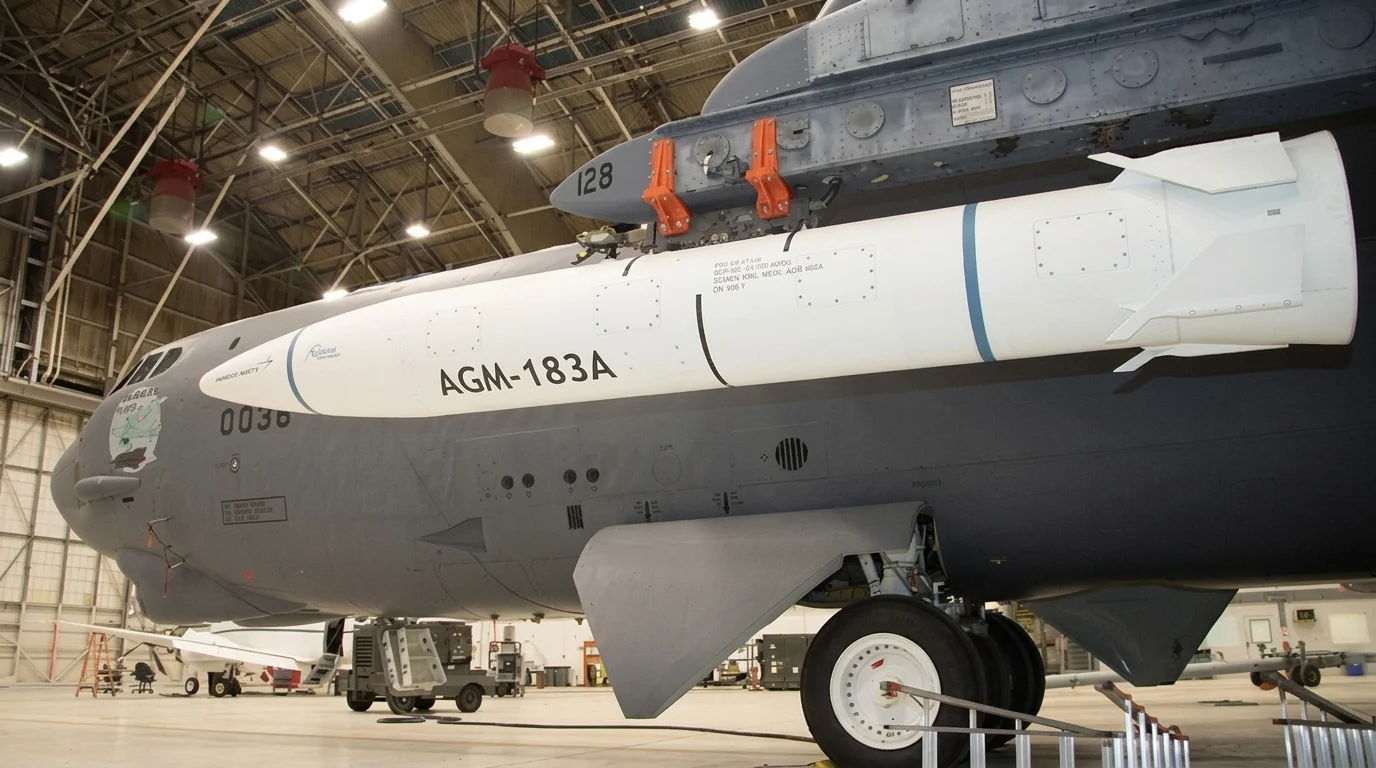
The AGM-183 ARRW was supposed to give the US Air Force a fast way to strike heavily defended targets. Then testing problems threatened to kill the program. Now, the missile has another chance.
The Air Force’s renewed budget plans have put the Air-Launched Rapid Response Weapon back in the spotlight. That shift matters because the United States has spent years trying to turn hypersonic weapons from promising designs into reliable military tools. The AGM-183 ARRW’s return suggests the service isn’t ready to abandon the concept, even after a rough development run.
The missile was designed to launch from a B-52H bomber and use a rocket booster to accelerate a glide vehicle to hypersonic speeds. Its intended role is to strike time-sensitive, high-value targets before defenders can react effectively. That sounds straightforward on paper. Making it work repeatedly in real flight tests is much harder.
The AGM-183 ARRW’s story is not a simple tale of failure followed by success. Some tests gathered useful data, while others exposed problems that delayed progress. Renewed funding also doesn’t mean the weapon has entered operational service.
The real question is why the Air Force has brought the program back, and what still needs to happen before it becomes a dependable weapon. The answer lies in its test record, the limits of current missile defenses, and the military value of having another way to deliver a fast, long-range strike.
What Is the AGM-183 ARRW and What Was It Designed to Do?
The AGM-183 ARRW was designed to give US bombers a way to strike valuable targets quickly without flying close to enemy air defenses. Its purpose wasn’t simply to fly fast. It was to compress the time an enemy has to detect an attack, make a decision, and respond.
ARRW stands for Air-Launched Rapid Response Weapon. Lockheed Martin developed the missile for the US Air Force, with the B-52H Stratofortress serving as its planned launch platform. Rather than relying on a conventional cruise missile’s sustained engine-powered flight, AGM-183 ARRW uses a rocket booster to accelerate a glide vehicle to hypersonic speed.
Once released from the booster, the glide vehicle travels toward its target at speeds above Mach 5. Its high speed and intended ability to maneuver are meant to make interception more difficult than it would be against some traditional weapons. But hypersonic speed alone doesn’t guarantee a successful strike. The missile still has to reach the right target, follow its planned flight path, and work reliably under real conditions.
The Air Force intended AGM-183 ARRW for high-value, time-sensitive targets, including those that might be protected by advanced air defenses. A mobile command site or a critical military asset could become harder to strike if defenders have enough warning to move it or change their defenses. A fast weapon could reduce that window.
Read also: KH-47 Kinzhal Missile: Russia’s Ultimate Hypersonic Weapon
That mission explains why the program attracted attention. The United States already has long-range missiles and stealth aircraft, but each has different strengths and limits. The AGM-183 ARRW was meant to add another option, launched from a bomber that could carry the weapon toward a launch area without entering the target’s most heavily defended airspace.
The distinction is crucial: the AGM-183 ARRW was developed as a prototype weapon, and its intended mission should not be confused with proven operational capability. Its promise was clear. Demonstrating that promise consistently proved much harder.
AGM-183 ARRW Specifications, Speed, and Range
| Specification | Details |
| Weapon designation | AGM-183A ARRW |
| Weapon type | Air-launched hypersonic boost-glide weapon |
| Developer | Lockheed Martin |
| Launch platform | B-52H Stratofortress |
| Propulsion | Rocket booster |
| Flight vehicle | Unpowered hypersonic glide vehicle |
| Speed | Hypersonic, above Mach 5 by definition |
| Range | Exact operational range not publicly confirmed |
| Warhead | Conventional, publicly available details limited |
| Intended role | Long-range strikes against high-value, time-sensitive targets |
The AGM-183 ARRW’s specifications remain partly classified or unconfirmed in public sources. Figures often quoted for its maximum speed and range should be treated cautiously, as design targets and reported estimates are not the same as verified operational performance.
Its central feature is the boost-glide approach. A rocket booster accelerates the weapon before releasing a glide vehicle that travels toward its target at hypersonic speed. This design aims to combine rapid flight with a less predictable path than a traditional ballistic missile.
The B-52H provides the launch platform, allowing the Air Force to test an air-launched weapon without building a new aircraft specifically for the program. But the aircraft’s involvement in testing does not, by itself, confirm that ARRW has entered operational service.

For this missile, the most useful specification is not a single speed figure. It is whether the complete weapon can repeatedly achieve its intended flight profile and reach its target under realistic operating conditions.
Why Did the AGM-183 ARRW Program Run Into Trouble?
The AGM-183 ARRW ran into trouble because building a hypersonic weapon is one thing, and getting every part to work together in flight is another. Early test failures delayed the program and raised doubts about whether the Air Force could field the missile on its original schedule.
The first major setback came in April 2021. During a test from a B-52H, the missile failed to complete its launch sequence and did not separate from the aircraft as planned. Without a clean release, engineers couldn’t assess the full weapon’s flight as intended. It was a basic failure at a critical stage.
Further tests brought mixed results. In May 2022, the AGM-183 ARRW completed a successful booster flight, showing that the rocket could accelerate the test vehicle as designed. A July 2022 test also succeeded. But a December 2022 all-up-round test did not meet its objectives, exposing the gap between demonstrating a component and proving the complete weapon.
That distinction matters. A hypersonic missile depends on several systems working in sequence: safe separation from the bomber, booster ignition, acceleration, glide vehicle release, navigation, and flight control. A failure at any stage can spoil the mission, even if other parts perform well.

The setbacks affected the Air Force’s plans. The service shifted attention toward other hypersonic efforts, including the Hypersonic Attack Cruise Missile, and the AGM-183 ARRW faced an uncertain future in the fiscal 2025 budget cycle. Reports of the program’s apparent demise followed.
But calling the AGM-183 ARRW a complete failure misses part of the record. Some tests succeeded and gave engineers useful data, while others showed that the weapon was not yet reliable enough. The problem was turning those test results into a repeatable system that could be produced and trusted in combat.
That history makes the renewed funding more interesting. The Air Force isn’t returning to a clean slate. It’s revisiting a program with real progress, real setbacks, and questions that still need clear answers.
Why Is the Troubled AGM-183 ARRW Back in the Budget?
The AGM-183 ARRW’s comeback became real when the US Air Force put money behind it again. After leaving the missile out of its fiscal 2025 budget request, the service included about $387 million for ARRW procurement in its fiscal 2026 plans. The following year’s request went further.
The fiscal 2027 budget requests approximately $452 million to procure the baseline AGM-183A missile. That money is separate from the roughly $296 million requested for the AGM-183 ARRW Increment 2 development. The newer effort covers design work, hardware upgrades, testing, and production improvements. The Air Force is asking to preserve the existing weapon while developing a more advanced version.
Those figures tell a more interesting story than a simple reversal. The Air Force completed its original rapid-prototyping test series in 2024, then faced questions about the program’s future. By 2025, procurement funding had returned to its plans. The service now appears intent on turning the earlier test work into a weapon it can buy and support.

Why bring the AGM-183 ARRW back after those setbacks? One reason is that the United States wants more than one route to a long-range hypersonic strike. Hypersonic programs are costly, technically demanding, and vulnerable to schedule slips. Keeping the AGM-183 ARRW moving could give the Air Force another option instead of depending on a single development path.
But the budget figures need careful reading. A request is not the same as money approved by Congress, and procurement funding doesn’t prove missiles have been delivered to combat units. The Air Force’s budget documents also withhold the planned purchase quantity.
The AGM-183 ARRW has returned to the funding plan. Its next challenge is showing that this investment can produce a reliable weapon, not just another promising test vehicle.
What Makes the AGM-183 ARRW Difficult to Intercept?
The AGM-183 ARRW is designed to make missile defense harder by combining extreme speed with a flight path that can differ from a conventional ballistic missile’s predictable arc. But difficult to intercept doesn’t mean impossible to stop. The outcome depends on the weapon’s actual flight profile and the defender’s sensors, tracking systems, and interceptors.
A conventional ballistic missile follows a high arc for much of its flight, giving defenders a chance to estimate its path and calculate where an interception might occur. A hypersonic boost-glide weapon changes that problem. After its rocket booster accelerates the glide vehicle, the vehicle travels through the atmosphere at hypersonic speed and is designed to maneuver toward its target.
Speed reduces the time available to react. At Mach 5, an object travels more than five times the local speed of sound, though its exact speed in kilometers per hour varies with altitude and atmospheric conditions. A defender must detect the incoming weapon, track it, determine its likely target, and launch an interceptor before the engagement window closes.

Maneuvering adds another challenge. If a glide vehicle changes direction during flight, a defense system may need to update its track and adjust an interception plan. That can make the engagement more demanding than tracking a weapon on a known path.
Still, public descriptions of the AGM-183 ARRW’s intended design don’t prove how difficult it would be to intercept in combat. Its real flight profile, accuracy, and performance under operational conditions are not fully established in public sources. Nor are all missile-defense systems equally capable against every threat.
The strategic value is clear, though. The AGM-183 ARRW aims to force an adversary to spend more time and resources defending high-value targets. Whether it achieves that advantage depends on reliable flight performance, not speed alone.
Which US Aircraft Could Carry the AGM-183 ARRW?
The B-52H Stratofortress is the aircraft most closely tied to the AGM-183 ARRW program. The Air Force used the long-serving bomber for flight tests because its size and payload capacity make it suitable for carrying large experimental weapons. But carrying a missile during testing is not the same as having a fully approved operational weapon system.
The B-52H has served as a test platform for the AGM-183 ARRW’s development, including flights designed to assess the missile’s release and boost phase. In these tests, the aircraft carried the weapon externally before releasing it for its flight sequence. The launch aircraft’s job is to bring the missile to the planned release point, then separate safely while the weapon’s own propulsion takes over.

That process involves more than fitting a missile under a wing. Engineers must confirm that the weapon separates cleanly, that its booster ignites as intended, and that the aircraft remains safe during and after release. The failed April 2021 test showed why this matters: the AGM-183 ARRW did not complete its planned launch sequence, preventing the test from demonstrating the full weapon’s flight.
The B-52H’s role also fits the missile’s intended standoff mission. A bomber can carry the weapon toward a launch area without needing to fly directly over the target. That could let the aircraft remain farther from some air-defense threats, depending on the missile’s eventual range and the enemy’s sensor coverage.
Still, the B-52H’s involvement in testing does not by itself establish the full operational deployment plan. Public information identifies it as the AGM-183 ARRW’s test aircraft, but any future integration with other bombers should be treated as unconfirmed unless the Air Force announces it.
For now, the key issue is whether the service can turn test-platform integration into a repeatable, approved capability. The missile must work reliably after release before its bomber connection becomes a practical combat advantage.
Can the AGM-183 ARRW Finally Become Operational?
The AGM-183 ARRW has another chance, but renewed funding is only the start. The Air Force still needs to show that the missile can perform reliably, move into production, and meet the demands of an operational strike force.
The first hurdle is repeatable performance. A successful test can prove that a specific flight sequence worked, but military planners need confidence that the weapon will work across many launches and under different conditions.
The AGM-183 ARRW’s earlier test record makes that a central question, not a minor detail. The Air Force must show that the missile can separate from its aircraft, accelerate as planned, release its glide vehicle, and complete its flight consistently.

The next challenge is turning a prototype into a weapon that can be built and supported. That means locking down the design, qualifying components, setting up production, and making sure the supply chain can deliver what the program needs.
The fiscal 2027 budget request for the AGM-183 ARRW procurement suggests the Air Force wants to move beyond research alone, but the request does not confirm how many missiles will be delivered or when.
Operational use also requires more than a working missile. Crews need approved procedures, maintenance teams need training and spare parts, and commanders need clear rules for planning and employing the weapon. The B-52H’s test role provides a starting point, but a tested configuration must still meet the service’s requirements for operational use.
There is a strategic reason to keep trying. A dependable air-launched hypersonic weapon could give US commanders another way to threaten high-value targets while keeping launch aircraft farther from some enemy defenses. Yet that advantage only exists if the weapon works when needed.
The best measure of the AGM-183 ARRW’s comeback is not another budget headline. Watch for clear evidence of successful follow-on tests, approved production plans, and a stated path to operational service. Until those milestones are confirmed, the missile remains a promising program with unfinished work.
