

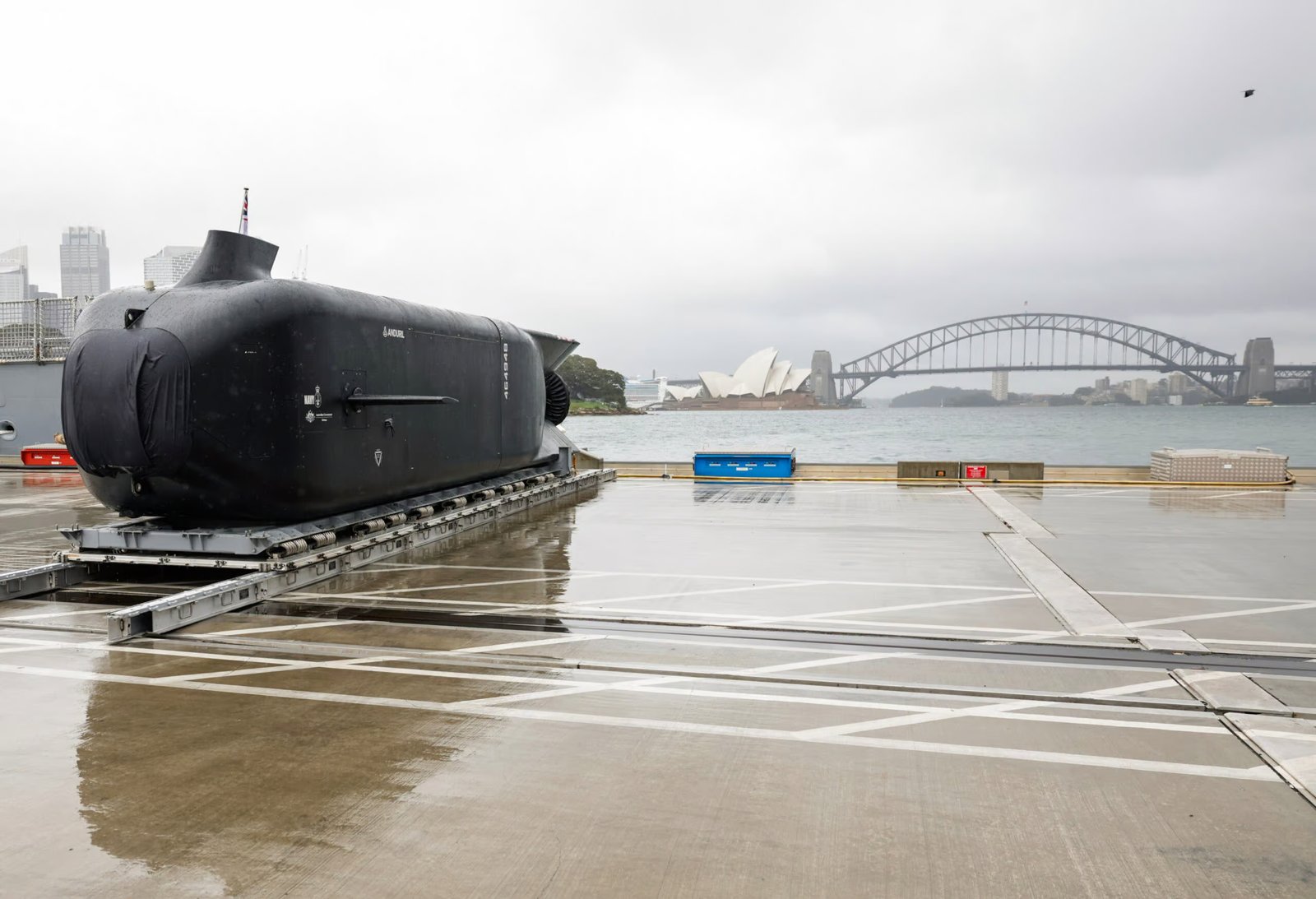

Australia has revealed details of its latest developments in advanced undersea warfare (UWW) payloads to support the Royal Australian Navy’s (RAN’s) maritime uncrewed system (MUS) capability programme.
Some of these existing MUS capabilities, new effectors, and other payloads will be demonstrated at the latest AUKUS (Australia/UK/US) ‘Maritime Big Play – Pacific’ exercise, the Australian Department of Defence (DoD) announced on 19 October.
The ‘Maritime Big Play’ event in question has been underway off San Diego, on the US west coast, since early October.
“For the first time, the government is today unveiling the development and integration of payloads into the Ghost Shark and Speartooth uncrewed underwater vehicles [UUVs] and BlueBottle uncrewed surface vessel [USV]. Some of these payloads will take part in Exercise ‘Maritime Big Play – Pacific,’ the DoD said.
Those three systems are the core of the RAN’s MUS programme. As its primary capability, each generates intelligence, surveillance, and reconnaissance (ISR) output.
Ghost Shark (also referred to as an extra-large autonomous underwater vehicle [XLAUV]) provides ISR, strike, and logistics capability at extended distances for extended periods. These tasks feed into the RAN’s broader requirement to build maritime domain awareness (MDA) and deterrence.
Speartooth – as an LUUV rather than an XLAUV – conducts missions similar to Ghost Shark, but on a smaller scale.
BlueBottle’s ISR input – as a surface-based, wind-, wave-, and solar-powered USV – provides long-range, near-persistent surface and subsurface surveillance.
“The modular design of these platforms allows them to operate a range of different payloads, customised to the required mission. Payload examples include the remote delivery of supply caches, sea mines, and uncrewed aerial vehicles,” the DoD said. “These technologies directly deliver on the RAN’s mission requirements, and will contribute to enhanced UWW capabilities, seabed operations, sea denial, and protection of critical undersea infrastructure.”
The DoD added that development of such new capability options had been taken forward at previous ‘Maritime Big Play’ iterations occurring over the last three years.
According to the DoD, the new capability developments complement the AUKUS defence ministers’ May 2026 announcement on the need to develop cutting-edge payloads and enabling systems for AUKUS partners’ UUV programmes, the first ‘Signature Project’ announced under the AUKUS Pillar II programme.
AUKUS Pillar II focuses broadly on advanced maritime – especially underwater – technologies. ‘Maritime Big Play’ is a Pillar II event designed to develop and demonstrate such technologies.
AUKUS Pillar I is delivering a new nuclear-powered attack submarine (SSN) capability for the RAN and the UK Royal Navy.
“The development of advanced, cutting‑edge payloads under AUKUS Pillar II is a critical part of our work alongside the US and the UK,” Richard Marles, Australia’s Deputy Prime Minister and Minister for Defence, said in the statement. “Australia will again have the opportunity to showcase its sovereign developments at ‘Maritime Big Play – Pacific’ this week.”
In early 2026, under the latest National Defence Strategy (NDS) and Integrated Investment Program (IIP), the Australian government announced up to AUD5.8 billion (USD4.05 billion) in investment over the next 10 years to further develop autonomous and uncrewed UWW capabilities, including procuring more Ghost Sharks.
To build its MUS capability, the RAN is working with the DoD’s Defence Science and Technology Group and its Advanced Strategic Capabilities Accelerator programme, along with defence industry.
by Dr. Lee Willettt
