

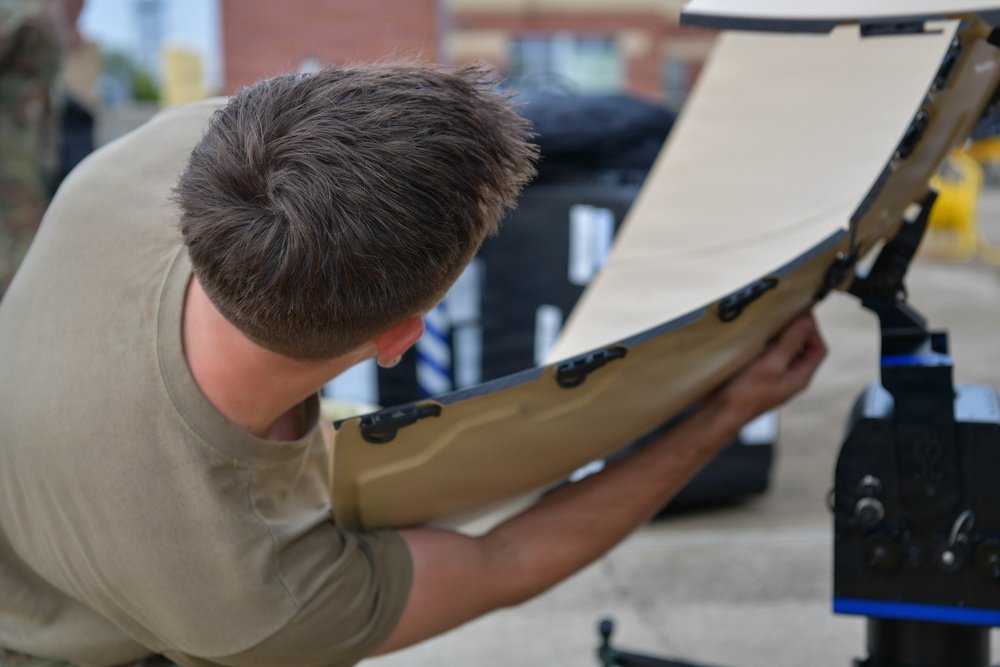
As technology advances, staying mission-ready means staying one step ahead. For airmen in combat communications, that starts with learning to operate the equipment that keeps them connected.
Airmen from combat communications squadrons across the country attended a military satellite course at the 178th Wing Sept. 14-18, to learn how to operate a new satellite terminal and maintain the communications capabilities that support Air Force operations.
“In all information systems, especially nowadays, our equipment gets refreshed every four to six years. Stuff progresses so fast,” said Master Sgt. Clay Bertke, radio frequency and transmissions senior noncommissioned officer in charge with the 269th Combat Communications Squadron at the 178th Wing.
As equipment evolves, airmen must learn to operate new systems to continue providing the same essential capabilities. Vendors provided instruction on the satellite terminal’s hardware, interfaces and procedures for connecting to satellite networks.
“We received these new dishes across the board, and no one’s used them in the past. So, having these vendors come out to teach us how to operate their built and produced equipment was really beneficial for us,” Bertke said.
The course began with classroom instruction before participants moved into the field to practice setting up the equipment, establishing connections and troubleshooting problems. The hands-on training allowed airmen to work through the challenges of operating an unfamiliar system.
“The first day was all in the classroom, getting the nitty-gritty knowledge base, and then every day since we’ve been out in the field setting it up, getting injects so we can make it work, get it not working and then bring it back up,” said Staff Sgt. Rebecca Hockenberry, a radio frequency specialist with the 271st Combat Communications Squadron at Fort Indiantown Gap, Pennsylvania.
Adapting to the new equipment required patience as participants learned how its components worked together.
“The hardest part with this equipment is patience, particularly because it’s a smaller unit than we’re used to. There are a lot of components that are in one device instead of multiple devices,” Hockenberry said.
Through the training, participants learned how to set up the satellite terminal and establish a connection with a satellite, preparing them to use the new technology in support of their units’ missions.
“These guys come in not knowing anything about the hardware itself. We were taught from step zero to fully connected to the satellite, as far as physically setting up the new dish, the new aperture, getting it linked up with that secure handshake to the satellite so that our communications are protected from anyone else trying to listen in,” Bertke said.
The updated satellite terminal is smaller and lighter than the equipment airmen previously used, allowing for faster setup and teardown. Those changes support the 269th Combat Communications Squadron’s agile communications package, which enables a small team to establish a temporary communications site, pack up and relocate as needed.
“This new dish is a lot smaller, it’s a lot lighter, it’s a lot faster for us to set up, tear down, get connected, and learning how to operate it is really helping us fulfill our mission requirements, therefore helping fulfill the wing’s mission,” Bertke said.
Along with learning the new equipment, participants collaborated with airmen from other combat communications squadrons, exchanging lessons learned and best practices throughout the week. The collaboration gave participants an opportunity to learn from others facing the same changes in communications technology.
“A lot of the participants that came here, obviously, we know of their units. We’re a big community. There’s a lot of members, but there’s only a few units. We didn’t know each other, though, when they showed up, and the collaboration that happened was amazing,” Bertke said.
The training’s impact extends beyond the airmen who attended. Participants must take what they learned back to their home units and help train other airmen, ensuring more members are prepared to operate the updated equipment.
“We do have to find a way to translate what we learned in the class and everything to teach our traditionals on the weekends,” said Tech. Sgt. Chase Thompson, radio frequency and transmissions noncommissioned officer in charge with the 269th Combat Communications Squadron at the 178th Wing.
Hockenberry said training airmen at her home unit will help prepare them to use the new technology when needed.
“These are newer terminals, so being able to train and advance the airmen back home so that they can be sufficient and ready to go when we’re out the door is very beneficial,” Hockenberry said.
As communications equipment continues to evolve, the ability to adapt allows airmen to maintain the capabilities their missions require. Bertke said he hopes participants leave the course confident in their ability to operate the new system and continue providing those capabilities.
“The biggest thing I really hope they came out of here feeling confident in their ability to set this new capability up or this new equipment up, and provide the capability that we’ve always been providing,” Bertke said.
