

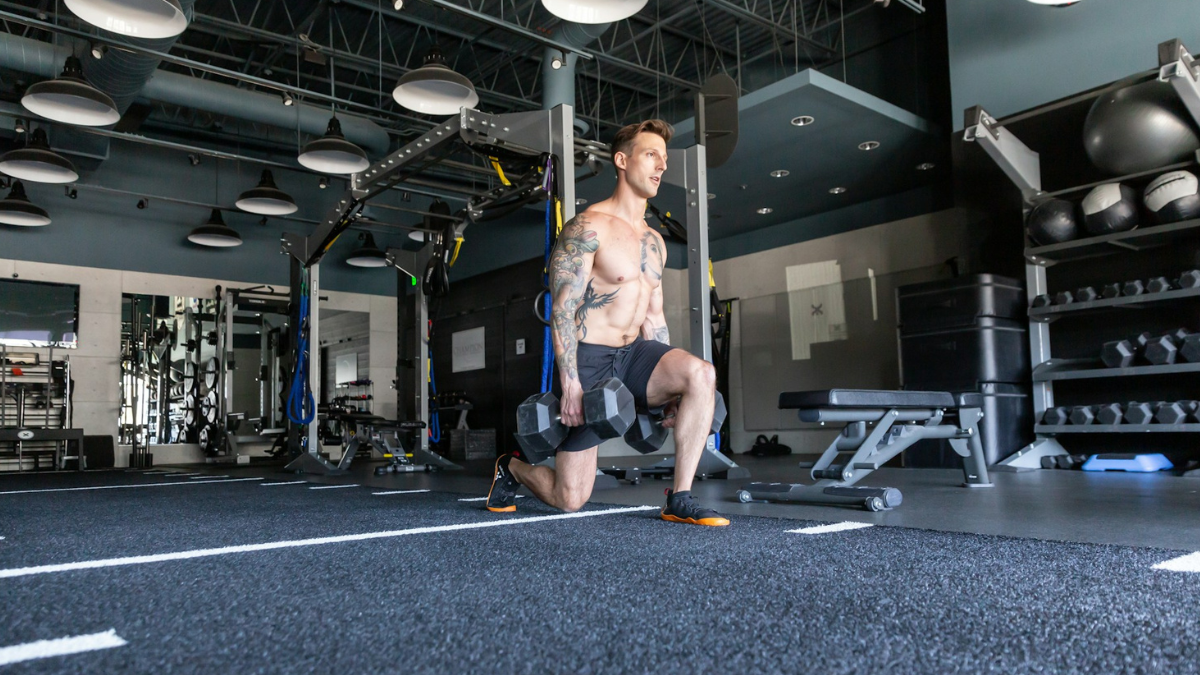
A basic squat is a useful place to start, but it does not have to be the only lower body exercise in your routine. Beginners can overlook movements that train the back of the legs, challenge each leg separately, or give the calves focused work. Adding those patterns can make a training program more complete and give you more ways to build strength and muscle.
The exercises below are not magic shortcuts, and they do not replace consistent training. They are practical choices that cover parts of the lower body a squat focused routine may miss. Start with a version you can control, use a comfortable range of motion, and add resistance gradually as your technique improves.
1. Romanian Deadlift
Why beginners often overlook it
The Romanian deadlift, often called the RDL, is a hip hinge that trains the hamstrings and glutes. Beginners may skip it because it looks like a complicated deadlift, or because they expect to feel it mainly in their lower back. Done with a controlled hip hinge, it gives the back of the legs a distinct job from the knee bending action in a squat.
Research on an eccentrically biased RDL program found increases in hamstring cross sectional area after six weeks. The study compared RDL training with Nordic hamstring training and found similar changes between the groups. That is useful support for the RDL as a hamstring exercise, though it does not prove that this particular exercise is best for every person or goal.
How to do it
Stand with your feet about hip width apart and hold a pair of dumbbells in front of your thighs. Soften your knees, brace your midsection, and push your hips backward as the weights travel down close to your legs. Stop when you feel a strong stretch in the back of your thighs or when your back position would begin to change, then drive your hips forward to stand tall.
3 Best Dumbbell Exercises for Bigger Bicep Peaks
The main movement comes from your hips traveling back and forward. Keep the weights close to your body and avoid turning the exercise into a squat by bending your knees deeply. You do not need to lower the weights to the floor. Your comfortable range depends on your mobility and ability to keep the movement controlled.
How to make it beginner friendly
Begin with light dumbbells, or practice the hip hinge with no weight by reaching your hips toward a wall behind you. Move slowly enough to feel when your hips stop traveling back and your knees begin to bend more. Add weight only when you can repeat the movement without losing control.
A useful starting point is two or three sets of eight to twelve repetitions. Choose a load that lets you finish each set with solid technique and a few good repetitions still possible. If holding two dumbbells feels awkward, try one light dumbbell held with both hands, or use a barbell only when you are comfortable setting up and moving it.
2. Split Squat
Why beginners often overlook it
A split squat trains one leg at a time, which means each leg has to contribute without relying on the other side to do as much work. The position can feel unfamiliar at first, and balancing may be harder than in a regular squat. That can make beginners leave it out even though it is a practical way to train the quadriceps and glutes with relatively light equipment.
A systematic review and meta analysis comparing unilateral and bilateral resistance training found no significant difference in muscle growth between the two approaches in the available studies. It did find that strength gains were more specific to the way people trained: bilateral training favored bilateral strength, while unilateral training favored unilateral strength. A split squat is therefore a useful option to include, rather than a claim that single leg work is automatically superior.
How to do it
Stand with one foot forward and the other foot behind you, both feet pointing generally ahead. Keep enough distance between your feet that you can lower your body without your front heel lifting. Bend both knees as you descend, letting your back knee move toward the floor, then push through the whole front foot to return to standing.
Use a comfortable depth and keep your torso steady. Your front knee can travel forward as you lower, provided the movement feels controlled and comfortable. Hold onto a stable support with one hand if balance is the main challenge. That lets you practice the leg movement without needing to turn every repetition into a balancing test.
How to make it beginner friendly
Start with a bodyweight split squat and use a shorter range of motion if a deep position feels uncomfortable. Once you can keep your balance and control the descent, gradually lower farther or hold light dumbbells at your sides. Train both sides and use the same planned number of repetitions for each leg.
Try two or three sets of six to ten repetitions per side. Since the exercise is performed on both legs, it can take longer than a bilateral movement. Rest enough between sides and sets to keep your technique consistent. If balancing remains difficult, a supported split squat is still a useful training choice.
3. Standing Calf Raise
Why beginners often overlook it
Calf raises are easy to dismiss because they are simple and use a small movement. Yet the calf muscles contribute to pushing the foot down, and focused resistance training gives them direct work that many leg routines lack. The calves also get some activity in other lower body movements, but that does not make direct calf training pointless.
A 12 week training study compared standing and seated calf raise training in untrained adults. The standing version produced greater growth in the gastrocnemius muscles and in the calf muscle group overall, while soleus growth was similar between the two conditions. The finding supports including a standing calf raise when building the calf muscles is a goal, while recognizing that a single study does not settle every programming question.
How to do it
Stand with the balls of your feet on a stable step or calf raise platform, with your heels free to move. Hold a rail or wall lightly for balance. Lower your heels under control until you feel a comfortable stretch, then rise onto the balls of your feet as high as you can without bouncing. Pause briefly at the top, then lower slowly.
If you do not have a step or platform, perform the movement on a flat floor. The range will be shorter, but you can still practice the exercise and add repetitions or resistance over time. Use a wall or sturdy support if needed, and avoid letting the ankles roll outward or inward as you rise.
How to make it beginner friendly
Begin with two or three sets of ten to fifteen repetitions using your body weight. Move through a controlled range and stop when you can no longer rise to the same height without bouncing. When bodyweight repetitions feel manageable, hold a dumbbell in one hand while keeping the other hand on a support.
You can include a seated calf raise as another variation, especially if you want to change your training or have access to a machine. The available comparison study found a greater overall growth response with standing calf raises, so beginners should not assume the seated version is a more effective default. Both can fit into a program according to comfort and equipment.
How to Put the Exercises Into a Beginner Routine
You do not need to add every exercise at once or train to exhaustion. One simple approach is to add the RDL, split squat, and standing calf raise to a lower body session, alongside a squat or leg press. Start with two sets of each movement, use a load that lets you control every repetition, and increase the weight when you can complete the planned repetitions with steady technique.
A repeatable routine matters more than complicated exercise selection. Keep a record of the weights and repetitions you use, then make small progressions over time. Resistance training guidance supports using progressive programs that match a person’s training experience and ability. If a movement causes sharp or persistent pain, stop and adjust the exercise or seek qualified guidance.
Key Takeaways
| Exercise | Main training focus | Beginner starting point |
|---|---|---|
| Romanian deadlift | Hamstrings and glutes | Practice the hip hinge, then use light dumbbells |
| Split squat | One leg at a time, with emphasis on the front leg | Begin with bodyweight and use support for balance |
| Standing calf raise | Calf muscles | Use bodyweight, a controlled range, and a stable support |
References
- American College of Sports Medicine (2009) ‘American College of Sports Medicine position stand. Progression models in resistance training for healthy adults’, Medicine & Science in Sports & Exercise, 41(3), pp. 687–708.
- Crawford, S.K., Sandberg, C., Vlisides, J., Thompson, Q., Mosiman, S.J., Heiderscheit, B.C. and Hickey, J.T. (2025) ‘Hamstrings muscle architecture and morphology following 6 wk of an eccentrically biased Romanian deadlift or Nordic hamstring exercise intervention’, Medicine & Science in Sports & Exercise, 57(8), pp. 1799–1809.
- Kassiano, W., Nunes, J.P., Costa, B., Ribeiro, A.S., Loenneke, J.P. and Cyrino, E.S. (2025) ‘Comparison of muscle growth and dynamic strength adaptations induced by unilateral and bilateral resistance training: a systematic review and meta-analysis’, Sports Medicine, 55, pp. 923–936.
- Kinoshita, M., Maeo, S., Kobayashi, Y., Eihara, Y., Ono, M., Sato, M., Sugiyama, T., Kanehisa, H. and Isaka, T. (2023) ‘Triceps surae muscle hypertrophy is greater after standing versus seated calf-raise training’, Frontiers in Physiology, 14, 1272106.
