

A good beginner chest workout does not need a long list of movements. Three well chosen exercises can teach you how to press, provide a clear way to adjust the challenge, and train different areas of the chest. The pectoralis major is the main chest muscle. Its fibers attach to different parts of the shoulder and upper arm, so changing the direction of a press can change which regions work hardest. The triceps and front of the shoulders also help during pressing movements.
The exercises below are all pressing movements, but each offers a different learning experience. The machine provides a guided path, the barbell helps you practice a familiar strength exercise, and dumbbells let each arm move independently.

Research comparing chest press variations shows that muscle activity can differ with equipment and bench angle. However, short term muscle activity measurements do not prove that one exercise will always build more muscle over time. The best choice is one you can perform comfortably and progress consistently.
Beginners can start with a small amount of work and add gradually as they learn. A practical starting point is two or three sets of each exercise for eight to twelve controlled repetitions, once or twice per week. Choose a load that lets you finish each set with good technique and a little effort still in reserve. Research reviews support resistance training for building strength and muscle, while also showing that different combinations of load, sets, and frequency can be effective. More work is not automatically better, especially when it makes technique harder to maintain.
1. Machine Chest Press
Why It Is a Good Starting Exercise
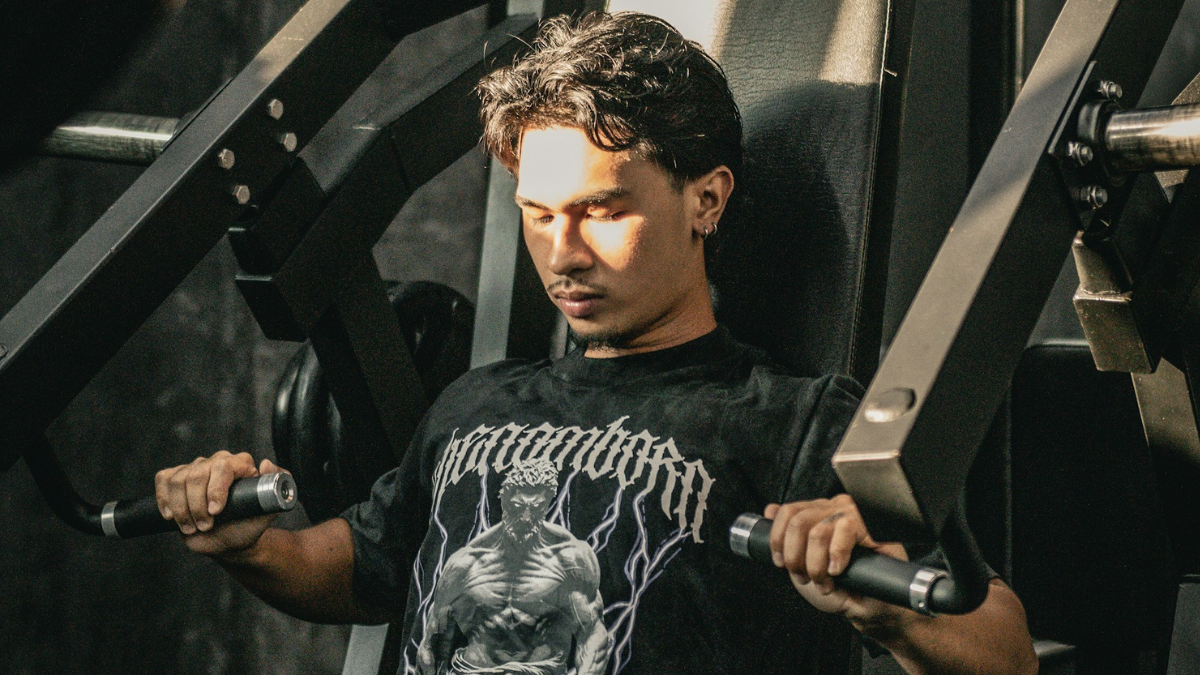
The machine chest press is a useful first chest exercise because the seat and handles help guide your movement. You do not need to balance a bar over your body, and the weight can be changed quickly. This makes it easier to focus on how the press feels and to practice a controlled repetition. A machine is still a resistance exercise, and research has recorded substantial chest muscle activity during machine chest presses.
Machines differ, so take time to set yours up. Adjust the seat so the handles begin around the middle of your chest. Sit with your back against the pad and your feet resting on the floor. Hold the handles with a comfortable grip, then press forward until your arms are nearly straight without forcefully locking your elbows. Bring the handles back slowly until you feel a comfortable stretch across your chest. Do not let the weight stack slam between repetitions.
Start with a light load and practice a few repetitions before choosing your working weight. If the handles feel too high or low, adjust the seat. If the machine causes sharp discomfort in your shoulders, stop and try a different setup or exercise. A comfortable range of motion is more useful than forcing the handles far behind your body.
How to Progress
When you can complete all your planned repetitions with control, increase the load by the smallest amount available. Keep the same setup and movement standard so that you can tell whether you are getting stronger. If you cannot reach the lower end of your target repetitions without changing your position, reduce the weight.
3 Best Dumbbell Exercises for Bigger Bicep Peaks
The machine press can also be a helpful warm up before barbell or dumbbell work because it lets you rehearse the pressing motion without handling free weights. It does not need to be a warm up, though. If it is one of your main exercises, count its sets as part of your workout.
2. Barbell Bench Press
How to Set Up and Press
The barbell bench press is a classic gym exercise that trains the chest while the triceps and front shoulders assist. It is also easy to track because the bar and plates provide clear load increments. For a beginner, the main goal is to learn a repeatable setup before adding weight.
Lie on the bench with your eyes beneath the bar. Place your feet flat on the floor and keep your hips on the bench. Grip the bar a little wider than shoulder width, then unrack it with your arms straight. Lower the bar under control toward the middle of your chest. Keep your wrists stacked above your forearms, then press the bar upward until your arms are nearly straight. Use a spotter or set the rack safeties at an appropriate height, particularly when lifting without help.
Choose a load that lets you move smoothly through every repetition. Avoid bouncing the bar off your chest or lifting your hips to finish a repetition. If you are unsure how to set the rack or safeties, ask gym staff for help before starting. A beginner does not need to test a one repetition maximum to make progress.
The bench angle matters because it changes the pressing direction and the measured activity of chest regions. Studies comparing flat and inclined bench press positions have found differences in activity across portions of the pectoralis major. This is one reason the flat bench press and incline press can complement each other. It does not mean that a specific angle guarantees a specific visual result.
How to Progress
Keep a training record with the weight and repetitions you complete. When you can perform all sets with steady form, add a small amount of weight or complete one more repetition in a later session. Do not increase weight if it causes you to shorten the movement or lose control of the bar.
The barbell bench press is optional for beginners. If you are uncomfortable getting into position, cannot set up safely, or have access to a chest press machine that feels better, use the machine while you learn. Research comparing low load bench presses and push ups in untrained men found improvements in both groups over eight weeks when the exercises were performed with a similar relative load. That study does not establish that one movement is best for every new lifter, but it supports the idea that beginners have more than one effective way to train the chest.
3. Incline Dumbbell Press
How to Press on an Incline
The incline dumbbell press adds a different pressing angle and asks each arm to control its own weight. Set the bench to a modest incline, around 30 degrees, and sit with a dumbbell resting on each thigh. Use your legs to help bring the weights up as you lie back. Hold the dumbbells over your chest with your palms facing slightly forward or toward each other, whichever feels comfortable.
Lower the weights under control toward the outside of your upper chest. Keep your forearms close to vertical and avoid letting your elbows flare straight out to the sides. Press the dumbbells upward until they are above your chest, without banging them together. End the set if you cannot lower and press the weights smoothly.
A modest incline is a sensible place to begin because research measuring muscle activity has found that incline angle can change which portions of the pectoralis major are most active. One study reported the greatest measured activity in the upper portion at 30 degrees among the angles it tested. These results are useful for understanding how the movement may differ, but they do not show that one angle is universally best for muscle growth. Keep the bench angle comfortable and consistent.
Why Dumbbells Can Help
Dumbbells can be adjusted to fit your natural arm path, and each side has to control its own weight. They also require more coordination than a machine, so start lighter than you think you need. If getting the weights into position feels awkward, ask a trainer to demonstrate the setup or choose the machine press until you are comfortable.
Do not lower the dumbbells farther than you can control. A deep stretch is not required if it causes discomfort or makes your shoulders roll forward. Aim for a smooth, repeatable range that lets you keep your upper back supported by the bench.
How to Put the Exercises Together
You do not need to perform all three exercises every time you train. A beginner can use the machine chest press and barbell bench press in one session, then use the machine and incline dumbbell press in another. If you train chest once per week, choose two or three exercises and perform two or three sets of each. If you train more often, spread the work across sessions and allow time to recover between hard workouts.
Start with a weight you can control. Rest long enough between sets to perform the next one with good technique. Add repetitions or a small amount of weight gradually when the current workload feels manageable. Resistance training research suggests that muscle growth responds to training volume, but it does not mean beginners should immediately chase a high number of sets. A simple plan that you can repeat and improve is a better place to start.
Use the exercises as tools, not tests. A machine press can build confidence, the bench press can teach bar control, and the incline dumbbell press can introduce a new angle and independent arm movement. If an exercise causes pain, stop and reassess your setup. For persistent pain or a known injury, consult a qualified health professional before continuing.
Key Takeaways
| Exercise | Beginner benefit | Starting approach |
|---|---|---|
| Machine chest press | Guided movement path and simple load changes | Adjust the seat, use a light load, and press with control |
| Barbell bench press | Builds pressing skill and makes progress easy to track | Learn the setup, use safety supports, and avoid max attempts |
| Incline dumbbell press | Adds an inclined pressing angle and independent arm control | Begin around 30 degrees and use lighter dumbbells |
| Weekly training | A small, repeatable plan is enough to begin | Try two or three sets of eight to twelve repetitions |
References
- Currier, B.S., McLeod, J.C., Banfield, L. et al. (2023) ‘Resistance training prescription for muscle strength and hypertrophy in healthy adults: a systematic review and Bayesian network meta-analysis’, British Journal of Sports Medicine, 57(18), pp. 1211–1220.
- Coratella, G., Tornatore, G., Longo, S., Esposito, F. and Cè, E. (2020) ‘Specific prime movers’ excitation during free-weight bench press variations and chest press machine in competitive bodybuilders’, European Journal of Sport Science, 20(5), pp. 571–579.
- Kikuchi, N. and Nakazato, K. (2017) ‘Low-load bench press and push-up induce similar muscle hypertrophy and strength gain’, Journal of Exercise Science & Fitness, 15(1), pp. 37–42.
- Rodríguez-Ridao, D., Antequera-Vique, J.A., Martín-Fuentes, I. and Muyor, J.M. (2020) ‘Effect of five bench inclinations on the electromyographic activity of the pectoralis major, anterior deltoid, and triceps brachii during the bench press exercise’, International Journal of Environmental Research and Public Health, 17(19), 7339.
- Schoenfeld, B.J., Ogborn, D. and Krieger, J.W. (2017) ‘Dose-response relationship between weekly resistance training volume and increases in muscle mass: a systematic review and meta-analysis’, Journal of Sports Sciences, 35(11), pp. 1073–1082.
