

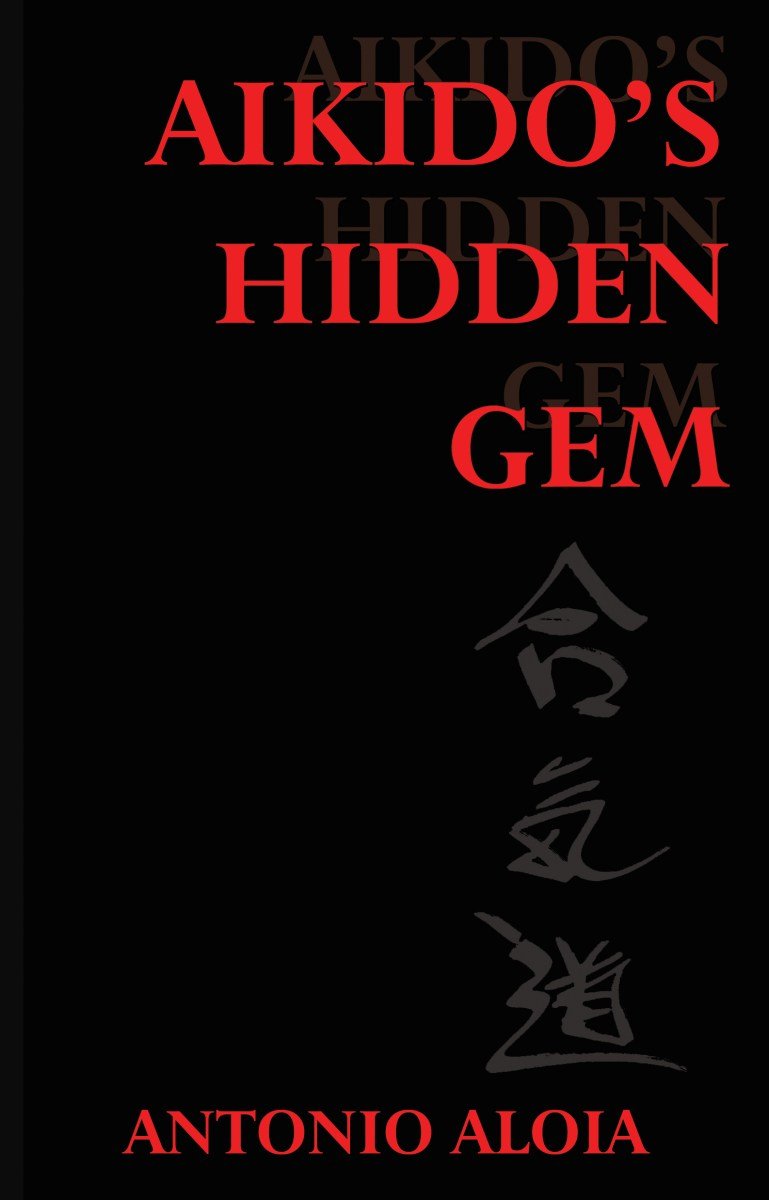
The recent biography of Shin-Budo Kai’s Shizuo Imaizumi, Aikido’s Hidden Gem, is not singular in nature – rather, the work is threefold in its purpose. Firstly, Aikido’s Hidden Gem serves as a life story of Imaizumi. Secondly, the biography showcases and illustrates the relationship between Imaizumi, Fumio Toyoda, and Shuji Maruyama within Ki Society. Thirdly, the book gives a glimpse into the larger history of Ki Society when so much of the organization’s history has been kept secret.
Focusing on Imaizumi, Toyoda, and Maruyama, these three figures were essentially the most prominent Ki Society teachers for the United States. Toyoda was based in the Midwest rather than the Northeast, but functionally speaking, when you look at Ki Society’s American presence, these were the three central figures: Imaizumi, Toyoda, and Maruyama.
Why is this important? To answer that, some background is necessary. When most people think of aikido, they often think of Aikikai. That makes sense, as it is the mainstream organization, and because it is mainstream, it has received the most attention. There is a great deal written about Aikikai, whether by aikido practitioners themselves or by outside observers. Aikikai gets the spotlight, while other styles remain largely in the shadows. Yoshinkan, at least in the United States, is not dead but certainly fragmented. Tomiki Aikido is small. Beyond that, you have a range of derivative or hybrid systems that receive little to no serious attention.
The Ki Society, especially in the United States, has received very little historical coverage. When Ki Society is discussed, the conversation almost always collapses into two ideas: Koichi Tohei and the concept of ki. Those are the dominant lenses through which the organization is understood. This framing is reinforced by Tohei’s own publications, as well as articles and materials produced by American practitioners at the time, all of which strongly emphasize ki as a universal force and the need to cultivate it through specialized and structured training. That training, in turn, is framed through Tohei’s four principles: keep one point, extend ki, keep weight underside, and relax completely.
Now, Maruyama, Imaizumi, and Toyoda all spoke about ki in some form. However, based on my research, none of them emphasized or explored the concept to the same depth or intensity as Tohei himself. And this brings me to the larger issue: the post-1974 history of the Ki Society in the United States has not been meaningfully documented, interrogated, or researched.
This biography of Shizuo Imaizumi helps address that gap. The book opens a door, or, as I like to say, it provides a window into a previously darkened room. Through the lens of Imaizumi’s life and career, we can see how Imaizumi, Maruyama, and Toyoda interacted between roughly 1974 and 1987. For the first time, we can begin to trace what Ki Society history looked like in the Northeast and the Midwest of the US. It is not a floodlight, but it is far more illumination than we previously had.
In aikido scholarship, we already have discussions about how Aikikai instructors interacted with one another and how they functioned within the same organizational structure. What we get here, through Aikido’s Hidden Gem, is something similar for Ki Society. We see that there was interaction among these three instructors. I would not necessarily call it a community, but there was a connective thread that brought them together under the larger Ki Society umbrella.
That said, their interactions mirrored early Aikikai history in the United States prior to 1974. The connections were small, sometimes sporadic, and often limited to occasional seminars. Large-scale joint events were rare unless Tohei himself was involved. Tohei continued visiting the United States until roughly 1982 or 1984, after which his presence – and his direct influence – diminished. What we see is that Ki Society’s early efforts to establish itself in America closely resembled Aikikai’s earlier attempts – just without the same head start. Aikikai had roughly ten to fifteen years on Ki Society, though Tohei himself had already done much of the groundwork during that period.
After leaving Aikikai in 1974, Tohei was trying to rebuild and expand Ki Society in the United States, in many ways attempting to regain lost ground. While I do not have a direct statement confirming this, the actions themselves – sending Imaizumi to New York in 1975 and Toyoda to the Midwest – suggest a deliberate strategy to establish a strong presence, particularly in contrast to figures like Yoshimitsu Yamada. Ultimately, that strategy did not unfold as Tohei may have hoped, but what we gain now is something arguably more valuable: a documented chronology.
One particularly interesting point that emerges is how these three teachers positioned their own lineages. From my research, Imaizumi was the only one who consistently downplayed his direct training under Morihei Ueshiba. To clarify, Imaizumi made it a point to highlight the fact that he consistently trained under other instructors, like Kisshomaru Ueshiba, Morihiro Saito, and others. Toyoda and Maruyama, by contrast, emphasized their connection to Koichi Tohei, and in some cases, even suggested early uchi deshi status under Kisshomaru. Such claims would benefit from further clarification, though accessing Aikikai Hombu records is notoriously difficult.
What bonded all three men was not Morihei, but Koichi Tohei. They were, in one way or another, his direct disciples. Unlike Aikikai uchi deshi, who often emphasized shared training experiences under O-Sensei and formed lasting bonds as a result, these Ki Society instructors did not appear to develop the same depth of camaraderie. Moreover, Tohei did not seem to have an uchi deshi program like the Aikikai, perhaps resulting in a lack of solidarity between students. Their relationships with each out appear to have been cordial, functional, and occasionally strained, rather than deeply interconnected.
Another revealing aspect involves Maruyama’s efforts to help establish Imaizumi in New York. Maruyama, and possibly his students, assisted in securing a dojo space and supporting Imaizumi’s early efforts until the fall of 1975. Imaizumi’s journey from Japan to Chicago, to Philadelphia, and finally to New York subtly reflects the nature of his relationships with both Toyoda and Maruyama. While Imaizumi never explicitly comments on these dynamics, the silences and omissions in his accounts speak volumes.
When Tohei appointed Imaizumi as head of Ki Society in the United States, Imaizumi effectively became Tohei’s representative. How this appointment came about – whether through political maneuvering, personal preference, or strategic necessity – remains unclear. However, it seems likely that Imaizumi’s New York base and Tohei’s desire to counterbalance Yamada played a significant role. From this vantage point, we can also detect the beginnings of rifts, either between Tohei and Toyoda and Maruyama, or between Toyoda and Maruyama towards Imaizumi.
As chief instructor of the US Ki Society, Imaizumi traveled extensively throughout the United States, visiting Ki Federations and demonstrating his aikido to a broad audience. This role allowed him to connect with students he would otherwise never have encountered, figures such as Mike Cheney, Mark Leidig, Wade Ishimoto, Mark Winkworth, David Misumi, Natanja den Boeft, Ralph Bryan, Larry Feldman, Evan Stover, and others. These connections ultimately formed the basis of what followed Imaizumi’s resignation from Ki Society in 1987: Shin-Budo Kai.
The biography also sheds light on the dissolution of certain national and regional federations during Imaizumi’s tenure, as well as the later restructuring that occurred in the post-1980s period to reestablish standards and cohesion. In this way, Aikido’s Hidden Gem reframes Ki Society history not as a purely esoteric or New Age movement, but as a lived aikido tradition shaped by organizational, political, and interpersonal realities.
Through this biography, we can see why Toyoda left Ki Society in 1984, why Maruyama left in 1986, and why Imaizumi remained until 1987. For the first time, we have a foundation upon which Ki Society history in the United States can be built. If aspects of this history are incomplete, misrepresented, or missing, this work provides a springboard for contemplation, correction and expansion. More importantly, the biography offers a glimpse into Ki Society’s internal dynamics with its focus on practice, its political divides, and the tensions between the Midwest and the Northeast. The book also opens the door to dialogue. Former Ki Society members, current practitioners, and aikido practitioners more broadly can now add their stories to this emerging foundation. In doing so, Ki Society’s pioneers and instructors can be properly represented, remembered, and documented, not only for future generations, but also to provide a fuller picture of American Aikido as a whole. In short, Aikido’s Hidden Gem does not claim to be the final word on Ki Society history, but it finally gives us something solid to work from.
Learn more about Shizuo Imaizumi, Ki Society, and more in Aikido’s Hidden Gem!
