

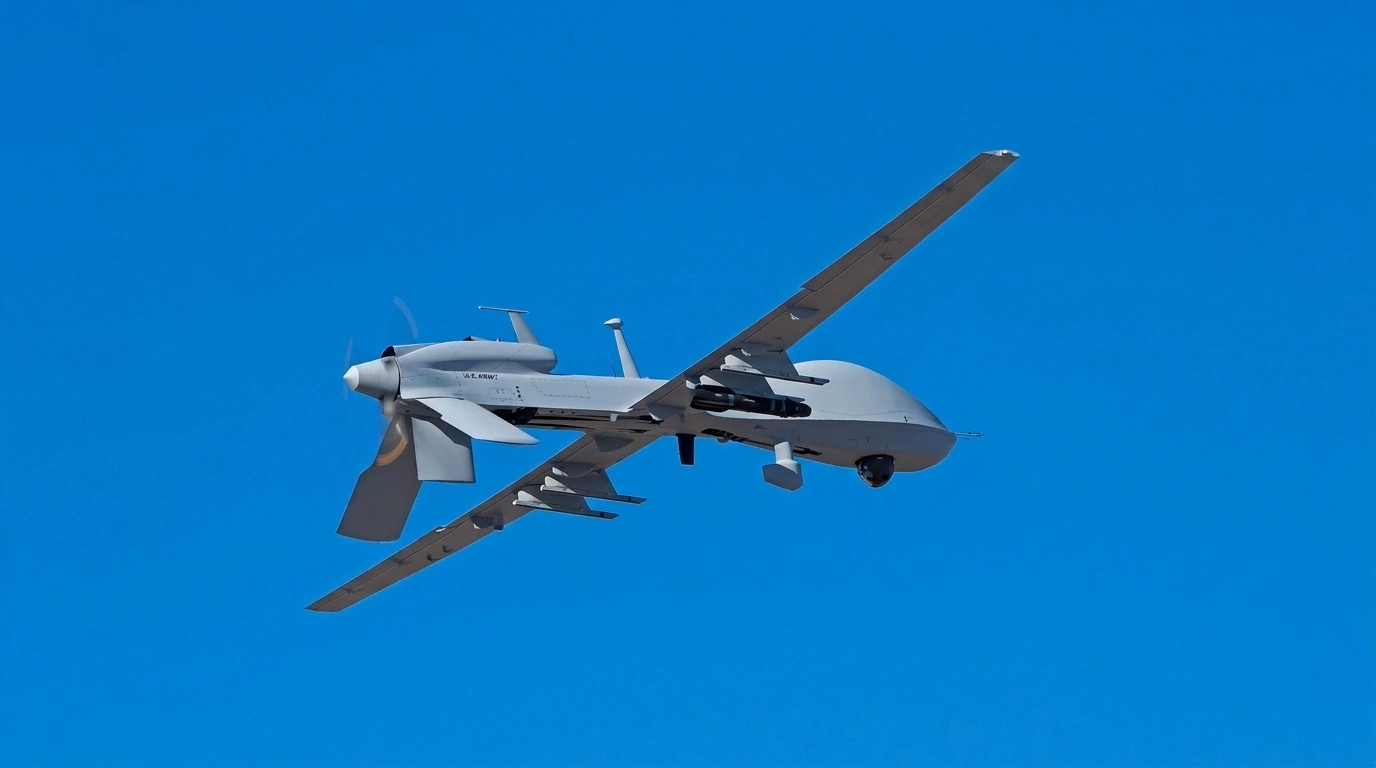
A drone that can stay in the air for roughly 25 hours gives the US Army something more useful than a quick strike. It gives commanders time to watch, track, and understand what an enemy is doing before making a move.
That’s the real strength of the MQ-1C Gray Eagle. It can carry precision weapons, but its value goes far beyond missiles. Its sensors help troops find targets, follow activity across large areas, and make better decisions without putting a pilot inside the aircraft.
Built by General Atomics, the Gray Eagle serves as a long-endurance unmanned aircraft system for US Army missions. Depending on its configuration, it can carry Hellfire missiles, advanced imaging systems, and other mission equipment. The extended-range version adds further endurance for missions that demand more time in the air.
But raw numbers don’t tell the whole story. A drone that flies high and stays airborne for hours can still struggle against modern air defenses or electronic jamming. Its performance depends on the threat, the mission, and the support available to its operators.
So, how powerful is the MQ-1C Gray Eagle? The answer lies in how well it combines surveillance, targeting, and armed attack. To judge its real strength, we need to look at its design, flight performance, weapons, sensors, and limits on the battlefield.
What Is the MQ-1C Gray Eagle?
The Gray Eagle was built around a simple Army requirement: keep eyes over the battlefield for hours, then act when a useful target appears. A fast attack aircraft might arrive, strike, and leave. The Gray Eagle can watch an area for much longer, giving ground commanders more time to understand what’s happening.
Developed by General Atomics Aeronautical Systems, the MQ-1C grew from the company’s Predator family of unmanned aircraft. The US Army adopted it to support reconnaissance, surveillance, target acquisition, and armed missions. Its role is broader than that of a drone designed only to launch missiles.
The aircraft also reflects a practical Army concern: fuel. Its heavy-fuel engine can use battlefield fuels such as diesel and jet fuel, helping reduce the need to maintain separate fuel supplies for different aircraft. That may sound like a small detail, but fuel logistics can shape how long a unit operates and how much support it needs.
The complete system includes far more than the aircraft itself. Operators use ground control stations, data terminals, satellite links, and other support equipment to fly missions and share information with troops. The Army’s acquisition documents describe a system built around aircraft and ground equipment working together, rather than a drone acting alone.
That distinction matters. The Gray Eagle’s value comes from the information it gathers and how quickly that information reaches the people making decisions.
It also isn’t a replacement for every crewed aircraft. It works best when commanders need sustained observation and a way to support ground forces without keeping a pilot aboard the aircraft.
MQ-1C Gray Eagle Specifications: Speed, Range and Endurance
The Gray Eagle’s biggest advantage isn’t speed. It’s the amount of time it can spend watching an area while carrying sensors and weapons.
The standard MQ-1C has a published endurance of about 25 hours, while the Extended Range (ER) version can stay airborne for more than 40 hours in the configuration described in Army program documents. The difference is substantial. Longer endurance can mean fewer gaps between missions and more time available to track activity over a large area.
Here are the key published figures for the aircraft.
| Specification | MQ-1C Gray Eagle |
| Length | 28 feet |
| Wingspan | Approximately 56 to 58 feet |
| Maximum takeoff weight | 3,600 pounds for the standard version |
| Maximum speed | Up to 167 knots, according to the manufacturer |
| Operating altitude | Up to 29,000 feet, according to the manufacturer |
| Endurance | About 25 hours |
| Extended Range endurance | More than 40 hours, depending on configuration |
| Maximum payload | 1,075 pounds of internal and external payload, manufacturer figure |
The speed figure needs context. At 167 knots, the Gray Eagle is much slower than a fighter jet. That’s not a design failure. The aircraft is built to remain on station, gather information, and support ground operations rather than race across contested airspace.
Range figures also need careful reading. The Army has published a range of 2,500 nautical miles for the system using satellite communications, but that number shouldn’t be treated as the distance an aircraft can travel out, conduct a lengthy mission, and return under every condition. Fuel reserves, payload, weather, and the mission profile all affect practical performance.

The takeaway is simple: the standard Gray Eagle offers a long period of airborne surveillance, while the ER variant pushes that advantage further. For commanders who need to keep watching after other aircraft would have to return, that extra time can matter more than another few knots of speed.
What Weapons Can the MQ-1C Gray Eagle Carry?
The MQ-1C Gray Eagle can do more than spot enemy forces. It can also attack them, turning hours of surveillance into a chance for a precision strike when the situation calls for one.
Its best-known weapon is the AGM-114 Hellfire missile. The standard published configuration allows the aircraft to carry up to four Hellfires, giving it a direct way to engage selected ground targets without sending a crewed aircraft into the same area.
That weapon load is useful, but it doesn’t make the Gray Eagle a flying arsenal. Four missiles are a limited supply, especially during a long mission. Once they’re gone, the aircraft may still be able to track targets and pass information to other forces, but it can’t keep launching weapons without rearming.
| Weapon or capability | Role |
| AGM-114 Hellfire | Precision attacks against selected ground targets |
| Laser designation | Helps guide compatible laser-guided weapons toward a marked target |
| Electro-optical and infrared sensors | Help crews find, identify, and track targets before an attack |
| Other light precision munitions | Potential options depending on aircraft configuration and integration |
The sensor system matters as much as the missile. The Gray Eagle’s Common Sensor Payload combines high-definition imaging with laser targeting, allowing operators to observe a target and support attacks with compatible weapons. The Army awarded Raytheon a $118 million contract action in March 2024 to produce upgraded Common Sensor Payload Version 3 systems.
This creates a useful link between surveillance and attack. Rather than relying only on a brief view of a target, operators can watch activity develop and assess whether a strike is warranted.

But a weapon’s presence doesn’t guarantee a successful attack. The target must be identified, the engagement must be authorized, and the conditions must support the weapon’s use. Weather, visibility, communications, and enemy defenses can all affect the result.
The Gray Eagle’s real advantage is that it can carry weapons while remaining useful as a surveillance platform. Its strength lies in joining those jobs, not in the number of missiles hanging beneath its wings.
How Powerful Are the Gray Eagle’s Sensors and Surveillance Systems?
The Gray Eagle’s most valuable weapon may be the information it collects before anyone fires a shot. Its sensors let Army crews watch an area for long periods, track movement, and help ground troops build a clearer picture of what’s happening below.
The aircraft can carry an electro-optical and infrared sensor system. In plain terms, that means operators can use visible-light cameras to inspect objects and infrared imaging to detect heat patterns, including at night. This gives the Gray Eagle a way to keep watching when darkness makes ordinary observation much harder.
Its Common Sensor Payload (CSP) also supports laser designation, which can help guide compatible weapons toward a selected target. The newer CSP Version 3 program aims to improve the Army’s sensor capability, giving crews better tools for finding and tracking targets.

Why does that matter? Imagine a ground unit trying to work out whether vehicles moving along a road belong to an enemy force. A quick overhead view might reveal little. Persistent observation can help crews follow the vehicles, note changes in activity, and pass updates to commanders. The drone doesn’t make every decision for them, but it can give them more time and information to make one.
The Gray Eagle can also use radar payloads such as synthetic aperture radar (SAR) and ground moving target indicator (GMTI). These tools help crews study terrain and detect moving objects, adding information that cameras alone may miss.
The Army also supports signals intelligence and electronic intelligence payloads, which can help locate and study electronic signals. The exact equipment depends on the mission configuration.
The next step is faster targeting. The Army’s CSP Version 3 adds Target Location Accuracy technology, designed to shorten the process between finding a target and engaging it with compatible weapons. Army program officials say this can reduce the sensor-to-shooter process from minutes to seconds.
There’s a catch, though. Sensors don’t make a drone all-seeing. Clouds, terrain, distance, heat, and enemy countermeasures can affect what operators detect. The Gray Eagle’s real advantage is its ability to combine different sources of information and keep collecting it over time, not a promise that every target will be found.
MQ-1C Gray Eagle vs. MQ-9 Reaper: Which Is More Capable?
If raw carrying power is the main measure, the MQ-9 Reaper wins by a wide margin. But the Gray Eagle wasn’t built to be a smaller copy of the Air Force’s drone. The two aircraft serve different forces and operational needs.
The numbers show the gap. The MQ-9 can carry roughly 3,850 pounds of payload, compared with the Gray Eagle’s published 1,075-pound capacity. It also flies faster and can operate at a higher altitude. Those advantages give the Reaper more room for weapons and mission equipment.
| Feature | MQ-1C Gray Eagle | MQ-9 Reaper |
| Primary operator | US Army | US Air Force |
| Maximum speed | Up to 167 knots | Up to 240 knots |
| Maximum altitude | Up to 29,000 feet | Up to 50,000 feet |
| Published payload capacity | 1,075 pounds | About 3,850 pounds |
| Endurance | About 25 hours for the baseline aircraft | More than 27 hours, depending on configuration |
| Main strengths | Army reconnaissance, persistent surveillance, tactical support | Larger payload, faster flight, broader strike options |
The Reaper can carry Hellfire missiles and larger guided bombs, giving it a broader strike loadout. Its greater speed also helps it reach an area faster when time matters. For missions that call for heavier weapons, the MQ-9 has the clear advantage.

But bigger isn’t automatically better for every task. The Gray Eagle is designed to support Army commanders and ground formations directly. Its sensors, communications links, and long time on station make it useful for tracking activity and sharing information with troops.
Think of the distinction this way: the Reaper offers more carrying power, while the Gray Eagle gives the Army a dedicated airborne tool for its own battlefield needs. Neither aircraft is the best choice for every mission.
What Are the MQ-1C Gray Eagle’s Biggest Limitations?
The Gray Eagle’s greatest strength, long endurance, doesn’t solve its biggest weakness: staying alive in contested airspace.
The aircraft flies at a modest speed and lacks the stealth features associated with modern low-observable combat aircraft. Against an opponent with limited air defenses, it may be able to remain overhead and gather information for hours. Against a force with capable radar, surface-to-air missiles, and fighter aircraft, the same flight profile can become a serious liability.
Electronic warfare adds another problem. The Gray Eagle depends on communications and navigation systems to carry out its mission. Jamming or disrupting those links can make it harder for operators to control the aircraft or share useful information. Satellite communications can extend its reach, but they don’t remove every vulnerability.

Payload also creates trade-offs. Carrying weapons and extra sensors uses capacity that could serve other mission needs. And even a drone with a long endurance rating must account for fuel reserves, weather, maintenance, and the need to return safely. Maximum published figures aren’t promises of performance on every mission.
The Army has reasons to keep investing in the platform. In April 2026, General Atomics announced an Army contract for an enhanced electronic intelligence capability on the Gray Eagle Extended Range. The upgrade is designed to detect and locate signals linked to threats such as integrated air defense systems, helping commanders build a better picture of danger from farther away.
That upgrade could help the Army gather information while keeping aircraft farther from some threats. It doesn’t make the Gray Eagle invulnerable, and detecting an air defense system isn’t the same as defeating it.
The sensible view is that the MQ-1C remains useful when commanders can manage the threat and exploit its endurance. Against a capable enemy, its value depends on tactics, electronic protection, intelligence support, and the wider force around it.
Final Verdict: How Powerful Is the MQ-1C Gray Eagle?
The MQ-1C Gray Eagle is a capable armed surveillance drone, but its real strength isn’t raw firepower. It’s the ability to stay airborne, collect information, and support Army operations for extended periods.
Its Hellfire missiles give it a strike option, while its sensors and communications equipment help commanders track activity and coordinate action. The Extended Range version pushes that persistence further, although no endurance figure guarantees success in combat.
The key question isn’t simply how many missiles the Gray Eagle carries. It’s whether the aircraft can gather reliable information, remain useful under the threat conditions, and get that information to the troops who need it. That’s the measure that matters most when judging its power.
