

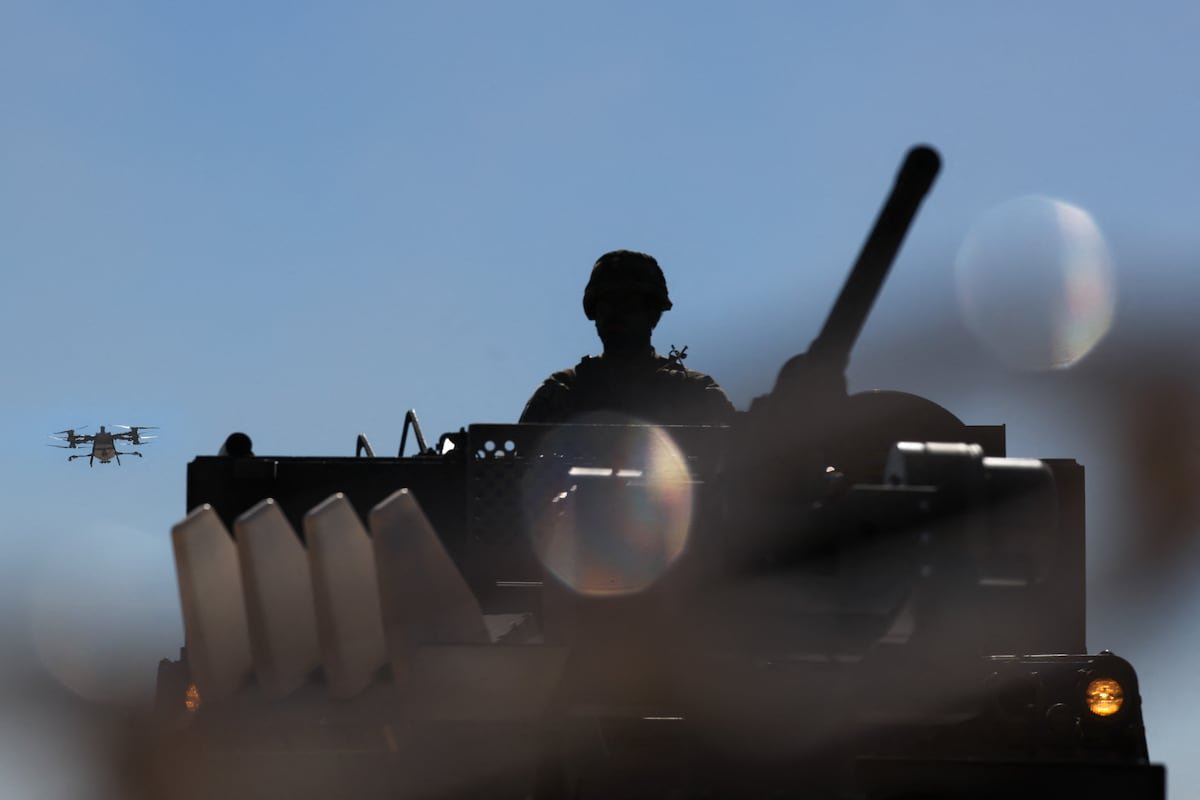
WARSAW, Poland — European governments are encouraging their defense industries to jointly develop and produce unmanned systems with Ukrainian companies, while cautioning to simultaneously new keep tanks and armored vehicles on hand for defending NATO’s eastern flank, officials said at the Warsaw Security Forum.
Dilan Yeşilgöz-Zegerius, the deputy prime minister and defense minister of the Netherlands, highlighted the Dutch defense sector’s ties with Ukraine in the field of drones.
“Our armed forces are really training, as we speak, every day with the knowledge the Ukrainians have, because … they have the most innovative Army in Europe,” Yeşilgöz-Zegerius said on Oct. 12. “And what we are doing at the same time … is investing in our own defense industry. Because it was also, of course, due to a lack of spending, not that strong anymore. And in Europe we have that issue.”
Meanwhile, while investing in drone and counter-drone systems, NATO allies bordering Russia are also procuring heavy gear for their land forces and seeking to secure a significant share of manufacturing work for their domestic defense industries.
Lithuanian Defense Minister Robertas Kaunas told Defense News at the forum that the country’s planned acquisition of six-wheel-drive armored personnel carriers from Finland’s Patria is an example of how allies can work together on major purchases for their land forces. The vehicles are to support the Baltic state’s National Division, its main combat unit.
“One of our intentions is not only to assemble, but also be involved in the R&D process,” Kaunas said. “The National Division is important because, together with our allies, including the United States, Germany, Poland, we can block our adversaries near the front line, near our borders, and then, of course, use drones, modern types of weapons to break them.”
Kaunas said that combining the two categories of military assets is crucial, as demonstrated in Ukraine.
“Ukraine adapted tanks with additional defense anti-drone capabilities and used them as a great source of protection for their soldiers, pushing Russians back near the front lines,” the Lithuanian minister said.
Dovilė Šakalienė, a Lithuanian lawmaker and the country’s former National Defence Minister, told Defense News that European allies must sign “smart contracts” that reflect the rapidly changing battlefield reality in Ukraine, as exemplified by Lithuania’s 2024 deal to buy 44 Leopard 2A8 tanks for the country’s military, which she signed while in office.
“We need to sign smart contracts which give us the delivery of the newest technology,” Šakalienė said. “In the Leopard agreement, we also included in a very clear way a condition that the newest version of anti-drone defense systems is going to be included. Not the ones which would be ready in 2024, but the ones that will be ready at the time of the assembly of these tanks. For the development of such technology, three years is eternity.”
Despite European nations’ rapid expansion of drone procurement, allies should continue to invest in heavy equipment such as tanks and armored vehicles for their land forces, Šakalienė said.
“Massive land maneuvers cannot be completed only with drones,” she added.
Meanwhile, as Poland, the forum’s host, is making efforts to increasingly shift from the role of a buyer of foreign military gear to exporter of such goods, foreign defense groups competing for major orders are investing to expand their manufacturing footholds in the country. For U.S. companies, Poland’s drive to expand its domestic production capacities comes as many industry players are already planning to boost their capabilities in the country.
“One of the things I can say about Poland is that the workforce here is exceptional. We’ve already got 1,000 employees here in Poland. And we’re looking to have much more than that,” Vince Logsdon, vice president for international business development at Boeing Defense Space and Security, told Defense News.
Building on the 2024 deal to sell 96 AH-64E Apache attack helicopters to Poland under a deal worth around $10 billion, the producer is now offering its CH-47 Chinook aircraft to the country’s armed forces, pitching it as a complementary platform to the Apaches that can support troop movements and battlefield logistics.
“The Chinook is our offering, it has proven itself throughout the world as a vertical lift, heavy lift helicopter. It has lots of operators throughout the world, and one of the things I have seen with our CH-47 offering is that most operators that acquire the Apache, they ultimately also acquire the CH-47,” Logsdon said. “It’s a perfect combination in terms of extending the battle space for the Apache.
Jaroslaw Adamowski is the Poland correspondent for Defense News.
