

Türkiye’s top gold importer is not the central bank or a jewellery manufacturer, but it is the defence company Aselsan. This company has a healthy appetite for raw materials as it invests heavily in research and development, produces defence equipment, and as it rapidly expands sales revenue.
Aselsan has enjoyed an average 25% annual growth rate in revenue over the past three years, including 29% in 2025. Its order backlog has increased 102% too. This is a phenomenal rate of increase – far more than a growth spurt – and it is exports that are driving the expansion.
Indeed, responding to a question from Asian Military Review during a sponsored media tour in late September 2026, Ahmet Akyol, President & CEO of Aselsan, explained: “The export ratio of Aselsan was 10% of total revenue three years ago. Now it’s 25% in total, and it will be 50% in 2030 in general.”
Asia-Pacific expansion
These figures highlight the growing importance of export markets, and the Asia-Pacific region has a vital role in this. Akyol noted, for example, that “the growth rate of Asia is higher than the average,” and that this will result in more cooperation with Asian countries.
As another company spokesperson pointed out, “Countries are realising that Aselsan has something to offer, which is combat-proven in the field, which is sustainable and which is cost-effective. That’s why we’re pushing into the Asian market.”
Aselsan has already achieved strong footholds in countries like Indonesia, Malaysia and the Philippines, but its sales strategy is now also eyeing markets that have traditionally been closely aligned with the USA. These include the likes of Australia, Japan and South Korea.

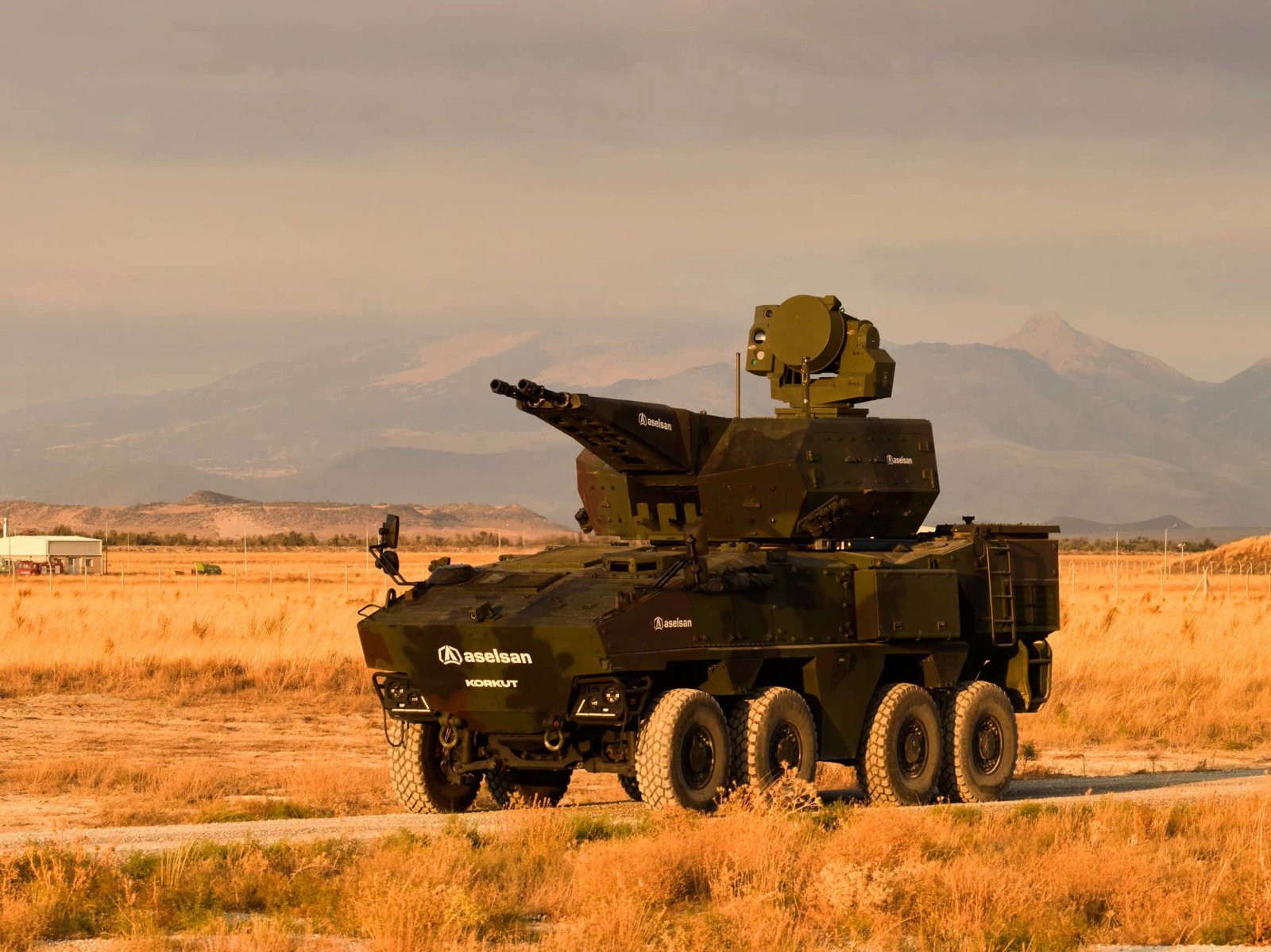
In fact, Aselsan participated in Land Forces 2026 in Perth, Western Australia from 6-8 October. This was the first time the company has exhibited in Australia. It has been talking to the Department of Defence about requirements such as counter-drone systems – currently proceeding under Project Land 156 – and it believes its Korkut 25 is suitable for Australia. Likewise, it is promoting the same weapon platform, which can be mounted on tactical vehicles, to neighbouring New Zealand as the latter proceeds with its own counter-drone project.
Aselsan, which produces important components of Türkiye’s Steel Dome air defence umbrella, may also be interested in Australia’s medium-range, ground-based air defence requirement. Named Project Air 6504, Australia is seeking an air defence system that will intercept ballistic missiles in their terminal phase, as well as air-breathing threats.
Aselsan has a widespread presence in Asia, where eight of its 25 affiliates are located. These are: Azerbaijan, Bangladesh, Indonesia, Kazakhstan, Malaysia, Pakistan, the Philippines and Uzbekistan.
As an example of its sales in Southeast Asia, Aselsan has been working with Sapura in Malaysia on communications technologies, encryption and a national waveform since February 2025. In nearby Indonesia, Aselsan has sold naval radars and Gökdeniz 35mm close-in weapon systems, for instance. Aselsan announced an agreement with Hyundai Heavy Industries in South Korea, plus it believes it can help Japan in arenas such as naval equipment and drones.

Korkut 35
When AMR visited Türkiye, Aselsan was demonstrating the Korkut 35 (the larger brother of the aforementioned Korkut 25) during a live-fire demonstration at a Turkish Armed Forces firing range near Konya. The Korkut 35, as its name suggests, features twin 35mm cannons mounted in a turret. The system can be installed on tracked or wheeled chassis. The Turkish Army, which introduced the Korkut 150/35 in 2016, uses the FNSS ACV-30 tracked chassis. The Pakistan Air Force is believed to have adopted the same Korkut 150/35 system, after it appeared in an official video posted in September this year. Incidentally, Pakistan also procured Aselsan’s Şahin 130/40GL counter-drone system.
At this live-fire demonstration, Aselsan used its Korkut 140/35 weapon system mounted on an Otokar Arma 8×8 armoured vehicle. AMR understands the demonstration also formed part of the vehicle’s certification process, before the system is adopted by the Turkish Air Force to protect air bases.
Aselsan demonstrated three scenarios – two against drones and one against a moving ground target – with the Korkut 140/35 successfully taking out its targets with Atom 35 smart airburst munitions possessing a 4km range. These 35mm munitions, whose fuses are programmed when they leave the gun muzzle, are designed to burst 20m in front of a drone to create a curtain of 160 tungsten alloy sub-projectiles.
Aselsan claims that its Korkut air defence system has already chalked up ten customers. This is astonishingly fast, given that the company’s 2025 annual report declared the first overseas delivery of the Korkut 150/35 system was realised only last year. The system is also used by Ukraine, where it is seeing active combat against Russian drones.
Company details
Aselsan achieved US$4.5 billion in revenue last year, sufficient to make it Europe’s fifth most valuable defence company in terms of market capitalisation. In a presentation to media at its Ankara headquarters, the company cited 97 international clients to date.
Aselsan employs some 14,000 staff, but 5,600 of these positions have only been created in the past three years. Furthermore, Aselsan emphasises the innovativeness of its workforce, whose average age is just 33 years. Last year, its expenditure in research and development rose 63% to reach US$1.36 billion. Of its 14,000 workers, 10,000 are engineers and 4,000 are technicians.
Aselsan owns six main facilities that span an area totalling 10.2 million m², including 618,000m² of enclosed floor area. In a tour of its Ankara production facility, it reminded AMR of the likes of Hanwha in South Korea, with these defence industry giants having scores of sophisticated pieces of defence equipment under production all at the same time. To feed its insatiable appetite for materials, Aselsan boasts 5,600 suppliers for its main business areas of air defence, naval and weapon systems; radars and electronic warfare, communication and information technologies; electro-optic systems; avionics and guided munitions; and transportation, security, energy and healthcare.
Aselsan, established in 1975, stresses that it is not a platform producer, though its products are found on innumerable products. For example, it has multiple components on Turkish-designed platforms such as the Kaan fighter jet, Atak helicopter, Akinci drone, Altay main battle tank, Firtina 155mm self-propelled howitzer, MILGEM warships and Preveze-class submarines. Incidentally, Aselsan is the largest producer of radars in Europe.

Confidence
It will not be easy for Aselsan and other Turkish companies to gain footholds in US-aligned markets in Asia-Pacific. However, the CEO believes it can be achieved. Akhol cited Aselsan’s ability to quickly deliver equipment, its cost-effectiveness, high-performance equipment, combat-proven credentials from conflict situations, and generous technology sharing as reasons why new customers should put their faith in Aselsan. Furthermore, he stressed that all its equipment is NATO-compliant since Türkiye is a NATO member.
Especially as countries become concerned at the unhinged policies of President Donald Trump, and production bottlenecks and growing order queues in the USA, it is perhaps the right time for Turkish defence companies to strike.
Akhol thus said with confidence: “I believe we’ll see these results in coming years.”
by Gordon Arthur
Note: Gordon Arthur was in Türkiye as a guest of Aselsan.
