

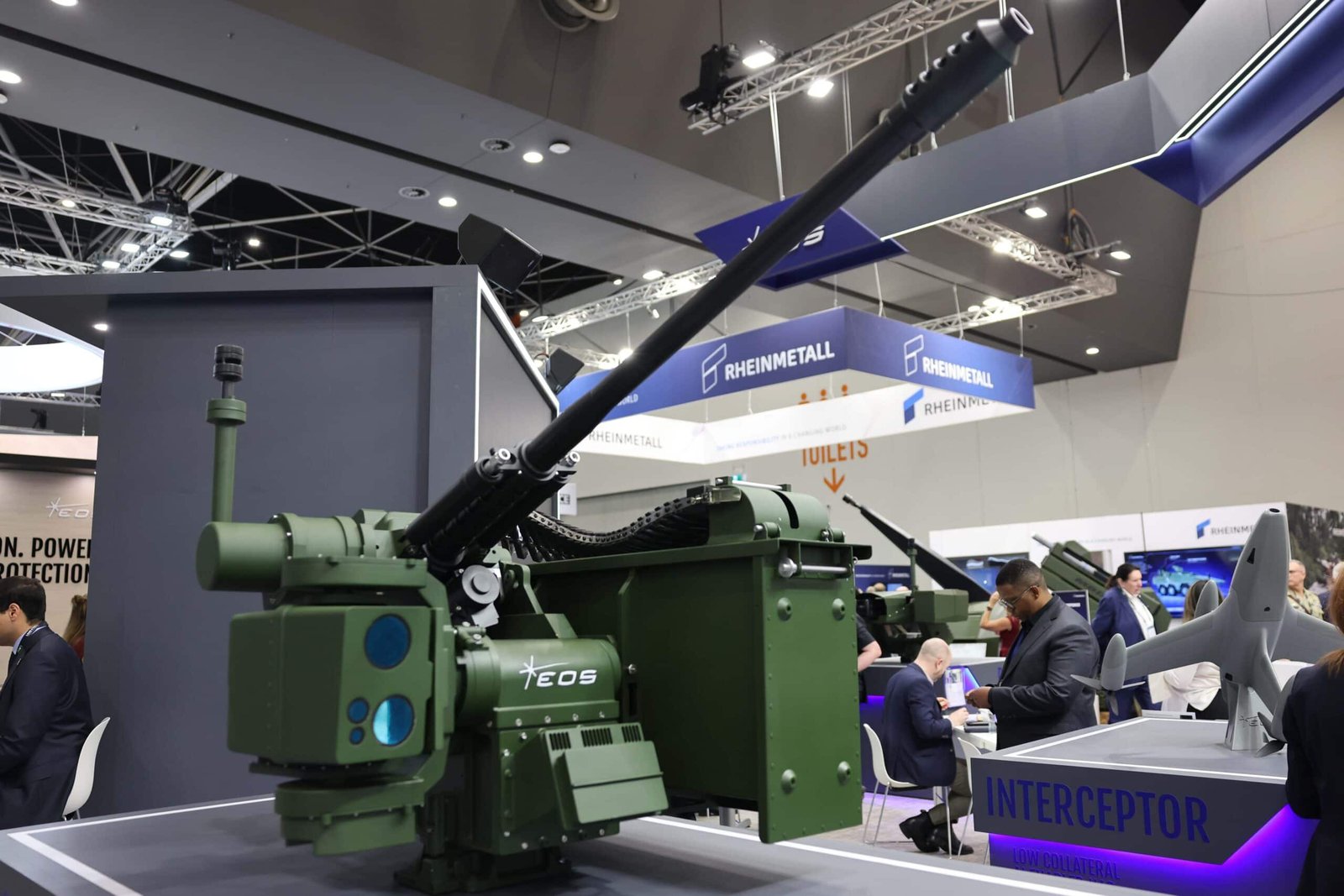
EOS is seeing unprecedented demand for its products, particularly in counter-drone roles. At the Land Forces 2026 exhibition held in Perth, Western Australia from 6-8 October, EOS was showing a wide range of its products.
Lee Kormany, Executive VP at EOS Defence Systems, explained that the R400 remote weapon station (RWS) is the company’s most popular model, but there is also strong demand for the Slinger, a dedicated counter-unmanned aerial system (C-UAS).
She said the global demand stems from the combat-proven pedigree of the company’s RWS products, as well as its ability to meet demand for counter-drone missions.
Kormany pointed out: “I think recent conflicts have really shown how effective they’ll be in the field.” She added, “We feel like you have to take a layered approach for the counter-drone challenge, and you have to have many different choices” for customers. The EOS range includes the R150, Slinger, R400, R500 and top-of-the-range R800, for example.
With Hanwha Defence Australia getting ready to commence production of 129 examples of the AS21 Redback infantry fighting vehicle for the Australian Army, EOS will supply customised R400s for these vehicles. These weapon stations are designed for ground-to-ground applications, with EOS receiving an A$108 million (US$71.4 million) contract for these in October 2025.
The army has also installed Slinger RWS atop a limited number of Hawkei protected vehicles as part of Mission Syracuse, an Australian Army C-UAS effort. In July 2026, EOS received an A$5.7 million contract to develop the R400 Slinger so it includes laser-guided rockets and a machine gun.
Still at the experimentation phase, series production contracts have not been awarded yet. A major Mission Syracuse demonstration scheduled for later this year will help bring clarity as to what systems the army will likely plump for.
Exports are rolling in too. EOS has registered R800 and R400 RWS sales to India and the Middle East respectively, for example. A Middle East client has recently received the R800 too for use as a fixed installation to protect infrastructure. EOS has also demonstrated its RWS in neighbouring New Zealand.
Kormany said it is important for a C-UAS system to be able to discern what targets are approaching. An enemy can use decoys to consume valuable ammunition, so the system needs the ability to detect what the target type is, even in the face of decoys and spoofing.

Turning to lasers, another focus for EOS, the Australian company and the Dutch government signed a letter of intent in late September regarding the latter’s desire to acquire a 100W Apollo high-energy laser for counter-drone use. This follows an agreement signed last year.
Kormany said, “We were really delighted to get that from the Netherlands government. It really is talking to the confidence they have in the work that we’ve been doing together to mature the 100W high-energy laser weapon.” Development is occurring at EOS’ Singapore laser centre that opened last year, but the Netherlands is keen for production to take place on its own soil.
She concluded: “I think it’s a really exciting time for EOS. We have a solution to a current problem in the world, but what we’re really focused on is bringing capability to the hands of the end user so that we can really protect what matters.”
The EOS executive acknowledged that Australia does not have development cycles that are rapid enough at the moment. “The battlefield is changing weekly or monthly, and we need to be able to adapt our system to address that.”
by Gordon Arthur, Perth
