

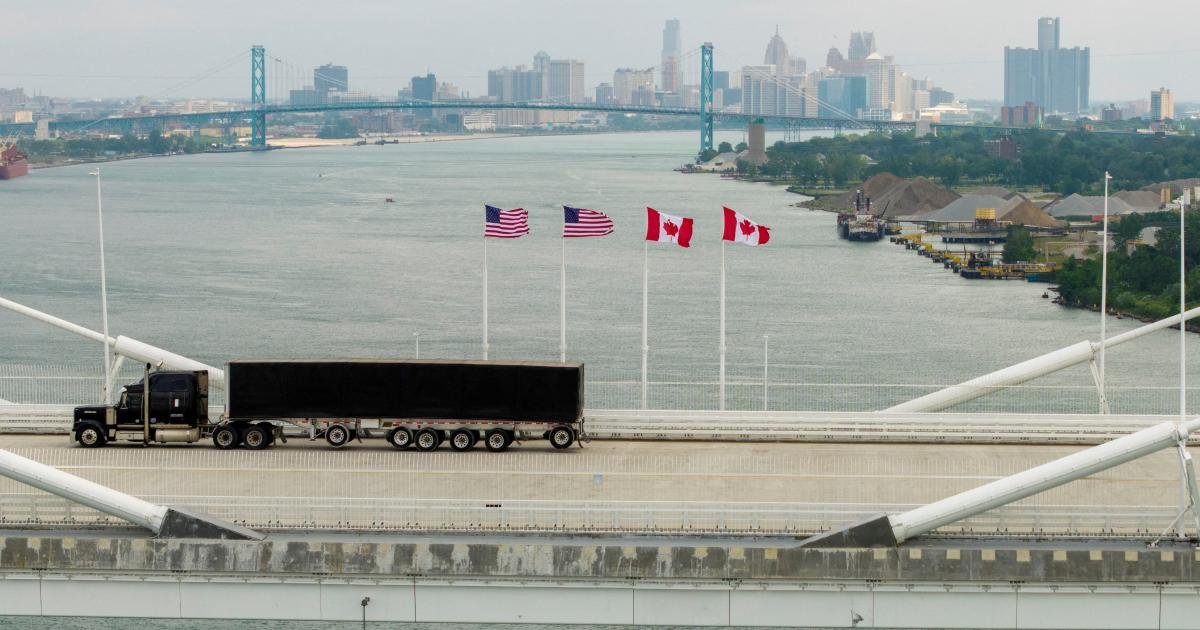
The Trump administration’s attack on Canada and Mexico is cracking the foundation of the United States’ global power. Friendly relations with neighbors enhance security, promote mutual economic gain, and make it easier to handle transnational challenges. Weak neighbors export trouble. Today, Canadians perceive U.S. President Donald Trump’s high tariffs and belittling of their country as the “51st state” as assaults on Canada’s economy and independence. In Mexico, Trump’s economic coercion and threats of military intervention have revived deep historical anxieties about gringo hegemony.
The North American partnership took generations to forge. During the nineteenth century, the United States’ foreign policy concentrated on its home continent, where it competed with France, Mexico, Russia, Spain, the United Kingdom, and indigenous peoples for dominance. As the United States became a global power in the twentieth century, U.S. strategists took North American relations for granted. Washington turned its attention to Europe, the Asia-Pacific, and the Middle East. Since the closing years of the Cold War, however, U.S. presidents have recognized the need to invest in North America. Ronald Reagan laid out the strategic rationale clearly when he launched his presidential campaign in 1979: “The key to our own future security may lie in both Canada and Mexico becoming much stronger than they are today,” he explained. “It is time we stopped treating our nearest neighbors as foreigners.”
Geopolitics begin with geography, and the United States’ geography gives it an enormous advantage over the world’s other major powers. China and Russia each have to manage relationships with 14 neighbors, many of which are unfriendly or carry resentments from histories of conflict. India must deal with six, including a nuclear-armed rival. All three powers’ access to the world’s seas depends on passage through maritime chokepoints. In contrast, the United States borders two benign neighbors and enjoys open sailing on two vast oceans. Close cooperation with Canada and Mexico enhances homeland security, attracts investment, promotes innovation, creates a huge market rich in resources and talent, and helps all three countries deal with criminal networks, illegal immigration, and threats to clean air, water, and wildlife.
A safe, resilient, and adaptive North America is the starting point of U.S. global strategy. Washington is best positioned to navigate an uncertain world when the United States, Canada, and Mexico present a common front. Yet Trump’s bullying is driving the United States’ natural partners away. The president is destroying a precious geopolitical asset: a strong continental base from which Washington projects power.
CONTINENTAL VISION
William Seward, who served as U.S. secretary of state from 1861 to 1869, first appreciated that good relations with the United States’ neighbors would boost the country’s global influence. He asserted that to have “control of this continent is to be . . . the controlling interest in the world.” When he was negotiating the U.S. purchase of Alaska in 1867, Seward observed that Alaska and the Aleutian Islands “extend[ed] a friendly hand to Asia.” He also tried to buy Greenland, Iceland, the Hawaiian Islands, and islands in the Caribbean, hoping that the purchases would help secure the United States’ oceanic approaches.
Seward recognized, however, that the United States could also boost its power by strengthening economic links, not just by adding territory. He abhorred European imperial conquests of foreign lands. He had also opposed the 1846–48 U.S. war with Mexico. At the end of the U.S. Civil War in 1865, Seward prevented Generals Ulysses Grant and Philip Sheridan from invading Mexico to depose the Habsburg archduke who the French had installed as emperor. He reasoned that an invasion would arouse Mexican hostility and that the Mexicans could depose the interloper themselves—which they did, in 1867.
The United States’ geography gives it an enormous advantage.
Seward dealt diplomatically with the United States’ northern neighbor, too. In 1867, the British government united its North American colonies to form the Canadian Confederation, in part to deter Washington from invading Canada in retaliation for London’s assistance to the Confederacy during the Civil War. Seward responded by choosing the peaceful path of arbitration to resolve wartime claims against the United Kingdom.
Seward envisioned a North American union created through free choice, not coercion or conquest. He believed in the attractive power of the United States. Commerce, he maintained, would be the new “god of boundaries” that would redraw borders and pull countries together. Ernest Paolino, his biographer, termed this idea Seward’s “law of imperial gravity.”
The restoration of Mexican President Benito Juarez in 1867, the same year the Canadian Confederation was formed, offered the prospect of a democratic North America with closer economic ties. The neighbors did establish peaceful relations. But Seward’s vision faded in later decades as Americans focused their sights westward, paying less attention to their neighbors to the north and south.
A SEARCH FOR STABILITY
By the early twentieth century, the United States had come to take continental harmony for granted. The Mexican Revolution of 1910 ended that sense of security. In the decade of violent conflicts that followed, attacks on border towns and seizures of American property by revolutionaries and bandits prompted the United States to send two military expeditions into Mexico. Washington narrowly avoided a quagmire. U.S. President Woodrow Wilson’s reelection campaign slogan in 1916, “He kept us out of war,” referred as much to Mexico as Europe. Still, the instability on its doorstep made the United States vulnerable. In 1917, imperial Germany sent the new Mexican government a secret proposal of alliance—a message intercepted by the British—that promised German assistance in recovering Arizona, New Mexico, and Texas if Mexico were to side with Germany in the event the United States entered World War I.
The United States was able to stabilize relations with the one-party authoritarian state that consolidated control in Mexico in the 1920s. As the political scientist Pamela Starr explained, Washington accepted its neighbor’s autonomy, but “within limits.” As long as Mexico did not threaten U.S. security, the United States would not interfere. Mexico’s stability was more important than challenging its stunted democracy, prickly nationalism, and closed economy. This arrangement lasted about 50 years, during which the two countries found ways to cooperate. Between 1942 and 1964, for instance, the United States’ Bracero Program offered some 4.6 million Mexicans guest worker permits, filling labor gaps in the agriculture, railroad, and other industries.
The twentieth century also saw Canada transition from British dominion to sovereign North American partner and ally. During the 1920s and 1930s, the United States and Canada built bridges and tunnels to boost economic exchanges. U.S. Secretary of State Cordell Hull negotiated important reciprocal trade agreements with Canada in 1935 and 1938. After World War II, Canadians fought beside Americans in the Korean War and vigorously supported the establishment of NATO, the General Agreement on Tariffs and Trade, the United Nations, and other institutions that made up the postwar order. During the 1950s, the United States and Canada constructed the St. Lawrence Seaway. The two countries also established a vast radar system to monitor possible missile attacks over the Arctic. In 1965, they signed a pact creating a duty-free integrated automobile market.
TIES THAT BIND
The pace of North American integration picked up during the Reagan administration. Reagan’s outreach to his Canadian counterpart, Prime Minister Brian Mulroney, encouraged Mulroney to propose an expansive free trade agreement in 1985. Mulroney ran a big risk: Canadians were wary of becoming economically dependent on or dominated by the United States, but they also wanted rules to discipline U.S. trade practices and encourage investment. The two countries concluded the agreement in 1987, and the U.S. Congress approved it the following year. The 1988 Canadian elections effectively became a referendum on the trade deal—one that Mulroney won.
Carlos Salinas, who assumed the Mexican presidency that year, recognized that a similar agreement would open up his country’s economy and attract investment. Mexico was struggling with debt crises, declining energy revenues, and the related breakdown of the ruling party’s half-century-old corporatist model, which had fostered a centralized, closed economy. Looking to escape stagnation and to spur reform, Salinas took the bold step of proposing a free trade agreement to President George H. W. Bush in 1990.
Trump is destroying a precious geopolitical asset.
Canada joined the negotiations in 1991, and together the three countries signed the North American Free Trade Agreement in 1992. For Washington, NAFTA was about much more than trade. It was a big step toward historical reconciliation with Mexico, which had remained wary of the United States since losing half its territory in the war ending in 1848. Mexico was now looking to the United States to help it accelerate an economic, social, and political transformation. Mexican negotiators hoped to import the rule of law through protections for investment, competition, and intellectual property. And reformers sought inspiration from U.S. and Canadian institutions as they built a multiparty democracy and a more open society.
Bush saw NAFTA as a cornerstone of U.S. post–Cold War strategy, explaining in 1992 that the agreement was “the beginning of a new era,” part of “a new world order” that would help let the United States “prepare for the challenges and opportunity of the next century.” His administration believed that the partnership could both deliver economic benefits and ease the way for continental cooperation on foreign policy, the environment, immigration, and drug smuggling. Unlike the European Union’s model of shared sovereignty, economic integration through NAFTA was supposed to respect national sensitivities about independence and sovereignty.
Bush’s successor, President Bill Clinton, faced the challenge of getting NAFTA approved by Congress, which Clinton accomplished with strong Republican support. Clinton deepened Washington’s commitment to the North American project, extending a large loan to Mexico during the 1995 peso crisis to prevent economic instability from spilling over into the United States. And after the 9/11 attacks, amid fears that terrorism would disrupt trade, President George W. Bush launched initiatives to ensure safe, fast transit for commercial vehicles across the Canadian and Mexican borders.
BETTER TOGETHER
Opponents of NAFTA asserted that Americans would lose many jobs to Mexican workers willing to accept lower wages, but these concerns were not borne out. The agreement was an economic and a strategic success. In 2000, six years after NAFTA came into effect, U.S. unemployment dipped to 3.8 percent, its lowest level in decades. Inflation fell, productivity rose, and real wages grew, with notable gains for low-wage workers. The pact encouraged investment in railroads, pipelines, electricity grids, and border systems that made supply chains more efficient, especially in manufacturing. U.S.-Canadian trade in goods and services grew from $169 billion in 1988 to about $900 billion in 2024. U.S.-Mexican trade neared $1 trillion, up from less than $100 billion before NAFTA.
Cross-border investment has powered this growth. U.S. direct investment in Canada rose from $61 billion before NAFTA to about $750 billion, and Canada’s investment in the United States increased from $27 billion to about $500 billion. American direct investment in Mexico rose from $15 billion to around $130–150 billion, while Mexican enterprises’ investments in the United States jumped from $1 billion to $40–50 billion. The United States is the source of as much as 60 percent of Canada’s and roughly 40 percent of Mexico’s imports—so when their economies grow and their companies and households buy more, the U.S. economy gains, too. Growth in more distant economies does not boost U.S. sales as much. When China imports more, for example, the United States receives only six to seven cents of every additional dollar it spends.
NAFTA’s architects also hoped that the agreement would create economic opportunities within Mexico, enabling people to find jobs at home rather than moving north. Because of Mexico’s economic difficulties, the number of Mexican-born immigrants in the United States had risen from about 760,000 in 1970 to nine million in 2000. But by 2010, Mexican immigration had fallen to net zero; most people arriving at the southern border came from Central America and beyond, and Mexico became an essential partner in helping the United States enforce its immigration laws.
Trump wanted to scrap NAFTA during his first term, but by then it had become too valuable to abandon. His administration settled for a renegotiation, replacing NAFTA with the United States–Mexico–Canada Agreement in 2020. The new accord modernized provisions for digital trade and added procedures for labor complaints, but its complex terms to protect regional auto producers undermined that sector’s global competitiveness. The agreement also reduced protections for foreign investors in Mexico, weakening confidence in the rule of law.
REPAIRING THE RIFT
The accord does not expire until 2036, but the North American idea is already on life support. The Trump administration declined this year to approve an extension of the trade pact to 2042, and uncertainty about its future now discourages investment in Canada and Mexico. An even bigger problem is that the Trump administration wants the freedom to ignore the agreement whenever it wishes. In 2025 and 2026, it placed high tariffs on Canadian autos, steel, aluminum, iron, metal-intensive equipment, lumber, and pharmaceuticals, claiming that these imports were a threat to U.S. national security. Given that the United States has supported the integration of those sectors for 70 years and that Canada has been a close military partner for more than a century, it is no surprise that the designation shocked and insulted Canadians.
The weakening or even breakup of U.S. ties with Canada and Mexico would be a strategic disaster. The three countries’ combined assets make North America a formidable global player. The continent stretches from the Arctic almost to the tropics. The three democracies together are home to almost a half billion people, and unlike most economies, their populations are still growing. They have a skilled labor force and an integrated infrastructure that fosters highly competitive agriculture, mining, manufacturing, and services. North Americans also have access to cutting-edge technologies, abundant financial capital, energy self-sufficiency, and the capacity to expand their production of oil, gas, and renewables.
NAFTA was an economic and a strategic success.
This is an enviable hand to play, not one that Trump should fold. Washington must stop antagonizing Ottawa and instead cooperate with its northern neighbor on Arctic and maritime security, mineral extraction and trade, and technological innovation. Canada’s artificial intelligence talent, research capabilities, and energy resources complement those of the United States, just as its resources and manufacturing did in the twentieth century.
Washington also needs to help Mexico realize its potential. NAFTA helped Mexico create world-class economic institutions and a freer society, but corruption still pervades its state and local governments, legal institutions, police forces, and schools. Many Mexicans are stuck working in the informal economy. Drug and other criminal enterprises have taken advantage of the government’s weaknesses. With U.S. intelligence and technological support, however, Mexico can improve security and the rule of law. Building stronger, more trustworthy institutions will boost growth and make the country a better partner.
From Seward to Reagan, the Bushes, and Clinton, U.S. leaders have recognized that a strong North America offers the United States a strategic anchor in an uncertain world. Trump’s need to dominate, his zero-sum approach to economics, and his transactional instincts cast him outside this circle of strategic leaders. But the next U.S. president will have an opportunity to change course. The United States needs to revive its powers of attraction and treat its neighbors with respect to restore and expand a constructive continental partnership.
Loading…
