

Hanwha Defence Australia’s production of AS9 Huntsmanself-propelled howitzers and AS10 ammunition resupply vehicles is in full swing at its facility in Avalon, Australia, and up next is the AS21 Redback infantry fighting vehicle. However, with production of these vehicles scheduled to cease by the end of 2028, Hanwha is looking at other product lines to pick up the slack.
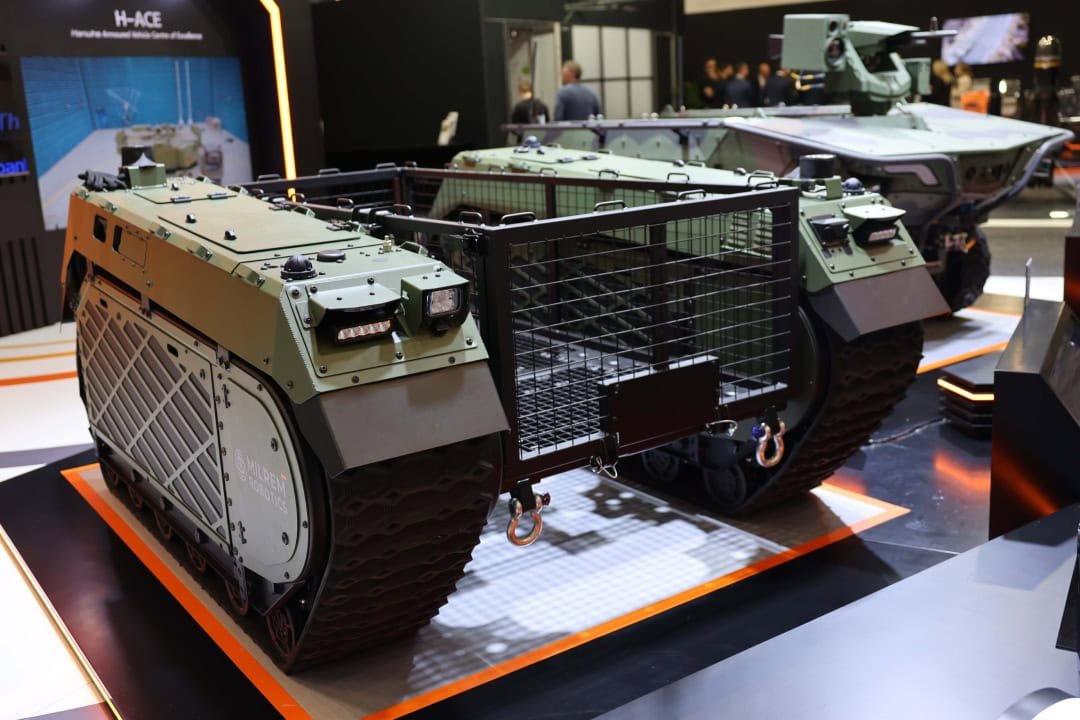
This includes unmanned ground vehicles (UGV), with Hanwha Defence Australia (HDA) signing a memorandum of understanding (MoU) with Milrem Robotics at the Land Forces exhibition in Perth, Western Australia on 7 October 2026.
HDA has purchased a THeMIS tracked UGV from Milrem, and it will soon participate in trials with the Australian Army’s 1st Armoured Regiment.
Hanwha stated, “The MoU establishes a framework for HDA to market, pursue local production, sell and sustain THeMIS locally in Australia for the wider region. This includes developing an Australian supply chain, building local maintenance and upgrade capabilities, and integrating payloads and subsystems to meet the specific requirements of regional customers.”
There is also an option to integrate the Milrem Intelligent Function Integration Kit with other Hanwha’s crewed platforms like the Huntsman and Redback.

Additionally, HDA exhibited an example of its ARION-SMET 6×6 UGV at Land Forces 2026. This vehicle recently won a contract from the Republic of Korea Army, believed to be for around 40 vehicles, and the company believes it has applicability to Australia too.
Turning to the AS9 build programme at the Hanwha Armoured vehicle Centre of Excellence (H-ACE) in Australia, three South Korean-built vehicles have been delivered in a first batch, as well as six Australian-manufactured units. All 45 AS9s and AS10s are to be delivered by the end of 2027, an HDA spokesperson told Asian Military Review.
The Australian Army’s 3rd Brigade received its first 48-tonne AS9 in May 2026. By the end of 2027, three batteries of the 4th Regiment, Royal Australian Artillery will each eventually field six AS9s and three AS10s. This regiment is moving from four M777A2 towed howitzers per battery to six AS9s, and Brigadier Ben McLennan, the 3rd Brigade Commander, said this would increase capability, firepower, mobility and protection by at least 300%.
Meanwhile, all 129 AS21 Redbacks are to be handed over to the Australian Army by the end of 2028. Eight prototype vehicles were manufactured in South Korea as a risk reduction activity, and these are currently undergoing trials in both Australia and South Korea. Full series production is set to commence at H-ACE before the end of this year, with a second production hall currently being fitted out. The H-ACE workforce will peak at 600-650 employees at the height of production.
Hanwha’s ability to set up production and churn out complex armoured vehicles under an accelerated production schedule is extremely impressive. Asked what will happen to the two production halls at H-ACE after these two projects are completed, the spokesperson said there are options such as production for export. “It could be something else, it could be foreign variants. We’ll be doing sustainment work as well on both these fleets of vehicles.”
When Australia cut its order from 450 Redbacks down to 129, it decided to field only two variants – an IFV and joint fires. However, there is hoped that other variants may be of interest to the army.
In fact, Hanwha views the H-ACE as a strategic asset, giving South Korea an alternative production facility outside the troubled Korean Peninsula. An electromagnetic interference and compatibility chamber at H-ACE – the largest in the Southern Hemisphere – is also proving to be a valuable sovereign asset, with outside companies queuing up to use it to test their own platforms.
HDA is also interested in Australia’s medium-range ground-based air defence system (MRGBAD) programme, known as Project Land 6504. Hanwha believes its L-SAM is a suitable solution. It will soon be operational in South Korea, with an even more capable Block 2 version already under development.
Hanwha is also a prodigious producer of munitions in South Korea, and the company stands ready to support the Guided Weapons and Explosive Ordnance (GWEO) enterprise in Australia in its quest to advance sovereign capabilities.
Counter-drone systems are another area where the company has various solutions available, and some of these were on display at Land Forces 2026 in scale model form.
by Gordon Arthur, Perth
