

For eighty years, the Western alliance has anchored its strength in moral legitimacy, shared values, and the resulting credibility to shape international norms. NATO’s durability through the Cold War rested on more than nuclear deterrence alone: a shared conviction that the alliance represented a rules-based order worth sustaining, in which the use of force was bounded by law, constrained by democratic accountability, and subject to independent scrutiny. Dozens of nations aligned with a framework in which power was subject to restraint.
That framework is now under pressure from several directions, but one unexpected contributor is the increasing use of AI embedded in the targeting processes of advanced militaries. During the war between the United States and Iran earlier this year, the Maven Smart System, built by Palantir and running Anthropic’s Claude, helped generate and prioritize targets at a pace inconceivable even just five years ago.
It raises a pressing question: What happens to human decision-making as AI compresses the kill chain towards machine speed? This article focuses on one layer — the decision support systems that fuse intelligence, nominate and prioritize targets, and increasingly apply generative models to reason across all of it. The race to automate that process risks becoming a strategic own goal disguised as a tactical capability gain if the West fails to implement it in line with its values.
Western militaries cannot preserve their current model and standard of human oversight while harnessing AI-enabled targeting at machine speed. Yet that should compel them to redesign oversight, not abandon it, because good oversight is ultimately a source of strategic advantage. Allied governments should agree now on which judgments should remain human, before these systems are fully integrated, and should ensure the same technology that accelerates the kill chain also strengthens the quality of oversight itself.
Sign Up for Our Newsletter
A Familiar, But New Challenge
From chemical to nuclear weapons, humanity has repeatedly confronted technologies that transformed warfare, and each time eventually developed doctrine, norms, and governance structures in response. But what is novel with AI is that it changes how decisions are made, not just how well the weapons work or how effectively they can execute a human decision. Earlier technological developments gave militaries more speed, accuracy, or scale, but a human had already decided what to hit. A fire-and-forget munition, for example, carries out a human decision rather than making one itself.
Some technologies did reach further: Radar changed how targets are recognized. Automated air defenses are the closest comparator, completing engagements without human intervention — though only within a narrow envelope, against parameters set in advance by a human. Otherwise, previous technologies have only affected the input to a human decision, and left a human to reach a conclusion at human speed. Oversight mechanisms were built around that speed. AI, on the other hand, reaches the verdict itself, faster than anyone can question it or even understand its reasoning. A physical weapon can be banned or restricted, while a judgment folded into a process is much harder to regulate.
The value proposition of AI in targeting is significantly increased speed and scale: more automation, more chance of battlefield victory, the argument goes. But this is also where the strategic consequences of error become most acute. Much of the public debate has focused on whether AI in warfare can adhere to international humanitarian law. Compliance with principles of distinction, proportionality, necessity, and humanity is vital and demanding, and is the foundation of the West’s moral authority. But it operates within a relatively well-defined framework, applying established rules to a given situation. The considerations in a targeting decision extend well beyond whether a strike is lawful. In UK targeting doctrine, the legal adviser considers “could we strike it in compliance with international law,” while the policy adviser answers “should we?”
The “should we” question can be a more nuanced proposition. There is no fixed rule that resolves it. It is a dynamic assessment of the strategic and political implications of action. A lawful strike can still inflame a third party on whose support an eventual settlement depends, open a rift in a coalition whose unity is itself a strategic asset, or forfeit the cooperation of a local community whose consent and intelligence are relied upon. A tactical military gain can be significantly outweighed by the strategic communications cost.
Consider a compound in a densely populated area where intelligence has identified a senior commander responsible for scores of coalition deaths. A strike is legally viable — the target is positively identified and the collateral damage estimate falls within proportionality thresholds. But the compound sits close to a site of profound cultural significance, and the commander is in talks with a faction quietly exploring ceasefire terms through a back channel that has taken months to establish. Striking would almost certainly collapse those talks and generate imagery that allied governments would struggle to defend publicly, at a moment when domestic consent for the operation is already wavering. Then the commander prepares to move, with no intelligence on where he is going. The decision-maker should weigh striking now, before he disappears, against the near-certain collapse of the talks. There is no algorithm that resolves this. It requires a human being to weigh incommensurable values under immense pressure and accept accountability for the outcome.
A Competitive Necessity
The drive to automate targeting is often framed as a competitive necessity. The West’s adversaries are pursuing AI-enabled warfare aggressively. If the West does not match their pace, the argument runs, it accepts a disadvantage that translates into operational and ultimately strategic defeat.
This logic is not necessarily wrong, but it is incomplete. Matching adversary capabilities is a baseline requirement. The question is whether, in pursuing that baseline, militaries engineer out the very oversight mechanisms that distinguish how democratic societies wage war, and in doing so surrender the asymmetry that has underpinned Western strategic advantage for eighty years. Democracies will never out-compete authoritarian regimes in the unconstrained application of force, nor should they try. Restraint is the architecture of the legitimacy that holds alliances together, sustains domestic political consent for military operations, and provides the moral authority to set international norms.
Yet no military can retain its current model of human oversight while harnessing the military advantage this technology can offer. A thousand strikes in twenty-four hours, widely cited as the tempo in the recent U.S.-Iran conflict, leaves roughly eighty-six seconds per targeting decision. Existing review processes were not built for that tempo, if they are indeed followed with integrity rather than rubber stamping machine decisions.
There is, however, a case for optimism. Safeguards and tempo are commonly assumed to be direct trade-offs. But a fundamental redesign — one that makes use of AI — could improve the quality of oversight rather than merely preserve it, whilst keeping pace with machine speed at the same time. The capability could be turned inward: surfacing relevant precedents, flagging coalition sensitivities, or sharpening commanders’ understanding of the implications of expected collateral damage. More ambitiously, AI deployed in an adversarial capacity within the targeting process — as a live red team, continuously stress-testing targeting recommendations against legal, ethical, and strategic criteria — would represent a genuine advance on what unaided human review can achieve. Commanders have every incentive to want such considerations built in. It is their career, and potentially their liberty, at risk if they get it wrong.
Redesigning these processes will be bedevilled by complexity. AI-enabled workflows can quietly prestructure the decision space — a so-called “triage trap” that determines which options a commander ever sees — and interrogating machine reasoning can consume precisely the time these systems save. Then there is automation bias: a well-documented tendency to defer uncritically to a sophisticated system, which will only intensify as AI grows more capable.
The notorious opacity of AI reasoning compounds these problems. The existing targeting process learns from its own failures, as investigations and inquiries interrogate rationale and human logic: The 2021 review of an erroneous American strike in Kabul reconstructed what the analysts saw and what they assumed. That’s how processes are continuously improved to avoid mistakes happening in the future. An AI system that nominates targets by a route no one can follow breaks that loop. It is critical that such systems remain auditable.
However, I believe these critiques are not necessarily arguments against AI in the oversight of lethal force. They are instead design requirements for it. The question is not whether to keep humans in the loop, but how to make human judgment substantive at the tempo these systems impose. That will require defense ministries and the commands that write doctrine to redesign how oversight is conducted — almost certainly placing greater trust in the technology than governments are currently comfortable with. The sooner those institutions confront that honestly, the sooner they can design something better.
Setting the Right Trajectory
AI may one day surpass human capacity to identify nuance, weigh competing considerations, and anticipate strategic consequences. As it improves, the guardrails could move with it, albeit not uniformly. On the “can we” side, where the test is compliance with a defined rule, delegation could expand as systems demonstrate reliability under strict testing and audit, overseen by a human legal adviser. On the “should we” side the guardrail is intrinsically anchored to accountability, and no improvement in the technology moves that dial.
But that is not the technology available today, and governments cannot afford to relax oversight on the promise of a capability that does not yet exist. A machine can never bear moral responsibility for the decision to take a human life. AI should therefore remain an input to the decisions that govern how force is used — much as legal or policy advice is today — not an authority in itself. The frameworks within which it operates should be designed, validated, owned, and audited by human beings, because the legitimacy of the use of force in a democracy ultimately rests on human accountability.
As AI becomes embedded in how allies collect, process, and act on targeting information, it will create doctrinal interdependencies alongside the technical ones. Allies already navigate differing legal interpretations and proportionality thresholds, managed through national caveats, red-card procedures and case-by-case review at human tempo. But AI-enabled targeting will demand agreement on the design principles of the system itself, in advance. Partners will need to satisfy themselves not merely that individual outputs meet their national standards, but that the system’s underlying framework does. This is not insurmountable, but if left unsolved, incompatible standards for human oversight could render coalition operations functionally impossible.
Encouragingly, the foundations exist to build on. The “Political Declaration on Responsible Military Use of Artificial Intelligence and Autonomy”, endorsed by nearly sixty countries, outlines a normative framework for AI in military systems. The Dutch-led Global Commission on Responsible AI in the Military Domain proposed that safeguarding human agency, responsibility, and accountability should be integrated throughout the entire lifecycle of AI-enabled military systems. These are the right instincts. Translating these principles into practice means concrete steps by the relevant institutions.
Four proposals follow. First, governments should determine in advance which kinds of judgment are never delegated to AI. For example, a decision should revert to a human where competing considerations should be weighed rather than measured against a fixed rule; where it touches sensitivities designated in advance (in the manner of a no-strike list but extended to political and wider considerations); where the system’s own confidence or the currency of its data falls below a set threshold; or where the rules and thresholds themselves are being created or amended.
Second, defense ministries should build an adversarial red team into the targeting process itself — an AI capability that stress-tests every nomination against legal, ethical and strategic criteria at the speed the system generates them, surfacing what a human should weigh rather than reaching the judgment itself. This should be a contractual requirement for AI targeting platforms, tested in exercises with the same rigour currently applied to systems designed to increase target-generation speed and scale.
Third, the reasoning behind target nomination and AI “decisions” should remain auditable to a sufficient standard for an inquiry to establish what happened and why. Systems should automatically log each nomination’s inputs, stated rationale and model version, alongside any related human decisions.
Fourth, governments should adopt measures to stop a “human in the loop” from decaying into rubber-stamping. The problem is well studied outside defense. Systems that ask the decision-maker questions rather than simply issuing recommendations keep reviewers engaged, as might putting the red team’s case against striking alongside the case for it. Imposed accountability measures work less well: The evidence suggests professionals who have internalized responsibility for checking machine outputs are the ones who actually do, which makes this a training and culture problem as much as a design one.
All four start with policy and doctrine, owned by national defense ministries. Each step serves the same purpose: to protect the judgment of whether a lawful strike is a wise one, and to keep it in hands that can be held accountable for it. But this cannot be done in isolation. The most obvious, if not the most straightforward, place to agree on coalition standards for human oversight in AI-enabled targeting is NATO.
None of this need be a limitation. Rather, it is the West’s very advantage. A doctrine that keeps human decision-making at its core reinforces the legitimacy, accountability, and trust that are the foundations of enduring strategic power. Abandoning that would perhaps yield a few tactical successes, but it would surrender something far more decisive. The West has faced moments like this previously, when new technologies tested the boundaries of what it stands for. Each time, its edge has come not from discarding its values but from integrating them into the way it fights and prevails. The West has done it before, and it can do it again.
Write for Cogs of War
Dan Summers was the United Kingdom’s operational policy adviser for air operations in the Middle East in 2024 and was previously head of international relations for cyber in the UK Ministry of Defence. The views and opinions expressed are those of the author alone and should not be taken to represent those of His Majesty’s Government, the United Kingdom Ministry of Defence, His Majesty’s Armed Forces or any government agency.
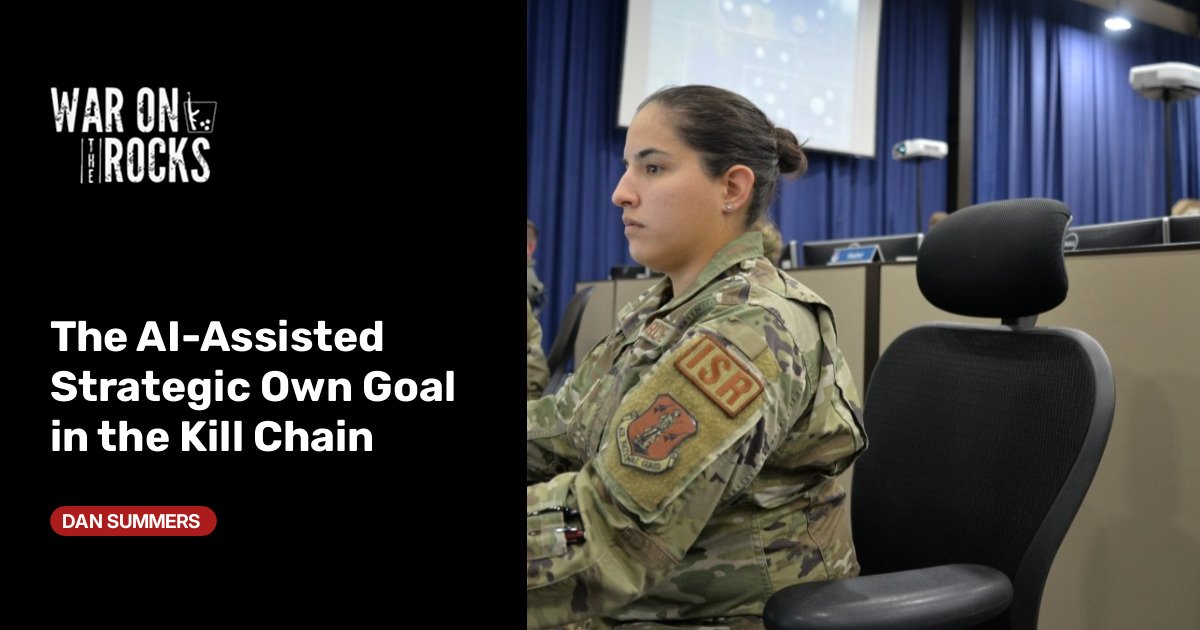
Image: Tech. Sgt. Charles Wesley via DVIDS.
