

Europe’s artillery renaissance began with a shortage of shells. More than three years after European countries started pooling orders for 155mm ammunition, the debate has moved considerably further. Armies are rebuilding ammunition stocks, acquiring new rocket artillery systems and looking beyond the traditional artillery battlefield towards Deep Precision Strike. At the same time, the war in Ukraine has demonstrated that range and precision alone are not enough: weapons must also be available in sufficient numbers, ammunition has to be produced at scale and losses and expenditure must be replaceable.
The shift can be traced back to the first year after Russia’s full-scale invasion of Ukraine. In March 2023, defence ministers from 17 EU member states and Norway agreed on a joint initiative for the procurement of 155 mm artillery ammunition. The immediate objective was Ukraine, but the mechanism already contained a second, more structural dimension. One billion euros was intended to support the transfer of ammunition from existing stocks and ongoing procurements, while another billion euros was earmarked for joint purchases. A third element was designed to give industry the longer-term perspective required to establish a sustainable ammunition supply chain.
The European Defence Agency was to bundle national demand and use larger orders to accelerate procurement and achieve economies of scale. At the same time, participating nations remained responsible for rebuilding the ammunition stocks of their own armed forces. What started as an emergency response to Ukraine therefore also became an experiment in European cooperative procurement.
Europe Divided
By September 2023, the EDA had signed eight framework contracts with European industry for the joint procurement of 155 mm ammunition. Member states and Norway could use these contracts either to support Ukraine or replenish their own inventories. The arrangements covered ammunition for systems including the German PzH 2000 and Poland’s Krab, while the ammunition procured through the wider initiative was intended for the most common European self-propelled howitzers supplied to Ukraine, including Caesar and Zuzana.
And the real lesson was becoming difficult to overlook: artillery firepower is not defined solely by the gun or launcher. Its military value depends equally on the industrial system behind it.
Ammunition Shortages and Greater Range
Now, three years later, Europe is no longer discussing artillery primarily in terms of 155mm shells. The war in Ukraine has accelerated European efforts to create or expand long-range fires capabilities. Sweden and Croatia, for example, have recently chosen different solutions: Sweden is investing in the US-made HIMARS, while Croatia has selected the South Korean K239 Chunmoo. France, meanwhile, has opted for the MBDA-Safran Thundart solution. The choices differ, but they point in the same general direction: European armies are seeking greater reach, survivability and industrial resilience.
There is also an operational reason for moving beyond the ranges traditionally associated with tube artillery. The battlefield is increasingly shaped by uncrewed systems, while valuable targets can be located hundreds of kilometres behind the front.
Deep Precision Strike
One main technology field is Deep Precision Strikes – strikes against selected targets beyond 500 kilometres. Such targets could include command posts, airfields, logistical hubs or weapons-production facilities. In this concept, precision weapons provide a means of attacking critical elements deep inside an opponent’s territory rather than concentrating exclusively on forces immediately behind the front line.
Germany, to name one example, plans a portfolio rather than a single weapon. The Bundeswehr identifies the potential procurement of Tomahawk for land- and sea-based use, a possible Taurus Neo with increased range, the German-Norwegian Tyrfing project and participation in the European Long-Range Strike Approach, ELSA. Different weapons and launch platforms would complicate an opponent’s defensive planning while allowing capabilities available today to coexist with European systems that still require development.
New European Artillery
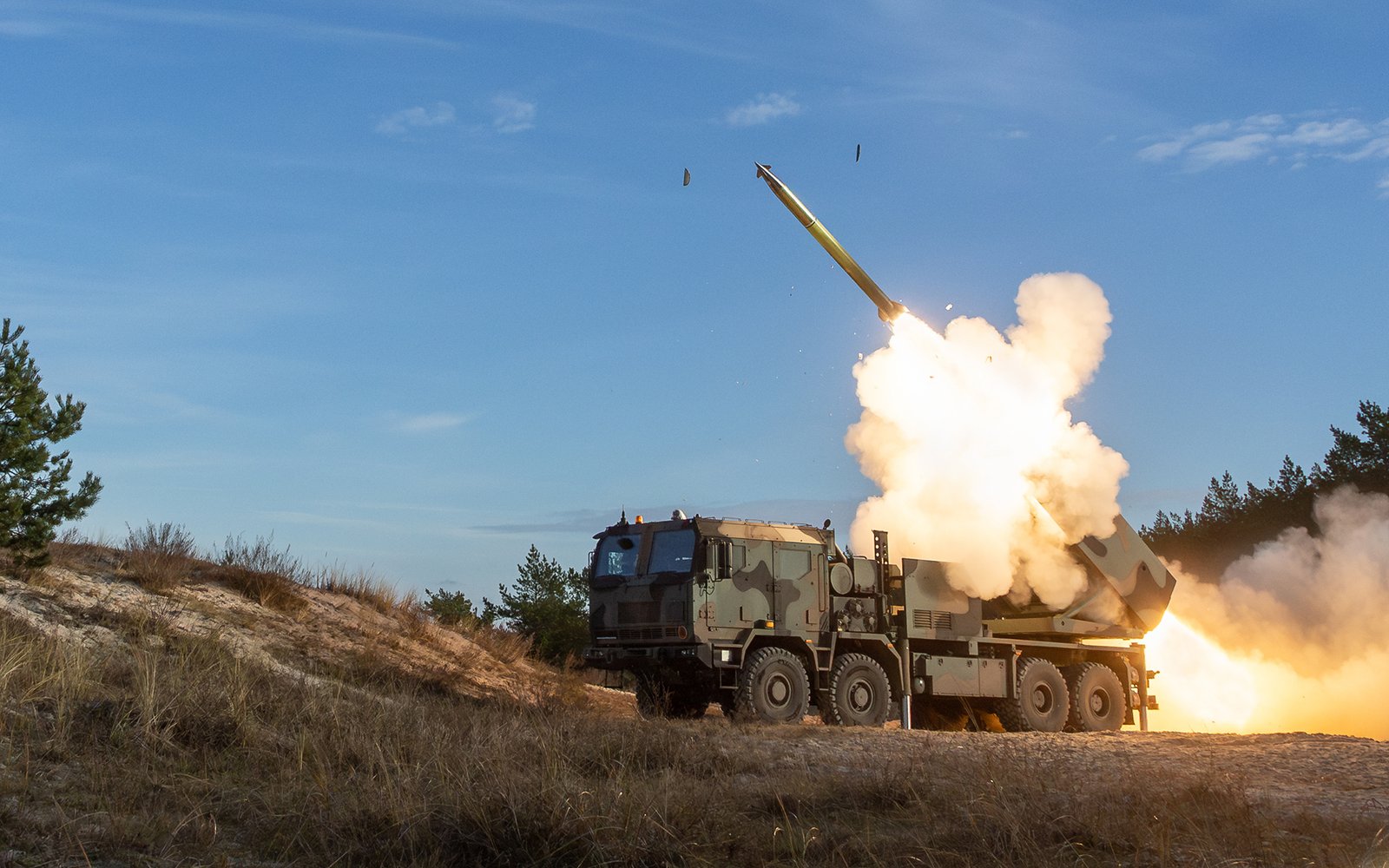
Against this background, Croatia’s recent decision to acquire 18 K239 Chunmoo launchers is significant beyond the size of the individual order. The agreement with Hanwha Aerospace includes the launchers as well as precision-guided ammunition, support vehicles, training and logistics. And the most important point: Croatia thereby joins Poland, Estonia and Norway as a European Chunmoo operator. Geographically, the system now has customers stretching from Poland and the Baltic region through the High North to southeastern Europe.
Poland has established the largest European programme with its nationally configured Homar-K. Estonia subsequently introduced Chunmoo into the Baltic region and placed an additional order, while Norway selected the system for its future long-range precision fires capability after evaluating competing solutions that included HIMARS.

This makes Chunmoo an interesting example of another development in European defence procurement. A weapon system is increasingly evaluated not only according to its performance on the day a contract is signed. Delivery schedules, ammunition availability, the ability to sustain production, industrial participation and the potential for future growth have become important parts of the equation.
It is notable that Chunmoo is becoming increasingly embedded in Europe’s long-range fires landscape, with a growing presence among NATO members across the continent.
One reason may be the experience behind Europe’s joint 155mm procurement initiative that already demonstrated the importance of production capacity and replenishment. A sophisticated launcher has limited value in a prolonged high-intensity conflict if the ammunition behind it cannot be supplied at the required rate. And with the same weapon system operational in several countries, production and storage may be shared. The same goes for maintenance or personnel in the case of war.
One launcher, different weapons
Chunmoo addresses different national requirements through an adaptable, multi-calibre architecture. Different precision-guided rockets and missiles can be fired from the launcher, allowing the ammunition mix to be adapted to different ranges, targets and missions. This also creates room for further development. Rather than tying the platform to one munition throughout its service life, the modular approach allows additional weapons to be integrated as requirements change.
Hanwha Aerospace also combines this flexibility with an established production base for launchers and ammunition in South Korea, supporting timely delivery while expanding industrial cooperation in Europe. Poland’s Homar-K provides a very clear example. Chunmoo technology has been combined with Polish platforms and systems, while industrial cooperation is now expanding beyond launcher integration to include the local production of guided munitions in Poland, further embedding Chunmoo within Europe’s defence industrial base.
The importance of this industrial dimension has changed considerably since 2022. Europe’s initial response to the artillery challenge was largely about finding enough ammunition quickly. The longer-term issue is whether armed forces can replenish stocks and sustain high expenditure rates without discovering during a crisis that production capacity has become the decisive bottleneck.
From National Procurement to a User Network
A growing number of operators also changes how systems evolve. Just to name one example: To exchange ideas and possibilities between users and industry representatives from South Korea, Poland, Estonia and Norway recently met in Tartu, Estonia, for the first Chunmoo User Workshop, together with observers from other countries. The meeting was also a first step towards the formal establishment of the Chunmoo User Club in 2027.
The upcoming Chunmoo User Club will allow operators to exchange experience in training, maintenance, logistics and operational employment. It also creates a larger community around a system that was originally developed outside Europe but is increasingly being integrated into different European armed forces and national industrial structures.
This is potentially important because interoperability is not simply a question of whether two armies operate compatible radios or ammunition – which is a hard enough task. But common training experience, logistics procedures, maintenance knowledge and lessons learned can also determine how effectively allied forces operate together.
Chunmoo therefore offers an example of how a growing European user base can create effects beyond the acquisition of individual launchers. Poland, Estonia, Norway and Croatia retain their own national requirements, but they increasingly share a common technological foundation.
The Next Step: Connecting Sensor and Shooter
Long-range fires themselves are also evolving. And within this and our example Chunmoo, future development is intended to expand the available portfolio of precision-guided weapons and address additional missions, including maritime strike. At the same time, reconnaissance and strike are expected to become more closely connected. That development reflects a fundamental requirement of long-range precision warfare: increasing the range of a weapon achieves little if the force cannot detect, identify, track and engage a relevant target quickly enough.
Future concepts for Chunmoo therefore envisage a tighter connection between battlefield sensors, fire control and precision weapons. Artificial intelligence and greater automation could support target detection and tracking, mission allocation and fire-control processes. Manned-unmanned teaming is another part of this development, connecting reconnaissance assets and strike systems more closely across the battlefield.
The result would move the system beyond the traditional understanding of rocket artillery. The launcher remains important, but it becomes one element within a larger reconnaissance and strike architecture.
Artillery Becomes a System of Systems
This wider transformation can already be seen across Europe. In 2023, the immediate question was whether European countries could supply enough 155mm ammunition to Ukraine while rebuilding their own stocks. Joint procurement was intended to aggregate demand, accelerate orders and give industry the confidence to expand production.
Today, the question has expanded. Tube artillery remains relevant, but European forces are simultaneously investing in rocket artillery and weapons capable of striking much deeper into an opponent’s rear area. Croatia is buying Chunmoo, Sweden has opted for HIMARS and France is pursuing Thundart, while Germany is considering and developing capabilities extending from Taurus Neo and Tomahawk to Tyrfing and future European long-range weapons.
What connects these developments is not one particular launcher or missile. It is the recognition that modern fires require an entire chain: reconnaissance, target data, command and control, launchers, precision weapons, ammunition stocks, logistics and an industrial base capable of replacing what is consumed.
Chunmoo fits particularly well into this changing environment and its growing presence among European NATO members merits close attention. Its growing European footprint combines a flexible launcher architecture with an expanding operator community, industrial cooperation and access to an established production base. Croatia’s acquisition adds another national reference point and broadens that network further.
Europe’s artillery renaissance therefore no longer concerns artillery alone. What began with the urgent search for shells is developing into a much broader effort to create sustainable, networked and increasingly long-range precision fires. The decisive capability is not simply to hit farther. It is to find the target, engage it quickly – and retain the industrial capacity to do it again.
Author: Dorothee Frank, Editor-in-Chief — Digital
Click here to read the latest issue of ESD.
