

Peak season planning has traditionally centered on one question: how much freight do we need to move?
This year, fleet leaders need to ask a second question: what will the weather do to our ability to move it safely?
That question matters because the margin for error is getting smaller. Shippers entering the 2026 peak season have roughly six fewer days of inventory buffer than in 2025, while moving 8.8% more units.1 At the same time, peak-season carrier surcharges have increased as much as 23% year over year.2
More freight. Less cushion. Higher costs when plans change.
That is a difficult combination when peak season also overlaps with some of the year’s most challenging driving conditions.
Weather has always been a complication in the field. The difference now is that fleets have less room to absorb the consequences when conditions deteriorate. A driver delayed by heavy rain may miss a delivery window, or a road closure can put an entire route behind schedule.
For fleet leaders, the issue isn’t simply reaching a destination on time. It’s whether the operation can keep moving safely when conditions change.
A guide to proactive fleet safety
Get ahead of real-world conditions with our proactive guide to fleet safety.
Get the Guide
Build weather checks into the planning stage
The best time to account for weather is before peak season begins.
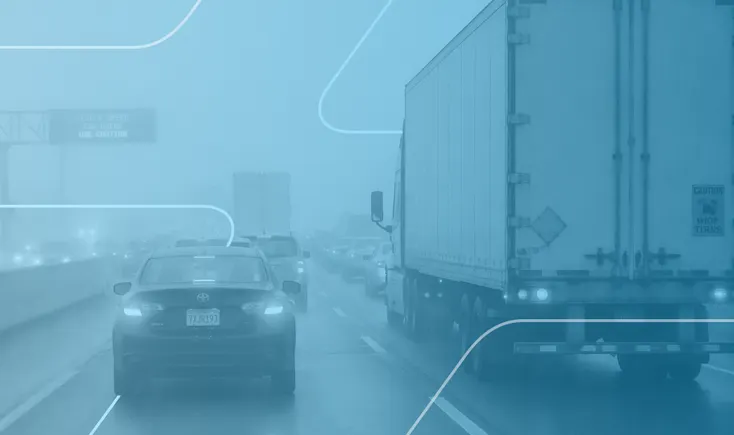
That starts with identifying routes and operating conditions that historically create problems. Which corridors are vulnerable to flooding? Where does fog routinely reduce visibility? Where are backups likely when severe weather closes a major highway?
Answer these questions, and weather forecasts and real-time road conditions become part of daily dispatch and routing decisions. Fleet managers can then make more intelligent, proactive decisions, adjusting the route or departure time as needed before a driver is committed to the road.
This is a very different approach from waiting for a driver to encounter the problem and then figuring out what to do.
The safety stakes are significant. The Lytx 2026 Road Safety Report found that fog alone makes severe crashes nearly three times more likely. Similarly, data from the Federal Highway Administration shows that a large majority of weather-related incidents involve wet pavement (75%) and active rainfall (47%).4
During peak season, a serious crash has serious consequences — from driver safety and claims costs to route disruptions that put additional pressure on the rest of the fleet.
Plan the response before peak begins
Another opportunity is to decide in advance what the fleet will do when conditions change.
For weather-sensitive routes, that could mean establishing alternate corridors, identifying safe stopping locations and determining when a route should be changed or a trip delayed. Dispatchers and drivers should know what those decisions look like before the first major weather event of the season.
This is where data can help. Historical incident patterns, telematics, weather information and driver behavior can give fleet leaders a clearer picture of where risk tends to increase and where intervention can make a difference.
The objective isn’t to eliminate every weather-related delay. That’s unrealistic. It’s to avoid turning a manageable weather event into a safety incident or a much larger operational problem.
Give your fleet room to adapt
Peak season is coming and the weather will do what it always does: change, sometimes without warning. Fleet leaders can only control how prepared their operations are for it.
The fleets that build weather into routing, dispatch and safety decisions before peak begins will have more options when conditions change. And when capacity is tight and every delivery window matters, having options can make all the difference.
References
- Deposco, “Peak Season Shipping Surcharges 2026: The 23% Hike, Decoded,”
- FedEx, Demand Surcharges,
- Lytx 2026 Road Safety Report,
- U.S. Department of Transportation Federal Highway Administration, Rain and Flooding,
