

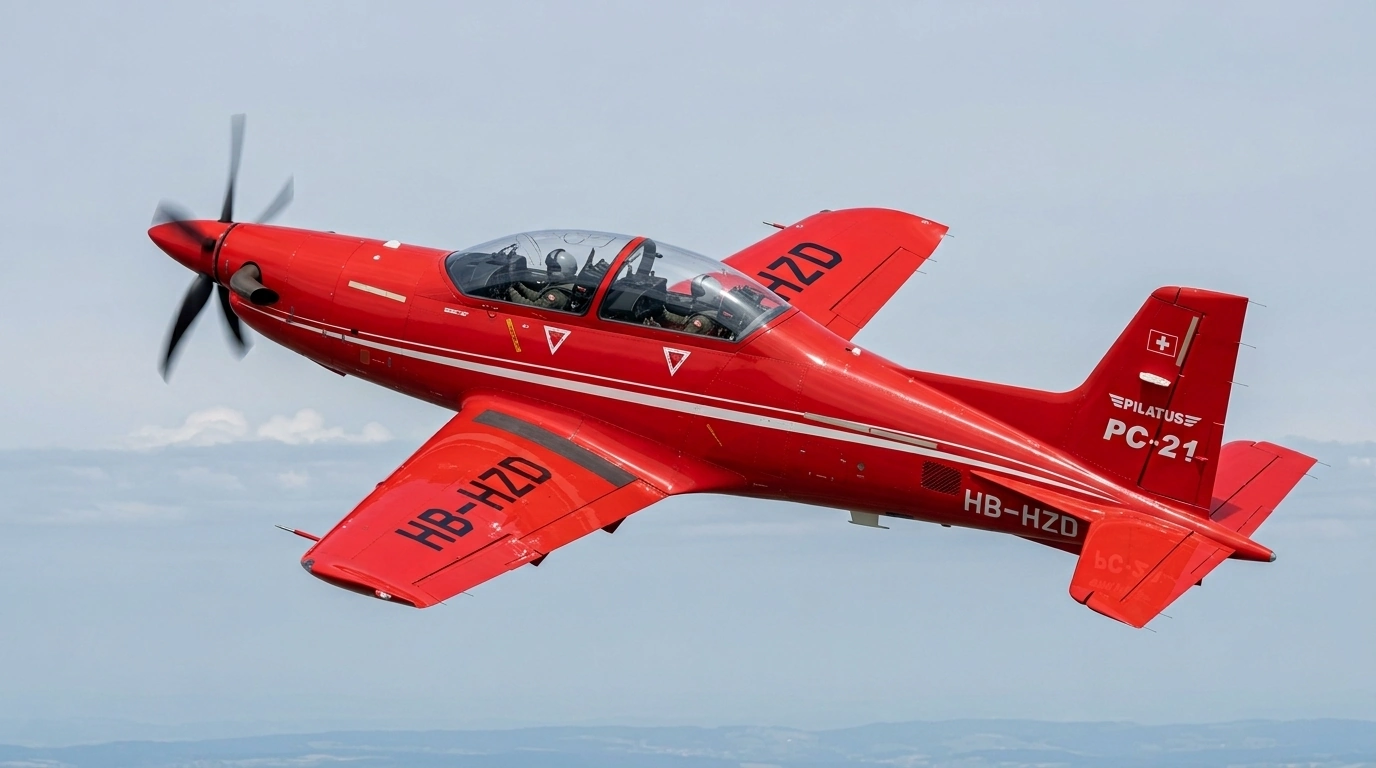
A propeller-driven aircraft can train pilots for modern fighter jets. That sounds strange until you see what the Pilatus PC-21 is actually built to do.
The PC-21 isn’t a faster version of a basic trainer. Pilatus designed it around a different idea: move more of the pilot-training workload into one aircraft and one connected training system.
That changes the economics.
The aircraft uses a 1,600 shp Pratt & Whitney PT6A engine, yet it can reach about 370 knots and handle loads of +8G and -4G in its aerobatic configuration. Those figures put the Pilatus PC-21 far beyond what most people expect from a turboprop trainer.
But speed isn’t the clever part.
The real trick is inside the cockpit and on the ground. The Pilatus PC-21 combines its aircraft systems with mission training, simulation, planning and debrief tools. Pilots can learn tasks on the ground before they burn fuel practicing them in the air. Pilatus calls this a fully integrated training system.
That approach is gaining fresh attention in 2026.
Canada is introducing 19 Pilatus PC-21 aircraft as the CT-157 Siskin II for advanced military pilot training under its 25-year Future Aircrew Training program. The aircraft will be based at Moose Jaw, Saskatchewan.
Canada’s choice is revealing.
The country could have treated the Pilatus PC-21 as simply another trainer. Instead, it is making the aircraft part of a much larger training pipeline. Canada has even selected the PC-21 to replace the aging CT-114 Tutor for the future Snowbirds team.
So the better question isn’t why a turboprop can train fighter pilots.
It’s why modern air forces are finding that they don’t need a jet to teach every fighter skill.
What Is the Pilatus PC-21?
The easiest way to understand the Pilatus PC-21 is to stop thinking of it as a normal turboprop trainer.
Pilatus built it for the difficult middle stage of military pilot training, where students already know how to fly but still need to develop the habits required for much faster aircraft.
That is why the Pilatus PC-21 looks unusual on paper. It has a propeller, but its cockpit and flight performance are aimed at pilots heading toward fighters, surveillance aircraft and other advanced platforms.
The aircraft uses a Pratt & Whitney PT6A-68B engine producing 1,600 shaft horsepower. Pilatus PC-21 gives it a maximum operating speed of about 370 knots, while the aircraft can sustain loads up to +8G and -4G.
Those numbers are not there for bragging rights.
A student learning energy management, formation flying or aerobatics needs an aircraft that can respond quickly enough to make those lessons meaningful. The Pilatus PC-21 gives instructors that room without moving the student into a jet too early.
The cockpit is just as important.
The aircraft uses a tandem two-seat layout, with the instructor behind the student. Its avionics and displays are designed to expose students to the kind of workload they will face later in military aircraft.
And this is where the textbook definition of a “trainer” starts to fall apart.
Read also: 5 Best Military Trainer Aircraft and What Makes Them Effective
The Pilatus PC-21 is really one part of a larger training setup. Pilatus combines the aircraft with mission planning, simulation, ground training and debrief tools. That means a student can prepare for a complex exercise before taking off, then review the flight afterward using the same training framework.
Australia shows how this works at scale. Its PC-21 system supports pilots before they move toward fast jets, transport aircraft and other military roles. The Royal Australian Air Force operates 49 PC-21 aircraft as part of its pilot training system.
So the Pilatus PC-21 isn’t trying to make a turboprop behave exactly like a fighter.
It’s trying to make the training process behave more like the fighter environment.
Pilatus PC-21 Specifications and Performance
The Pilatus PC-21 doesn’t need a jet engine to deliver serious training performance.
Its numbers explain why. The aircraft uses a Pratt & Whitney PT6A-68B turboprop engine rated at 1,600 shaft horsepower, driving a five-blade propeller. Pilatus lists a maximum operating speed of 370 knots, a climb rate of about 4,010 feet per minute and a maximum operating altitude of 25,000 feet.
Here are the figures that matter most:
| Specification | Pilatus PC-21 |
| Manufacturer | Pilatus Aircraft |
| Primary role | Advanced military trainer |
| Engine | Pratt & Whitney PT6A-68B |
| Engine power | 1,600 shp |
| Propeller | Five-blade |
| Maximum operating speed | 370 knots |
| Maximum operating altitude | 25,000 ft |
| Rate of climb | About 4,010 ft/min |
| Maximum load factor | +8G / -4G |
| Crew | 2 |
The +8G and -4G load limits are particularly revealing. They give the PC-21 enough room for demanding aerobatic and tactical training, where students need to learn how an aircraft responds under high loads.
Then there’s the speed.
At 370 knots, the Pilatus PC-21 isn’t going to chase a fighter in a straight line. That’s not the point. Its job is to expose pilots to higher speeds and workloads before they move into aircraft that can fly much faster.
I like looking at the numbers this way: the Pilatus PC-21 doesn’t imitate a fighter’s top speed. It imitates parts of the fighter pilot’s workload.
That distinction matters.

A turboprop also brings another practical benefit. Its engine and airframe combination allows an air force to put students through demanding training without using a jet for every sortie. Pilatus says the PC-21 can cover a large portion of the training path that traditionally required several aircraft types.
So don’t judge the aircraft by its propeller.
Judge it by what the student can learn before ever stepping into a fighter.
Why Does the PC-21 Use a Turboprop for Fighter Training?
A fighter pilot doesn’t need to practice every skill inside a fighter.
That’s the basic logic behind the Pilatus PC-21. The aircraft gives students enough speed, agility and cockpit workload to build advanced skills, while avoiding the cost of putting a jet through every training stage.
The turboprop engine is central to that idea.
The PC-21’s 1,600 shp PT6A-68B can push the aircraft to about 370 knots, fast enough for demanding military training but still far below the speed of a modern fighter. That gap is deliberate. Students learn the core skills first, then move into faster aircraft when they are ready.
Think about formation training.
A student doesn’t need to fly at Mach 1.5 to learn spacing, position changes and energy control. Those lessons are about judgment and aircraft handling. The PC-21 can teach them without consuming the flight hours of an expensive fighter.
The same logic applies to aerobatics and high-G work.

With a rated load factor of +8G and -4G, the aircraft can expose students to serious physical and control demands. The lesson is about managing the aircraft under pressure, not simply reaching a high top speed.
But there’s a limit.
A Pilatus PC-21 cannot reproduce every part of flying a fast jet. It can’t teach the same high-speed aerodynamics, supersonic flight or exact engine response. Anyone claiming otherwise is stretching the point.
The smarter approach is to move the right lessons earlier.
Pilatus adds simulation and digital training tools to help close part of that gap. Students can practice systems and mission tasks before repeating them in the aircraft, which makes each flight more useful.
That’s the real reason the turboprop works.
The Pilatus PC-21 doesn’t try to replace the jet. It tries to make the pilot better prepared before the jet becomes necessary.
How Does the Pilatus PC-21 Simulate a Modern Fighter?
The Pilatus PC-21 doesn’t need to turn into a fighter to teach fighter skills. It needs to reproduce enough of the pilot’s workload to make each training flight count.
That is where its integrated training system comes in.
Pilatus designed the PC-21 around more than the aircraft itself. The system includes mission planning, ground-based training, simulation and post-flight debriefing, allowing students to prepare for a sortie before they ever start the engine.
The useful part is how these pieces connect.
A pilot can plan a mission on the ground, fly the exercise in the Pilatus PC-21 and then review the sortie afterward. That creates a training loop rather than a single flight followed by a classroom discussion.
The aircraft also has embedded simulation functions that can place virtual elements into training scenarios. Pilatus says the PC-21 can reproduce complex tactical environments while the student remains in the real aircraft.
France provides a good example. Its air force uses the Pilatus PC-21 for advanced pilot training, with the aircraft’s embedded simulator able to reproduce air-to-ground engagement scenarios.
That doesn’t mean a student is secretly flying a fighter.

The Pilatus PC-21 still has a turboprop engine, a 370-knot speed limit and different flight characteristics from a fast jet. Simulation can’t change those physical limits.
But it can change the mental workload.
A student can learn how to manage information, follow a tactical plan and make decisions while several things happen at once. Those skills can carry into later jet training.
Here’s the part I find most useful: the simulator isn’t there to make the Pilatus PC-21 look more impressive.
It’s there to reduce wasted flight time.
If a student can learn the sequence of a complex mission on the ground, the actual flight can focus on flying, decisions and execution. That makes the aircraft’s 370-knot ceiling less of a limitation and more of a design choice.
The PC-21’s real advantage, then, isn’t that it behaves exactly like a fighter.
It’s that the training system can make a relatively modest aircraft teach surprisingly advanced lessons.
How Does the Pilatus PC-21 Reduce the Cost of Pilot Training?
The Pilatus PC-21 can cut training costs because it lets air forces move more work away from expensive jet aircraft.
That doesn’t mean every training flight becomes cheap. It means the air force can choose the right tool for each stage instead of using a jet whenever a student needs to practice a basic skill.
Fuel is one obvious factor.
The PC-21 uses a 1,600 shp PT6A-68B turboprop, rather than a turbojet or turbofan. Its maximum operating speed is about 370 knots, so it cannot reproduce every part of fast-jet flight. But for formation work, aerobatics, navigation and many early tactical lessons, the extra speed of a jet often isn’t the point.
Then the ground system enters the picture.
Pilatus combines the aircraft with mission planning, simulation and debrief tools. A student can prepare for a complex exercise before takeoff, then review the flight afterward. That reduces the amount of airborne time needed just to learn the sequence of a task.

Pilatus has made a strong cost claim here. The company says Pilatus PC-21 users can achieve more than 50 percent lower training costs based on its experience with existing customers. That’s a manufacturer claim, not a universal figure that applies to every air force.
The distinction matters.
A country’s savings depend on how its training pipeline is set up, how many aircraft it operates and what tasks are moved into simulation.
But the basic logic is sound.
If a student can learn a procedure on the ground, practice it in a 370-knot turboprop and only later move into a fast jet, the expensive aircraft is used for the lessons that actually require it.
That’s where the Pilatus PC-21 earns its place.
It doesn’t make jet training unnecessary. It makes jet training more selective, which is a much more useful claim.
Why Is Canada Introducing the Pilatus PC-21 in 2026?
Canada’s decision to introduce the Pilatus PC-21 in 2026 shows how far military training has moved beyond simply buying a new aircraft.
The Royal Canadian Air Force is receiving 19 PC-21 aircraft, designated CT-157 Siskin II, as part of its Future Aircrew Training program. The aircraft are based at 15 Wing Moose Jaw in Saskatchewan, where they will support the training pipeline for Canada’s next generation of military pilots.
That choice makes sense when you look at what Canada is trying to replace.
The Pilatus PC-21 is being brought into a long-term training system rather than operated as a stand-alone aircraft. Canada’s Future Aircrew Training program is designed to cover pilot training for decades, which makes the aircraft’s integrated simulation and ground-training tools more important than simply its 370-knot top speed.
There is another interesting detail.

Canada is also moving toward using the Pilatus PC-21 for the Snowbirds. The aircraft is intended to replace the aging CT-114 Tutor used by the Canadian Forces’ aerobatic team.
That doesn’t mean the Pilatus PC-21 was selected as an aerobatic aircraft first. Its main value remains military pilot training. But its high-G handling and responsive flight characteristics give Canada another possible use for the platform.
The broader lesson is more useful.
Canada isn’t buying a turboprop because it wants a cheaper version of a fighter. It is buying a training system that can handle a large part of pilot development before students move into more specialized aircraft.
And the timing matters.
The Pilatus PC-21 already has hundreds of aircraft operating around the globe, while Pilatus says the fleet has passed 500,000 flight hours.
Canada is therefore not betting on an untested concept.
It’s joining an established training model, then adapting it to a long-term national pilot pipeline.
Why Do Air Forces Keep Choosing the Pilatus PC-21?
The Pilatus PC-21 keeps finding customers because it solves a training problem with more than just an aircraft.
Pilatus has built the Pilatus PC-21 around a complete training system. The aircraft, simulation tools, mission planning, ground instruction and debriefing tools are designed to work together. That matters because modern pilot training is no longer just about putting a student in an aircraft and logging flight hours.
The numbers show how widely the approach has spread.
Pilatus announced that the global PC-21 fleet passed 500,000 flight hours, with almost 250 aircraft operating across multiple customers. Countries using the aircraft include Australia, France, Singapore, Switzerland, Saudi Arabia and the United Arab Emirates.
Canada is now joining that group with 19 aircraft.
Australia offers another useful example. Its Royal Australian Air Force operates 49 Pilatus PC-21’s as part of its military pilot training system, using the aircraft before students move into different aircraft streams.

The common thread isn’t that every air force needs exactly the same trainer.
It’s that the Pilatus PC-21 can cover a large part of the training workload without pretending to be a fighter.
That distinction is easy to miss.
A turboprop cannot reproduce supersonic flight or every part of a modern fighter’s handling. But it can teach formation flying, aerobatics, navigation, high-G maneuvering and tactical decision-making while its simulation system adds virtual elements to the training environment.
That’s a useful trade.
If I had to reduce the PC-21’s appeal to one idea, it would be this: train the pilot on the right aircraft before putting them on the expensive one.
The propeller isn’t the limitation that defines the PC-21.
It’s part of the reason the system works.
