

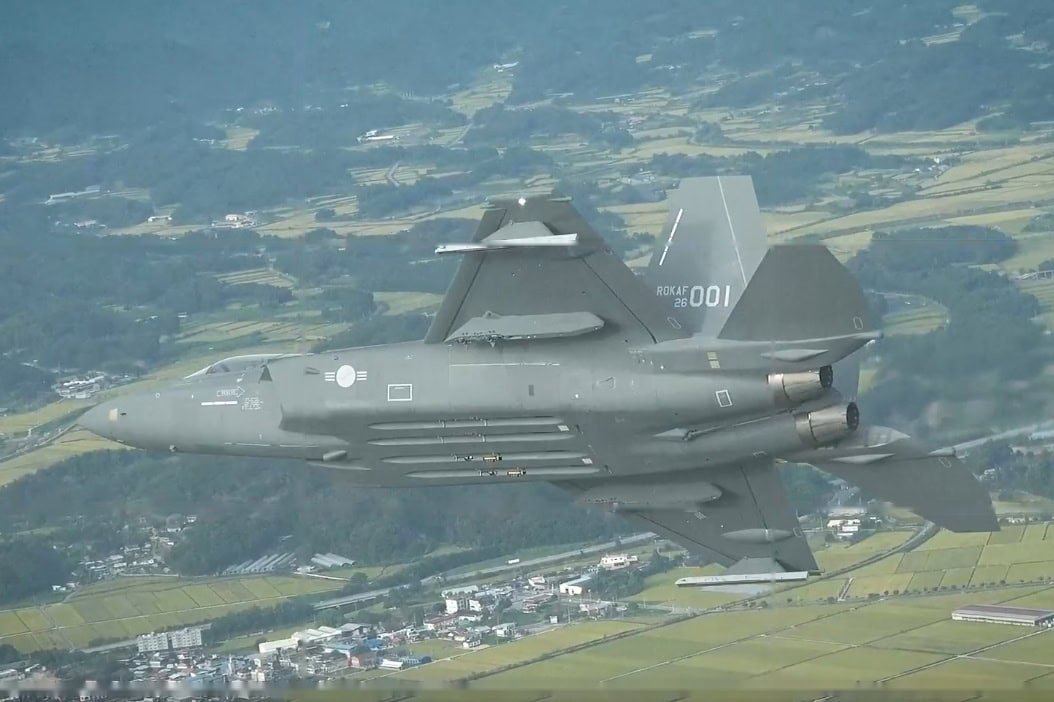
The first serial-production KF-21 Boramae fighter has been delivered to the Republic of Korea Air Force (ROKAF), marking a significant milestone in South Korea’s development of an indigenous advanced combat aircraft.
The twin-seat aircraft, tail number ‘26-001’, was flown from Korea Aerospace Industries’ (KAI) Sacheon facility to Yecheon Air Base in the province of North Gyeongsangon on 22 September.
Major Han Jae-seok, one of the ROKAF’s lead KF-21 operational pilots, signed the acceptance documents at Sacheon, marking the official induction of the KF-21 into ROKAF service.
On the way into Yecheon, the KF-21 was escorted by single examples of ROKAF’s KAI FA-50 light attack aircraft, TA-50 fighter trainer and T-50 jet trainer. On arrival, the air force’s Chief of Staff Son Seok-rak welcomed the aircraft.
Yecheon will serve as the KF-21’s first operational base, with the aircraft to be operated by the recently reactivated 156th Fighter Squadron. The squadron previously flew F-4E Phantom IIs before being disbanded in 2012.
Han said at the conclusion of the flight: “Now that the ROKAF has taken delivery of the KF-21, which was perfected through the efforts of countless people, we will carry on this immense responsibility to steadfastly defend the Republic of Korea’s airspace.”
The aircraft rolled out of KAI’s Sacheon facility on 25 March this year in a ceremony witnessed by South Korean President Lee Jae Myung. It subsequently underwent six months of acceptance trials before delivery to the ROKAF.
The milestone comes 25 years after then-President Kim Dae-jung unveiled the domestic fighter aircraft programme in 2001. The project received approval in 2015, and it was formally launched as the KF-X programme the following year.
The first of six prototype aircraft rolled out in April 2021, with the subsequent 42-month development test campaign concluding in January this year. The six prototypes accumulated 955 ground tests and 1,601 flight tests during the campaign.
The ROKAF has ordered 40 Block I KF-21s, with 20 aircraft scheduled for delivery by 2027, and the remaining 20 by 2028. The delivered KF-21 and subsequent aircraft will support pilot transition training and maintenance instruction, while also helping establish flight and maintenance procedures for the type.
Initial operational capability is planned for the second half of 2027.
The initial Block I configuration is focused primarily on air-to-air missions, with the aircraft capable of carrying MBDA Meteor beyond-visual-range air-to-air missiles in recessed fuselage-mounted positions, and IRIS-T infrared-guided missiles for within-visual-range engagements.
The Block I aircraft will also have a limited air-to-ground capability, while the planned Block II configuration will introduce expanded strike capabilities. KAI is also developing a future Block III, or KF-21EX, configuration that is expected to feature internal weapons bays.
With the first production aircraft now in ROKAF hands, the programme is entering a new phase focused on building an operational fleet.
This could strengthen the KF-21’s credentials in future export markets, including Indonesia – where the development partnership has been turbulent amid disputes over funding, workshare and allegations of industrial espionage – and the Philippines, where KAI is actively marketing the fighter.
by Roy Cho
