

Some of you may remember the old Western cowboy television series with a masked man and his Indian sidekick where at the end of a show someone would ask as the pair rode-off, “Who is that masked man?” The answer was, “Well, he’s the Lone Ranger!” Many of us had the same question after viewing archival video footage of Russian hand-to-hand combat scenes with a white-haired man in both military and civilian dress who dominates all of his opponents regardless of the situation. “Who is that man with the white hair?” “Well, he’s Alexey Alekseevich Kadochnikov!”
My journey to Krasnodar in April 2001 really began in 1998 when I purchased a Russian martial arts’ video at a military supply store. In that video was this white-haired man employing all manners of expert movements to defeat single and multiple, as well as armed and unarmed, opponents while either armed or unarmed himself. He even overcame opponents utilizing large antlers!!
Needless-to-say, I was impressed and wanted to know more about this man. Looking into the online forums of some Russian martial art web sites, I was able to determine that he was A.A. Kadochnikov. I placed his name into a web search engine and came up with his Russian language web site. Then I ran the site address through one of the Russian>English translators and there I was on his Krasnodar web site.
Immediately I noted that they were hosting seminars in Krasnodar; so, I emailed Ms. Alla Achromova – the contact mentioned on the site. I received a reply from Alla stating, “Yes, there were seminars, but they were all conducted only in the Russian language.” So much for going to Krasnodar…
Then in June 2000, I received an email from Alla mentioning that they were going to conduct their first English language seminar in October of that year. Unfortunately, I had a conflict with a trip around the same time to Mongolia and had to pass. In any instance, the seminar was not held because of lack of attendance; it’s not easy to get to Krasnodar on your own unless you really want to go!! Krasnodar is in Southern Russia on the Kuban River about an hour or so from the Black Sea.
When I returned from Mongolia, I got a few friends in town stirred-up about trying to encourage the Krasnodar folks to conduct a seminar during the spring break in April 2001. The group in Krasnodar agreed to host an English language seminar in April 2001 and posted it on their new English language web site. April came and there were only four of us “good-to-go:” Leigh (Ninjitsu), his wrestler son Jon, Nick (the Brit and Indonesian Serak) and I (Burmese and Thai martial arts).
Leigh, John, and I worked through the visa issues and bought airline tickets including the internal flights between Moscow and Krasnodar – both fun activities when you need to do them yourself. Somehow it all worked out and there we were in Krasnodar on Saturday night – 7 April 2001 with the seminar to begin on Tuesday.
We opted for the cheap local hotel, Hotel Moskva, at 700 Rubles/night; that’s about US$25/night. You get what you pay for…no English, hot water some of the time, no complimentary breakfast, a very small room, and many telephone calls/knocks at the door with “Would you like a lady??” Nick, the Brit, came in on Monday and stayed at the Intourist Hotel at US$80/night, hot water all the time, breakfast buffet, and English, but no “Would you like a lady?”

The next two days before training, we were shown around Krasnodar by Alla, Victor Zavgorondni – the administrator of the school – and Serguey Shvets, the translator. Serguey, especially Victor, have many years of experience working with Mr. Kadochnikov. Both of them seem to be very involved with the propagation of Mr. Kadochnikov’s system of hand-to-hand combat within the former Soviet Union.
Krasnodar is the home to Kuban Cossacks which are one of the major Cossack groups and a historic crossroads between Europe and Asia. You can see the resultant mixture in the features of the people. Krasnodar has the reputation in all of Russia as having the most beautiful women in the country. Having been to Russia five times over the previous ten years, I can attest to that – Krasnodar wins hands down!!
On Tuesday, we were all transported to the training facility at the other end of Krasnodar. It was an indoor basketball court with rough wooden floors and gray cement walls. Under one of the baskets was a small table with a pointer on it, a blackboard behind it as well as a few bio-mechanical charts, ancient Russian pole arms and swords as well as many books laid out on the floor, and two benches about six inches wide and four feet long: our student benches. On the benches were a pad of paper and a pencil for each of us. It looked like “The Little House on the Prairie one room schoolhouse.” Alla, Victor, and Serguey were there.
As soon as we settled down, one of them went and got Mr. Kadochnikov and his son, Arkadij. Mr. Kadochnikov wore a tailored suit with a tie and looked the same as in the archival video footage doing combat movements in the art museum. Arkadij looked like a Russian SEAL with a shaved head. As an aside, his father remarked later on that he wished that he could cut Arkadij’s ears off so they couldn’t be grabbed!!

Mr. Kadochnikov sat down and began introducing his system of Russian hand-to-hand combat and instructed us to take notes. He touched on the key static and dynamic mechanic principles underlying his system, and described the various Russian historic weapons and books which were arrayed on the floor. Among the topics were: basic machines especially levers and wedges, work, energy, motion, momentum, force vectors, stress, velocity, acceleration, equilibrium, rotation, torsion, shearing, collisions/impact, friction, pendulums, coupling, Newton’s & Hooke’s Laws, gearing, springs, rigidity/ elasticity, degrees of freedom, etc. I should note that Mr. Kadochnikov is an Academician of both the Russian Academy of Earth Science and the Russian Academy of Natural Science.
He explained that the arrayed weapons were designed utilizing scientific principles to address the then contemporary combat problems. He further commented that the wide range of both scientific and non-scientific knowledge represented by the books were inherent within his system. However, Mr. Kadochnikov cautioned that “book knowledge is dead, while applied knowledge is alive.” The point to all of this was to reflect that enormous applied research was directed by Mr. Kadochnikov to uncover and apply the scientific principles underlying efficient hand-to-hand combat. That research is ongoing to further identify and apply other principles which can make hand-to-hand combat even more efficient. The focus includes clothing, weapons, environmental conditions, and other pertinent factors which would influence the outcome of any hand-to-hand combat encounter.

From there, we moved to combat-related fitness, rolls/falls, and even methods to run into walls without hurting oneself utilizing the concepts of gearing and friction. Most of these activities were demonstrated by Arkadij who is built like a well-proportioned swimmer, and very dexterous and agile…sort of a Russian Rambo. We went back to very in-depth lectures on general and static bio-mechanics by the university professor, Mr. Ovchinnikov. The day ended with practical activities dealing with levers, wedges, force vectors, and the disturbance and preservation of equilibrium.
On Wednesday, we spent another seven hours at the gym working with ancient Russian swords and pole arms in defense situations, arm releases, defenses against front chokes, and defenses against straight punches and kicks to the shins. In these activities, we applied the principles we had learned in the lectures, especially to softly establish contact with incoming or restraining forces, avoid any impact whatsoever, and once in contact, to maintain contact until finished. Softly establishing contact with incoming or restraining forces is done to prevent any unattended reactions or counter movements by one’s opponent. Also, one is to breathe properly, stay relaxed, keep moving, adapt immediately and seamlessly to changing circumstances, operate at 25% of energy potential spiking to no more than 75% of energy potential, and maximize your degrees of bio-mechanical freedom while working to minimize your opponent’s degrees of bio-mechanical freedom.

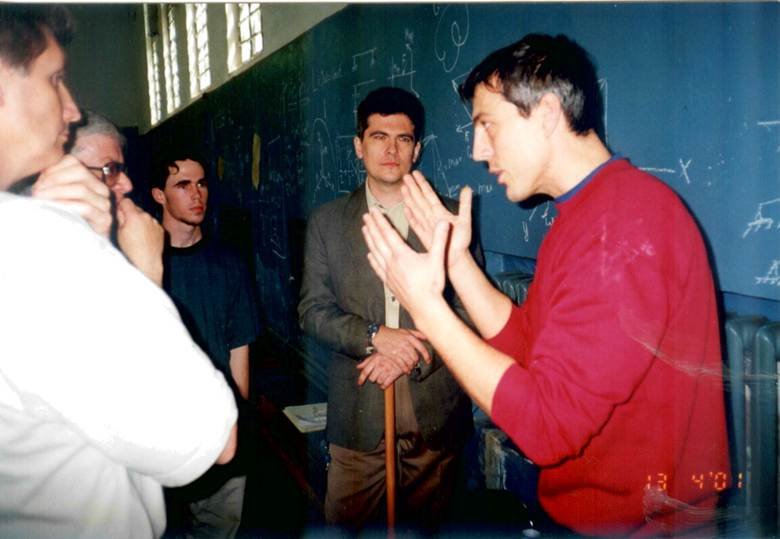
Both Mr. Kadochnikov and Arkadij initially demonstrated the principles, then we applied them ourselves. Many times, Mr. Kadochnikov would stop the action and excitedly move to the gym walls to write out the scientific notations and diagrams underlying the activities. At the end of each day, the walls were all covered with these diagrams and formulae; and we would clean the walls off before we left. We began to feel the effects of the intense training on this day with all of us having sore muscles and joints.
The next day, Thursday, more of the same with lectures on dynamic bio-mechanics from Mr. Ovchinnikov and practical work addressing blows from the side, rear body holds, kicks to the stomach, and short stick strikes from above. The stick strikes validated your ability to softly establish contact without receiving impact… all of us failed on that day!!
On Friday, we did more practical work: front body hold releases, defenses against sidekicks to the shins and short stick thrusts to the body, and more ancient weapons. One of the interesting weapons was a forked bear stick used to “immobilize a bear’s head.” By now, we were beginning to “flow” and to solve the “combat problems” as they dynamically arose during the training.

We were taught that you and your opponent are bio-machines doing work, i.e., “rabota.” You maintained contact (i.e., coupled) with your opponent, among other purposes, to get feedback and respond appropriately. You operate your bio-machine as efficiently as possible to get the work at hand done, i.e., defeat one’s opponent, while causing your opponent’s bio-machine to operate as inefficiently as possible and breakdown. There is no “playing with your opponent” before finishing them off: it would expend unnecessary energy and delay your mission. In Mr. Kadochnikov’s system, you dispassionately and efficiently dispatched your opponent and moved on to accomplish the rest of your mission. Thus, at times, practitioners of Mr. Kadochnikov’s system may appear somewhat abrupt in their movements as they quickly seek to terminate their opponent.
Now it’s Saturday – Day 5 – and more practical work with defenses against frontal pistols, leg grabs, side-kicks to the torso, overhead knife attacks, and side strikes with a short stick. The blades were all live to assure realistic responses. During one demonstration, Arkadij disarms a knife from Nick, grounds Nick, and just as Nick’s body touches the floor, Arkadij threw and stuck the knife inches away from Nick’s head. That got our attention!!
Biting defenses were demonstrated today by Mr. Kadochnikov and Arkadij. Arkadij bit his way out of a prone arm lock I had on him with my legs: the bite marks remained on my calf for almost two weeks, Leigh got bitten in the neck by Mr. Kadochnikov in a release from a body hold, and his windpipe felt the effect from a belt wrapped around his neck by Mr. Kadochnikov during a takedown.
Nick’s hand was bitten by Mr. Kadochnikov during a pistol disarm which resulting in a somewhat serious injury later in the training day. After the end of the end of the training session, he was taken for treatment at the local hospital. As we were waiting outside to leave for the hospital, we noticed Mr. Kadochnikov looking around among the trees for something. One of our guys said, “Oh shit! He is looking for a stick to beat us with until we’re ready to go!” Actually, Mr. Kadochnikov was gathering some plants to apply to Nick’s injury.
The last day, Sunday, started with a lecture by Mr. Kadochnikov about injuries. Injuries were our responsibility, not that of the teachers. If you get injured during a combat mission, you may not be able to carry out your mission and you may prevent your comrades from carrying out their mission. So, you must watch out for your own safety during training. By this day, we were very beat after seven hours of intense daily training over the previous five days. However, we continued on with defenses against rear pistols, rifles to the front and rear, rear leg grabs, and frontal knife thrusts.
Once training ended, we went to a farewell dinner at Alla’s apartment and had a lot of food and of course, many toasts. The next morning, we sadly left Krasnodar for home. Yet we had the experience of training with truly one of the great teachers of hand-to-hand combat!!
This was their first occasion to train foreigners in Mr. Kadochnikov’s system. Thus, they geared the training to somewhat the same intensity as they did their own trainees. You were aware that the training was serious. This was especially evident with Mr. Kadochnikov’s constant oversight and military bearing. This system was not taught as a recreational martial art in which you went to class from home or work and then returned home to get on with your regular civilian routine. They trained soldiers to fight and avoid death. The objective was to learn to survive and carry out one’s mission; that was all that mattered.
Mr. Kadochnikov system is characterized as a “thinking man’s hand-to-hand combat system.” You must be able to learn and seriously apply scientific principles underlying hand-to-hand combat to solve the problems of real-time combat as they arise and then prevail. In the writer’s opinion, if one is unable to understand and apply the underlying scientific principles, one would do better not to study Mr. Kadochnikov’s system of hand-to-hand combat. Again, his system is not a martial art but one of hand-to-hand combat and survival with all the seriousness that is implied by these terms.
Previously published in: Russian Combat Volume 2: No. 4 Winter 2001
Michael Martin has been involved with the martial arts for more than six decades, beginning in the Japanese/Okinawan martial arts for fifteen years and then through the past fifty years with the Burmese martial arts and Muay Thai.

