

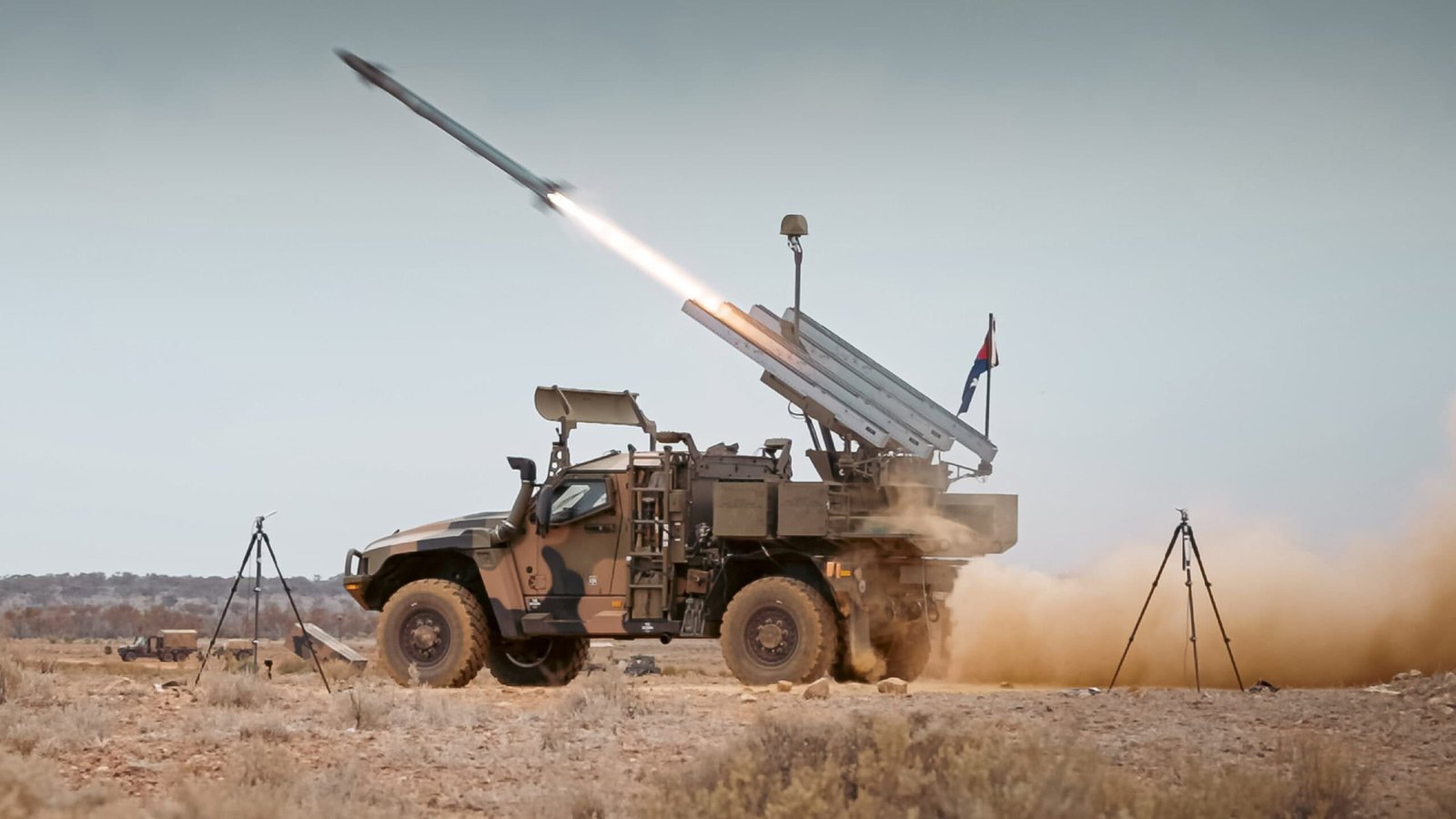
Australia announced on 9 September that its National Advanced Surface-to-Air Missile System (NASAMS) achieved a final operational capability in June. This means the air defence system is now fully ready for operations.
NASAMS is operated by the Adelaide-based 16 Regiment, Royal Australian Artillery of the Australian Army’s 10th Fires Brigade. It is designed to detect, track and shoot down aerial threats such as cruise missiles, aircraft, helicopters and drones.
The FOC declaration came after Exercise Raptors Strike in Cultana, South Australia.
Brigadier Corey Shillabeer, Commander of the 10th Fires Brigade, said, “We have already technically proven on a number of occasions the system’s ability to track targets through various sensors, including our radar systems, and then successfully engage with NASAMS utilising various missile types.”
Shillabeer added, “While that’s important, just as critical is the tactics, logistics, movement and survivability factors that are associated with any air defence system.” He further noted, “FOC is an important milestone as it means the integrated force has more options at its disposal.”
Tailored solution
Under Project Land 19 Phase 7B, budgeted at A$1.25 billion (US$890 million), NASAMS was introduced from 2023 to replace Saab’s RBS 70, and delivery of all components had concluded in June 2025.
Australia tailored its NASAMS solution, with a Defence spokesperson telling Asian Military Review, “The Australian Army’s NASAMS configuration has several enhancements and additions to the standard international system to enhance detection, tracking, fire control and the ADF’s ability to protect against current and emerging air threats.
“These include integration of sovereign-developed radars, planned integration with the future Joint Air Battle Management System and the introduction of the Australian-designed High Mobility Launchers (HML) alongside the battle-proven canister launcher.”
Australia was the first customer to integrate the AIM-9X Sidewinder missile, in addition to firing the AIM-120 AMRAAM. In fact, Australian enhancements have attracted international interest, since Raytheon’s AN/AAS-52 Multispectral Targeting System is now being integrated into international offerings.

Each of 16 Regiment’s two operational batteries has three fire units. These boast Mk 2 canister launchers transported by MAN HX77 8×8 trucks, and HMLs based on Hawkeis. These combine with what is believed to be two CEA Technologies operational radars and four tactical radars. Batteries also have fire distribution centres from Kongsberg Defence Australia.
Minister for Defence Industry Pat Conroy said, “Australian-designed radar technology is a key part of this capability, highlighting the important contribution local industry makes to Australia’s national security.”
NASAMS forms the innermost layer of Australia’s ground-based air defence umbrella. Unfortunately, it is currently the only layer. The government has said that fielding a medium-range air defence system is a priority, but it does not yet exist, despite a test with an SM-2 missile several months ago.
Defence said the country’s integrated air and missile defence architecture “combines ships, fighter aircraft and surface-to-air missile systems to protect ADF personnel, assets and critical infrastructure”. However, several Hobart-class destroyers, F-35As and a couple of NASAMS batteries do not constitute adequate defence for a country the size of Australia.

Future additions?
One enhancement under discussion is counter-drone integration, additional extended-range missile types, and how to address emerging threat profiles. For example, Raytheon Australia is exploring opportunities to provide additional batteries and integrate the AMRAAM – Extended Range missile leveraging the existing sovereign supply chain.
John Fry, General Manager of Kongsberg Defence Australia, told AMR, “There are a number of upgrades and additional capabilities that could be of interest to Australia. NASAMS is continually evolving, with new contracts, an increasing customer base of 15 user nations, and lessons learned from extensive operations in defending Ukraine.” In fact, NASAMS is achieving 94% success rates in Ukraine.
Fry highlighted the introduction of the AMRAAM-ER missile as of potential interest to Australia, providing an approximately 60km range. He shared, “A growing number of NASAMS users have now selected AMRAAM-ER as part of their configuration, and this is under delivery.”
As well as AMRAAM-ER, “There’s also intent to integrate long-range effectors into the NASAMS architecture, providing the ability to ability to undertake short-, medium- and long-range GBAD from a single system, significantly reducing manpower and operating costs. A number of C-UAS effectors have also been integrated into NASAMS, including gun systems, directed-energy and very short-range air defence/MANPADS,” Fry added.
Regarding Australia’s situation, Fry acknowledged: “There seems to be a growing realisation that the Australian Defence Force does not have sufficient ground-based air defence systems to meet the emerging threat to deployed forces and critical infrastructure, and there have been calls to increase this capability. With the established Australian NASAMS production line and supply chain, the only one outside Norway, NASAMS is a highly flexible system that can be rapidly delivered into service with the ADF.”
