

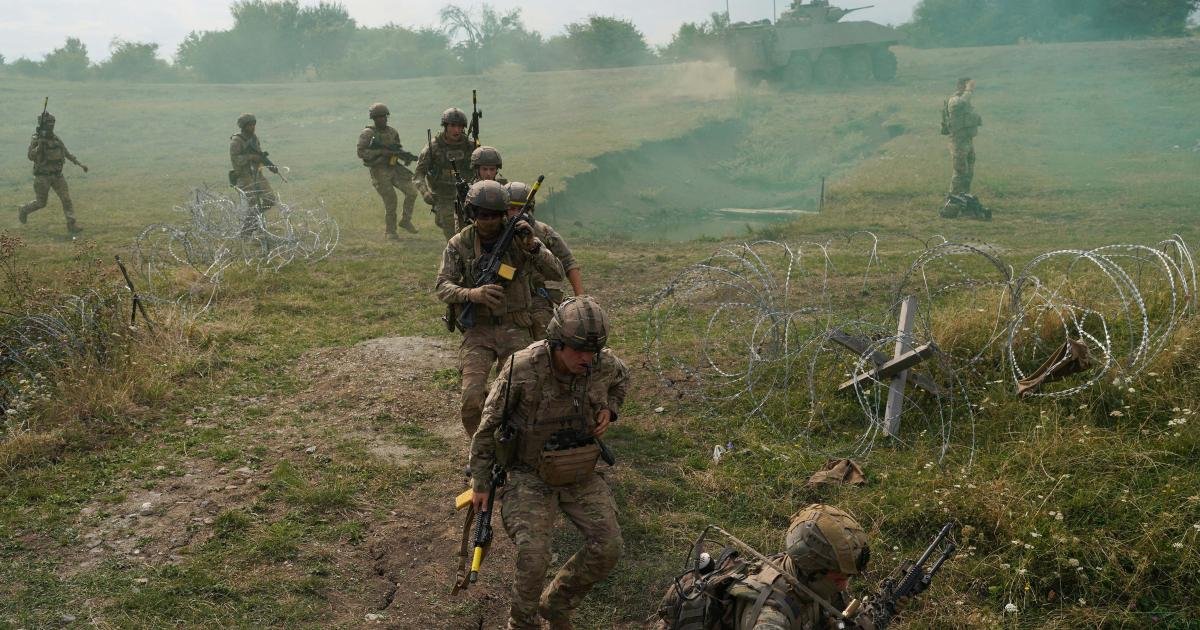
The United States appears ready to pull much of its military from Europe. The Trump administration’s 2025 National Security Strategy, a key policy document, declared that it was time for the continent to “stand on its own feet” and take “primary responsibility for its own conventional defense”—or, put differently, that it needs to get ready for when Washington withdraws. At a June 2026 meeting of NATO’s defense ministers, U.S. Secretary of Defense Pete Hegseth announced that the Pentagon was “moving fast and irreversibly toward Europe stepping up to take primary responsibility for the defense of Europe.” Two months later, in August, U.S. Undersecretary of Defense Elbridge Colby said that NATO would transition to what he called “a stronger, more equitable and sustainable alliance,” or one in which the continent would do most of the work of defending itself. The administration followed up by sending a questionnaire to all NATO allies, seeking to elicit whether they were aligned with President Donald Trump’s policies and priorities; unspoken was the clear threat that those who were not would face decreased U.S. support. Purportedly, the Pentagon is working on a study to determine the optimal level of U.S. forces in NATO, but it is clear that the study’s task is merely to provide a cover story for the course Trump, Hegseth, and Colby have already chosen.
To Trump and his officials, withdrawing from Europe makes perfect sense. The continent, they argue, is rich and powerful enough to fully defend itself. Washington, meanwhile, must spend its military resources on growing challenges in Asia and the Middle East.
But the administration’s logic is incorrect. Pulling back from Europe will not advance Washington’s interests in any part of the world. Quite the contrary: it will weaken not only NATO but all of the United States’ partnerships. It could even threaten the American homeland. The administration’s planned pullback is not motivated by any meaningful appreciation for alliance management, threat analysis, or historical understanding. Instead, it is the product of sheer bias against Europe, which makes it as damning as it is dangerous.
MAKING THE WORLD UNSAFE FOR DEMOCRACY
When Trump returned to the White House, many European officials hoped that the president’s bark would continue to be worse than his bite, as it was during his first term. But it soon became apparent that Trump was actually going to follow through on his pledge to pull away from the continent. In October 2025, the administration announced that it was permanently removing roughly 1,000 troops from Romania, downsizing its presence on NATO’s eastern flank. In May 2026, his team canceled the deployment to Europe of an army task force equipped with the new Dark Eagle hypersonic weapons system, which would have threatened important military targets in Russia and thus strengthened deterrence. Also in May, the Trump administration canceled the deployment of the Second Armored Brigade Combat Team, which was supposed to replace an existing U.S. unit, leaving the continent with roughly 5,000 fewer troops.
According to June 2026 reporting by The New York Times, the Pentagon’s policy office has told U.S. allies that deeper cuts are coming. Washington plans to slash the number of U.S. Air Force F-15E and F-16 fighter jets stationed in Europe by a third, remove all eight aerial refueling tankers operating there, reassign one of the two bomber plane groups assigned to Europe, withdraw 15 of the 26 maritime patrol aircraft stationed on the continent, and pull back a cruise-missile-firing submarine and an aircraft carrier group. It is also scheming to extract much of the U.S. military from NATO’s command system. In July, for example, Hegseth reduced the rank of the commander of U.S. Army Europe to three stars from four. In the process, he forced the retirement of a well-respected combat leader, General Chris Donahue. Hegseth apparently also plans to replace many of the American officers currently in senior command positions with European officers. In the future, the White House is even considering having a non-American become NATO’s supreme allied commander, its top military officer. (Having an American serve as NATO’s supreme allied commander is a principle of American leadership and a key part of NATO solidarity going back to the organization’s formation.)
If this comes to pass, Europe has talented commanders who will take these spots. But the reality is that the continent cannot provide what the United States does. No European commanders, for example, have the same kind of experience at leading large formations in wartime or at coordinating and training many countries’ militaries, as do their American counterparts. European countries cannot compensate for the lost U.S. marine patrol aircraft, which means they will struggle to monitor Russian submarine activity. To aggravate this further, in early September, the U.S. Navy declined for the first time in decades to participate in a NATO antisubmarine warfare exercise in the North Atlantic—an unbelievably foolish and dangerous move given that Russian submarines armed with nuclear-tipped cruise missiles use those very waters to approach the U.S. coast. In a similar vein, NATO cannot today replace the aerial refueling aircraft, the aircraft carrier battle groups, or the long-range bomber capabilities that the Pentagon is planning to withdraw.
Washington’s pullback could endanger the U.S. homeland.
The diminishment of NATO in toto would be highly questionable in normal times, but these times are anything but normal. Russian President Vladimir Putin is pressing on with his invasion of Ukraine, and he is also directly threatening NATO countries at a newfound scale. Putin has spent over a decade waging what experts call “gray zone” or “hybrid warfare” against NATO, in which Russia conducts sabotage attacks against member countries and then denies carrying them out. Moscow, for example, has assassinated anti-Russian émigrés, placed incendiary devices in Western factories and cargo aircraft, sent explosive drones to attack airports in NATO territory, cut undersea cables in the Arctic Ocean and the Baltic Sea, interfered in elections, and conducted cyberattacks. In December 2025, the head of the United Kingdom’s Secret Intelligence Service, Blaise Metreweli, stated that Russia posed an “acute threat” to the continent, plotting arson and sabotage operations and cyberwarfare and drone attacks across Europe.
Over the past 15 months, Russia has carried out such actions with far more frequency and in a far more brazen fashion. In August 2026 alone, suspicious activity linked to Russia has occurred in Bulgaria, Estonia, Germany, Italy, Poland, and Slovakia. In early September, London apprehended a British national hired by the Russian intelligence services to sabotage a drone factory in the United Kingdom. Putin has also deployed more military assets to the parts of Russia that border NATO states. This has, in turn, prompted several of the alliance’s senior military and intelligence officers to warn that Putin is planning to conduct limited ground operations against NATO within the next several years.
The fact that Putin has grown more belligerent at precisely the same time as Washington is pulling back is not a coincidence. In a world with aggressive and revanchist national leaders—and Putin is certainly one of them—the perceived weakness and unreliability of the United States invites such behavior. (Conversely, a credible American commitment to defending European targets is the best way to deter gray zone attacks.) In fact, Washington’s unreliability in Europe creates major uncertainty about its dedication to the defense of other places, including the Indo-Pacific. Chinese leader Xi Jinping and North Korean leader Kim Jong Un will almost certainly see the United States’ decisions to back away from defending its NATO allies as an indication that Washington will not stand by Taiwan and South Korea. The United States’ security pledges are not severable: the perception that the country is withdrawing from commitments in one theater inexorably raises doubts in the minds of allies and adversaries about its commitments elsewhere.
In fact, Washington’s pullback could even endanger the U.S. homeland. Deploying American air, naval, and ground forces abroad helps keep enemy forces far from U.S. shores. The proposed withdrawal of American antisubmarine warfare forces, including both patrol aircraft and attack submarines, provides a perfect example: it eases access to the United States for Russian forces.
NUCLEAR DELUSIONS
The Trump administration claims it is not wholly abandoning Europe. In response to concerns and criticisms about its decisions, the government has suggested that Europe will still have the backstop of U.S. nuclear deterrence. Indeed, the Financial Times has reported that American officials say the administration is considering stationing U.S. nuclear weapons in more European countries, under arrangements similar to those governing the existing deployment of nuclear bombs and aircraft in Europe.
But this plan leaves out some of the nuclear reforms most likely to strengthen deterrence, such as accelerating a program to build new nuclear-armed sea-launched cruise missiles. And even if Trump were pursuing such reforms, it is unrealistic to imagine that more U.S. nuclear weapons at bases in Europe or indeed any other nuclear hardware fix will shore up deterrence. After all, if the United States is not willing to station substantial conventional forces to assist in Europe’s defense, then there’s little reason for Putin (or other leaders) to conclude that Washington will ever take the awesome step of using nuclear weapons.
What is fundamentally at issue is the credibility of U.S. threats to use military force—both conventional and nuclear—if NATO is overtly threatened or attacked. As the late British nuclear policymaker and scholar Sir Michael Quinlan once noted, nonnuclear war is “the likeliest route to nuclear war—in practice indeed the only likely route. . . . The risk would be at its highest when bitter conflict had already broken out at a lower level. War-prevention needs therefore to operate upon all levels of military conflict between nuclear-capable states.” Any serious consideration of the use of nuclear weapons is overwhelmingly likely to come in either an imminent or ongoing conventional war. Conventional and nuclear deterrence are inextricably linked. The presence of U.S. nuclear forces on European territory during the competition with the Soviets was always intended to broadly couple the defense of the United States with that of Europe. Reducing Washington’s contribution to the conventional defense of the continent ultimately weakens both conventional and nuclear deterrence against renewed Russian aggression.
There is, then, no logical or military reason for the United States to withdraw from Europe. Instead, the only plausible explanation is a decidedly illogical one: Trump hates the continent.
DRAW THE LINE
Given that this administration, left to its own misbegotten prejudices, is imperiling U.S. national security, Congress needs to assert itself and ensure that no further harm is done. It must enact legislation in accordance with last year’s National Defense Authorization Act, which forbids the use of authorized or appropriated funds to reduce or modify American troop levels in Europe. It should, in fact, ban any presidential administration from reducing U.S. troop levels on the continent without explicit congressional approval. And it should force the White House to provide annual classified and unclassified reports on threats to NATO and on the alliance’s ability to deter and defend against such threats—along with suggestions and recommendations for how NATO can become stronger. The report should indicate how U.S. deployments in Europe help defend the American homeland and improve Washington’s military operations outside Europe.
Congress will also need to protect the very structure of NATO from Trump’s poor judgment. In future defense authorization acts, for instance, it should require that the position of supreme allied commander in Europe be held by an American military officer of four-star rank, so that neither Trump nor a future president can give the position up. Doing this will not only make sure the alliance is maximally effective; it will also protect the “nuclear release chain,” or the command arrangements that ensure—and have ensured since the 1950s—that U.S. nuclear weapons can be employed in combat only under the president’s specific authorization. Finally, it will help guarantee that U.S. nuclear deterrence remains credible.
Remarkably, given Trump’s threats against Canada and Greenland, Congress will also have to explicitly ban the United States from seizing any NATO country’s territory by force. To reinforce this, Congress should prohibit an administration from moving U.S. forces to any allied country during peacetime unless the recipient country requests it or agrees to it. Washington must also pay better attention to peacetime planning overall. If the United States is going to defend Europe and defend itself, it must not only have the military and other instruments needed for success in war. It must also convince both friends and prospective enemies that it can be relied on to fight beside allies if necessary.
Since 1949, the United States has maintained its commitment to the most successful military alliance in modern history. It has done so despite deep fears that the Soviet Union would overwhelm the alliance and despite repeated debates from within, including over its purpose. The United States has built and sustained allied confidence in U.S. security guarantees. Thanks to American stewardship, NATO has kept Europe at peace, helped end the 40-year Cold War, and produced a continent whole and free. To fritter this alliance and the trust of U.S. partners away at the altar of unproved theories and petty grievances would be a supreme act of self-harm—one that imperils the peace and prosperity of the American people.
Loading…
