

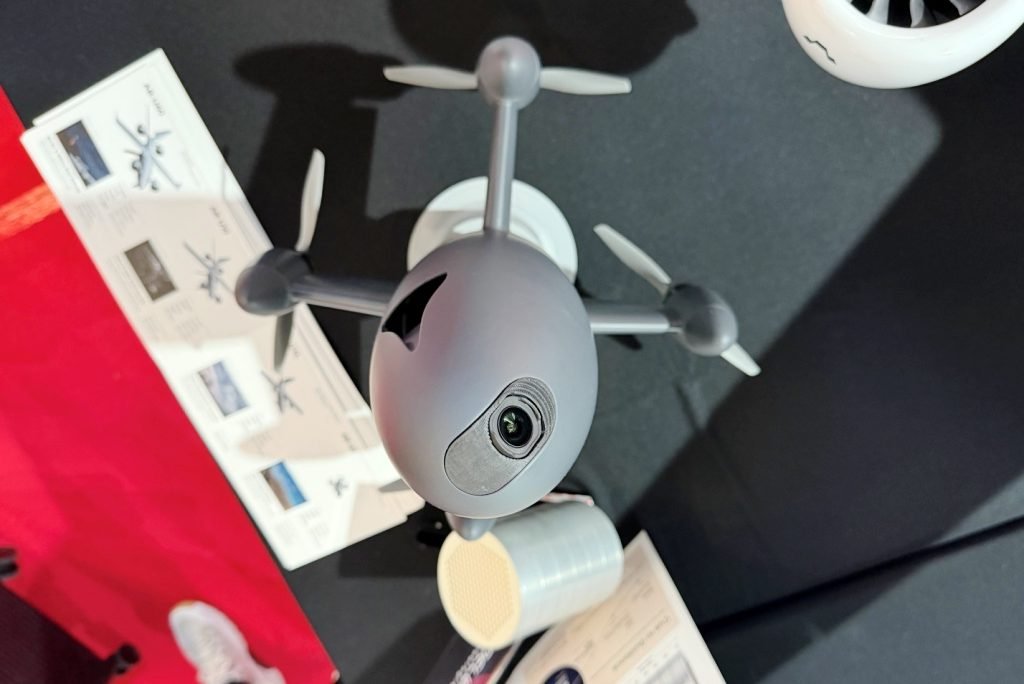
Making its world premiere at MSPO 2026 in Kielce, Poland, the AB-U2, an AI-guided kinetic hard-kill interceptor developed by South Korean company Airbility Inc., is designed to address an increasingly central challenge for armed forces and critical-infrastructure operators: neutralising unmanned aerial vehicles in environments where satellite-navigation signals are jammed, spoofed or simply unavailable
A response to drones without GPS
GNSS disruption – affecting GPS, Galileo, GLONASS or BeiDou – is now an operational reality in modern theatres. Yet depriving a hostile drone of a satellite-navigation signal does not necessarily stop it. More advanced platforms may continue their mission using an inertial measurement unit, onboard sensors, visual navigation or pre-programmed autonomous flight modes.
It is precisely in this grey area, between electronic warfare and close-range air defence, that Airbility Inc. – a South Korean system integrator founded in November 2023, specialising in counter-unmanned aerial systems (C-UAS) built on its own vectored-thrust ducted-fan platforms – positions the AB-U2. The system is being developed to intercept aerial threats without relying on uninterrupted GNSS availability. Its world premiere is scheduled for Airbility’s stand at the 34th MSPO exhibition in Kielce.
AI terminal guidance, SLAM and inertial navigation
The AB-U2’s guidance concept is layered rather than dependent on any single source. Initial vectoring comes from the sensor and command-and-control layer; mid-course navigation combines inertial data with SLAM-based (Simultaneous Localisation and Mapping) visual positioning; and the terminal phase is handled by an onboard AI seeker that detects, classifies and tracks the target optically. That last point is the one that matters most operationally: once the seeker has acquired the target, the interceptor no longer needs to know where it is on a map — only where the target is relative to itself.
The AB-U2’s technical distinction lies in its combination of SLAM navigation and inertial sensors. SLAM enables a mobile system to build a representation of its surroundings while simultaneously determining its own location within that environment. Rather than continually asking the sky where it is, the interceptor observes, maps and recalculates its position from the immediate environment around it.
Its inertial system, meanwhile, uses data from accelerometers and gyroscopes to estimate movement, attitude and trajectory. This approach does not remove all navigation constraints – inertial navigation can accumulate drift over time – but it provides valuable autonomy when satellite signals become unreliable or are deliberately manipulated. In practice the drift budget is bounded by the engagement itself: an interception is measured in seconds to a few minutes, not hours, so the error accumulated over a single sortie stays within the terminal seeker’s acquisition envelope.
Airbility is explicit about where the programme stands: GNSS-independent operation under severe jamming and spoofing is the AB-U2’s governing design objective, and the capability is currently under development rather than fielded. The company’s stated goal is an interceptor that completes the engagement with no usable satellite navigation at any point in the flight.
In a spoofing scenario, a drone does not necessarily lose GPS reception; rather, it receives a plausible but false signal intended to make it calculate an incorrect position. For an interception mission, that distinction is critical: a counter-drone system that can be misdirected by the same electromagnetic environment affecting its target would lose much of its operational value.
Intercepting in electronic warfare
The proliferation of small drones, loitering munitions and commercially derived systems adapted for military use requires a layered defensive approach. Electronic-warfare tools retain an important role in disrupting command links, data communications and satellite navigation. However, they are not a universal answer against autonomous aircraft using inertial or visual navigation, or platforms programmed to complete their mission despite the loss of a control link.
The AB-U2 is intended for this particular engagement envelope: situations in which non-kinetic effects are no longer sufficient, the electromagnetic environment is degraded, and the interceptor must retain the ability to reach an aerial target. Such a capability is relevant both to the protection of deployed forces and to the defence of sensitive sites, including bases, ammunition depots, command centres, energy networks and airport infrastructure.
The requirement is therefore no longer limited to detecting a drone. It demands a rapid sequence of detection, identification, decision-making, effector allocation, interception and neutralisation assessment. Airbility is also expected to present ABLE C2, its open-architecture command-and-control system intended to bring sensors and effectors together in a single operational environment covering this entire engagement chain, including third-party sensors and effectors already in service with the customer.
A multi-option architecture
The AB-U2 forms part of a wider family of C-UAS solutions presented by Airbility at MSPO. The company is also exhibiting the AB-U10, a net-based interception platform designed to capture a drone without destroying it. Such an option may be particularly relevant in locations where collateral damage is unacceptable, including airports, industrial sites, urban areas, major public events and critical infrastructure.
At the other end of the spectrum, the AB-U60 is presented as a hard-kill mothership: a larger vectored-thrust ducted-fan platform designed to carry and deliver effectors at greater range. Airbility publishes a 3 metres span, a 60 kg maximum take-off weight, a 10 kg payload, a 200 km/h maximum speed, a range in excess of 30 km and 15 minutes of endurance, and states that the platform has completed full transition-flight verification. Taken together, the systems suggest a graduated defensive concept: capture where the operational environment requires restraint; destroy where the threat, range and force-protection requirement demand it; and coordinate the different assets through a common C2 layer.
The real message from Kielce
The AB-U2’s world premiere at MSPO comes at a time when resilience to electronic warfare is becoming as important a design criterion as speed, endurance or payload capacity. For military users, an effective counter-drone system must now be able to operate in a contested electromagnetic environment – rather than only under the ideal conditions of a demonstration.
With an architecture based on an AI terminal seeker backed by SLAM and inertial navigation, Airbility is working towards a response to that requirement: when GPS goes silent – or starts lying – the interceptor must keep hunting. The exact integration of the AB-U2, including its associated sensors, interception profile, effector type, range and engagement rate, will need to be assessed at the Kielce exhibition in order to establish its full position within the next generation of C-UAS capabilities.
Photo by J. Roukoz
