

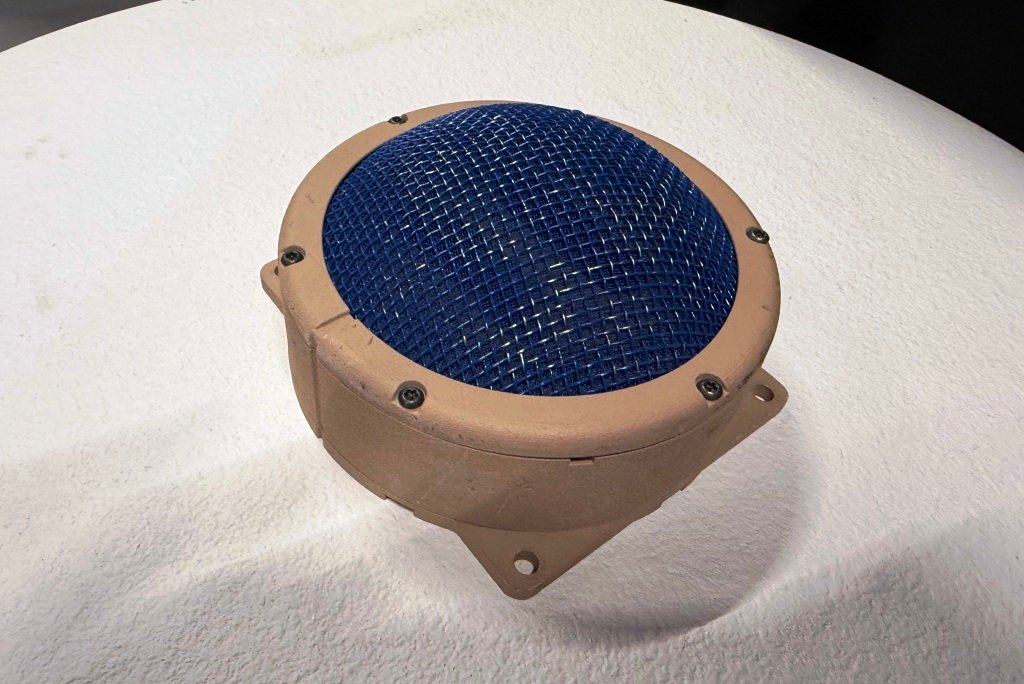
First unveiled at Eurosatory 2026 in Paris, Metravib Defence’s Piton system is continuing its international tour at MSPO 2026 in Kielce, Poland. Marketed and showcased by Pagacz Defence Group, this acoustic gunshot-detection sensor addresses a rapidly expanding requirement: protecting VIP vehicles, security forces, special units and unmanned ground vehicles
After missiles, drones and jamming systems, here comes equipment designed to listen to the battlefield – and listen quickly. Piton does not need to see a shooter in order to alert the crew: it analyses a gunshot’s acoustic signature to indicate the direction of the threat, its range and the likely calibre category involved.
A world premiere in Paris
Piton was publicly unveiled at Eurosatory 2026, held in Paris from 15 to 19 June. The presentation formed part of an expanded co-operation between Pagacz Defence Group and French specialist Metravib Defence, known for its acoustic gunshot-detection and localisation solutions for armed forces, security units and platform protection.
A few weeks later, the system is being presented at MSPO 2026 in Kielce. At the Pagacz I Synowie stand, Piton is featured within a vehicle-protection portfolio that also includes ballistic solutions, optical equipment and technologies for land platforms. The Polish exhibition therefore represents the first international showcase for this new solution among users and integrators in Central Europe.
For the Polish Armed Forces, however, the underlying technology is not entirely new: they previously used Metravib’s PILAR acoustic gunshot-detection system during their deployment in Afghanistan.
Seeing without a camera, hearing before being hit
Piton operates through acoustic gunshot detection. The sensor analyses the sound phenomena associated with a weapon firing: the muzzle blast, generated at the moment of firing, and the shockwave created by a supersonic projectile. By correlating these data, the system can determine the probable origin of the threat.
This operational capability is especially useful in environments where observation is restricted: dense urban areas, confined routes, convoys, close-protection missions, checkpoints or unmanned-vehicle movements. In such situations, a crew may come under fire without immediately identifying its origin, particularly when the shooter is concealed behind a building, dense vegetation or an elevated position.
Piton therefore provides an initial layer of situational awareness. Instead of responding solely on instinct or to the apparent direction of the sound, the operator receives usable information about the threat axis. This can support an evasive manoeuvre, cue optronic sensors, alert an escort element or prepare a response consistent with the rules of engagement.
360° detection
According to information released at Eurosatory, Piton provides continuous 360° surveillance around the vehicle, including while it is moving. It is designed to detect the origin of supersonic-projectile gunfire across a calibre range from 5.56 mm to 14.5 mm, at the effective engagement ranges of these munitions.
The system is credited with a detection probability of more than 90%. It provides the shooter’s azimuth with a stated accuracy of ±7.5°, while range estimation is reported with an accuracy of ±20%. Piton can also discriminate threats according to two broad calibre categories: below or above 7.62 mm.
Its stated reaction time is under two seconds. In close-protection and convoy-security missions, that timing is crucial: the objective is not merely to know that a shot has been fired, but to obtain an immediate directional indication clear enough to prevent surprise from becoming vulnerability.
Artificial intelligence for acoustic filtering
The inclusion of artificial intelligence deserves particular attention. For a vehicle-mounted gunshot detector, the challenge is not simply to record a loud sound. A vehicle operates in a complex acoustic environment: engine noise, rolling noise, transmission sounds, horns, construction activity, distant detonations, fireworks, friendly fire and a range of mechanical signatures.
Piton uses embedded artificial intelligence to analyse acoustic events and reduce the likelihood of false alarms. The challenge is twofold: to recognise a signature consistent with hostile fire more rapidly, and to prevent the operator from being overwhelmed by irrelevant alerts. The system is also presented as being able to identify the type of incoming fire, increasing the tactical value of the warning.
This approach reflects an important shift in acoustic detection. The sensor is no longer limited to providing a raw warning; it becomes a source of mission data, potentially connectable to a battle-management system, a pan-tilt camera, a remotely operated weapon station or an information-sharing network.
Small package, broad platform potential
Piton also stands out for its compact architecture. The system presented at Eurosatory weighs approximately 0.7 kg and measures 120 × 120 × 60 mm. Powered by the vehicle, it can be fitted to a roof or external structure, facilitating integration on protected civilian vehicles as well as light tactical platforms.
Information is displayed on an Android terminal through a circular, dial-style interface: the vehicle is shown at the centre, while the threat direction appears around it. This straightforward design follows a clear operational logic: under stress, an operator must be able to understand an alert at a glance, without having to interpret a complex set of co-ordinates.
The intended applications span several user categories:
- VIP-protection vehicles and convoys, particularly in high-risk areas
- Police forces, intervention units and homeland-security services
- Special forces operating light or low-profile vehicles
- Tactical reconnaissance and liaison vehicles
- UGVs, for which acoustic detection can offset the absence of a crew on board
A response to market needs
With Piton, Metravib Defence and Pagacz offer a solution tailored to platforms that do not have the space, electrical power or budget required for a comprehensive gunshot-detection suite designed for heavy armoured vehicles. Rather than replacing Metravib’s more sophisticated PILAR-family systems, which are employed on military vehicles, sensitive sites and aircraft, Piton provides a lighter and more readily integrated option for security, mobile-protection and ground-robotics missions.
Piton’s journey from Eurosatory to MSPO is significant. Its Paris presentation placed the product on the international stage; its Kielce appearance now brings it before users, integrators and decision-makers with a strong interest in protected mobility, border surveillance, anti-ambush capability and the equipment of land forces.
In short, Piton lives up to its name: compact, discreet and constantly on the lookout, it does
not bite – but it can indicate very quickly where the danger is coming from.
Photos by J. Roukoz
