

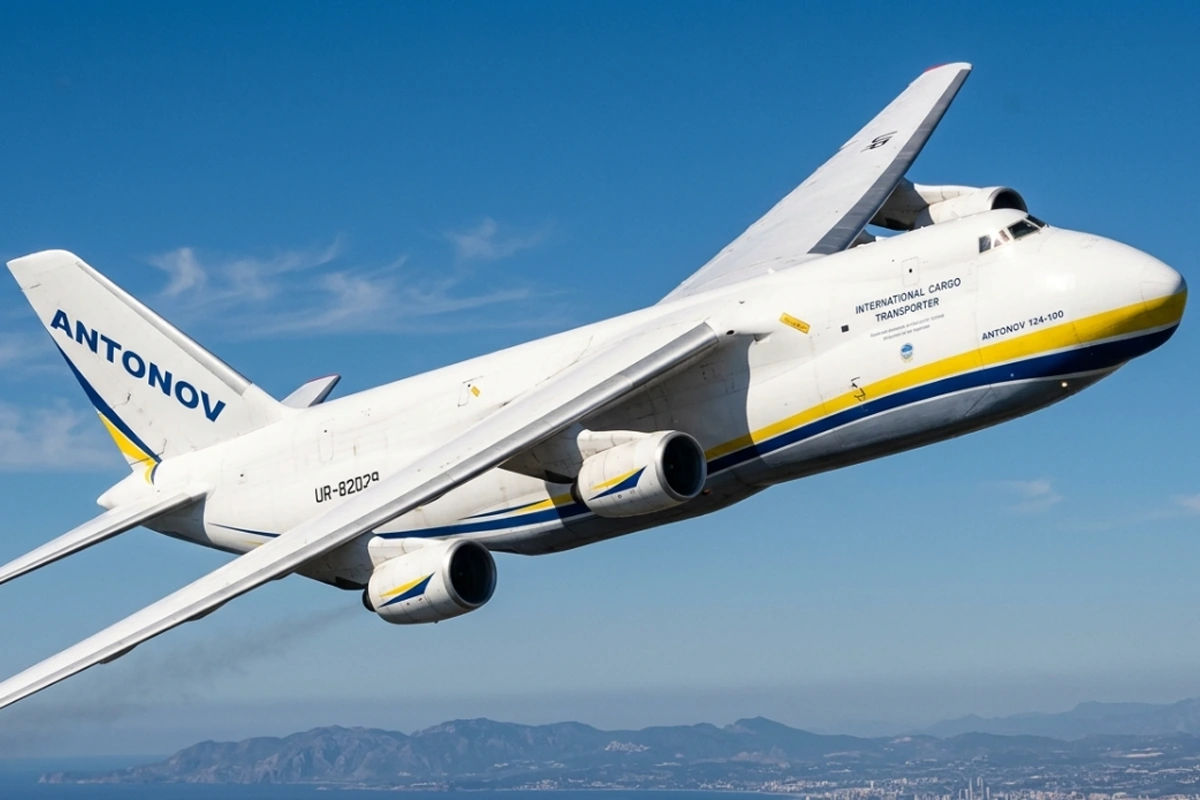
What do you do when the cargo is so big, so heavy, or so awkward that almost every cargo aircraft on Earth simply isn’t an option?
You bring out the Antonov An-124 Ruslan.
This enormous aircraft was designed during the Cold War to move military equipment weighing more than 100 tons. But somewhere along the way, the Ruslan became something much stranger and arguably more useful: a global heavy-lift workhorse carrying everything from industrial machinery to generators and mining equipment.
Antonov describes it as the world’s largest production transport aircraft, with the ability to carry up to 150 tons in its modern configuration.
The numbers alone are impressive. The Antonov An-124 Ruslan stretches 69.1 meters from nose to tail and has a wingspan of 73.3 meters. Yet its real trick isn’t simply being enormous. Its designers built the entire aircraft around one question: how do you load something that was never meant to fly?
That question produced an unusual combination of front and rear cargo doors, a kneeling landing gear system, an onboard crane and a double-deck fuselage. In other words, the Ruslan isn’t merely an aircraft with a large cargo hold. It’s almost a self-contained heavy-haul operation with wings.
And then comes the complicated part.
The Antonov An-124 Ruslan was a Soviet project involving industrial facilities across what later became Russia and Ukraine. Production took place in both Kyiv and Ulyanovsk, while its D-18T engines came from the Ukrainian industrial base. After the Soviet Union collapsed, that once-integrated production system became divided by borders, politics and eventually war.
So the story of the Antonov An-124 Ruslan isn’t just about a giant airplane. It’s about engineering, logistics and how geopolitics can reshape the life of an aircraft built to move almost anything.
Why Was the Antonov An-124 Ruslan Built?
The Antonov An-124 Ruslan was born from a simple Cold War problem: the Soviet Union needed to move very heavy military equipment over very long distances, and its existing transport aircraft were reaching their limits.
By the late 1960s, Soviet planners were looking for a new strategic airlifter capable of carrying roughly 100–120 tons of cargo. The requirement was ambitious. This was not simply a request for a larger transport aircraft; it demanded an entirely new approach to strategic airlift.
The design work eventually led to an aircraft that could transport equipment that was too heavy or bulky for conventional military transports. Tanks, missile systems, engineering vehicles and other outsized loads could be moved directly by air rather than relying entirely on ships, railways or multiple smaller aircraft.
That requirement explains many of the An-124’s stranger-looking features. Its enormous fuselage was designed around cargo rather than passengers.
The aircraft received front and rear loading doors, a kneeling landing gear system and onboard cargo-handling equipment. These features allowed crews to load extremely heavy equipment with comparatively little dependence on specialized airport infrastructure.
After years of development and testing, the first Antonov An-124 Ruslan made its maiden flight on December 24, 1982. The aircraft was fundamentally a military machine at birth, intended to give the Soviet Union a strategic airlift capability comparable to the enormous logistical demands of its armed forces.
But history took the Antonov An-124 Ruslan in a direction its original designers could hardly have predicted. After the Cold War, the same aircraft built to support Soviet military logistics became a commercial heavy-lift specialist, transporting power generators, mining machinery and other cargo that ordinary freighters simply could not handle.
The Antonov An-124 Ruslan was built for war, but its most enduring role would be moving almost anything too big to fly.
Next, we’ll move from the aircraft’s dimensions to the numbers that define its actual heavy-lift capability.
What Are the Antonov An-124 Ruslan Specifications?
The Antonov An-124 Ruslan is impressive on the outside, but its specifications explain why it became such a specialized heavy-lift aircraft.
The standard An-124-100 can carry up to 120 tons, while the upgraded An-124-100M-150 raises the maximum payload to 150 tons. The aircraft also has a cargo volume of approximately 1,040 cubic meters, giving it an unusual combination of payload capacity and internal space.
| Specification | Antonov An-124 Ruslan |
| Length | 69.1 m |
| Wingspan | 73.3 m |
| Height | 21.08 m |
| Cargo volume | ~1,040 m³ |
| Maximum payload | Up to 150 t* |
| Cargo compartment | 36.5 × 6.4 × 4.4 m |
| Cruise speed | 800–850 km/h |
| Operational range | Up to 15,700 km** |
| Engines | 4 × D-18T turbofans |
| Onboard crane capacity | Up to 30 t |
One important detail is that “An-124” does not describe just one identical configuration. The original aircraft evolved into variants such as the An-124-100 and the more heavily upgraded An-124-100M-150. Structural reinforcement, improved navigation systems and other modifications allowed later versions to handle heavier loads and operate more efficiently.

The numbers also reveal why the Ruslan occupies such a narrow but valuable niche. A 150-ton payload is one thing; combining that payload with a cargo compartment more than 36 meters long and specialized loading equipment is something else entirely.
That is the real Antonov An-124 Ruslan advantage: it doesn’t just carry heavy cargo, it combines weight, volume and loading flexibility in one aircraft.
Read also: Top 5 Largest Military Transport Aircraft in the World
How Can the Antonov An-124 Ruslan Carry Cargo That Other Aircraft Can’t?
The real test of a cargo aircraft isn’t how much it can lift on paper. It’s whether it can actually get an enormous object inside the aircraft, secure it, and fly away with it.
That is where the Antonov An-124 Ruslan becomes particularly difficult to replace.
Antonov An-124 Ruslan’s cargo compartment is roughly 36.5 meters long, 6.4 meters wide and 4.4 meters high, but the aircraft’s loading system is just as important as the available space. The Ruslan can open its nose and rear cargo doors, while its kneeling landing gear lowers the fuselage to make loading easier. Built-in ramps and a 30-ton-capacity onboard crane can then help move heavy equipment into position.
And this capability has been tested with cargo that sounds almost absurd.

Antonov An-124 Ruslan records the transportation of a 152-ton Euclid mine dump truck, an object that illustrates exactly why the An-124 exists. The aircraft has also carried a 135.2-ton Siemens generator from Düsseldorf to Delhi. In another operation, it transported a 120-ton Liebherr crane to Armenia following the devastating 1988 earthquake.
These aren’t normal air-freight jobs. You can’t simply put such equipment inside a standard container and roll it onto an aircraft.
Read also: 5 Biggest Aircraft in the World Ranked by Size and Power
The Antonov An-124 Ruslan was designed around that problem. Its combination of cargo volume, structural strength, loading doors and onboard handling equipment means the aircraft can function almost like a flying heavy-haul logistics platform.
That distinction matters. A smaller aircraft might have enough payload capacity but lack the cargo-door dimensions. Another might have the space but not enough structural capacity. The Antonov An-124 Ruslan brings the critical pieces together.
And that is why its most impressive specification isn’t necessarily its 150-ton payload.
It’s the ability to turn an object that seems impossible to transport by air into something that can actually take off.
Why Did the Antonov An-124 Ruslan Become a Global Heavy-Lift Workhorse?
The Soviet Union built the An-124 Ruslan for military airlift. After the Cold War, however, the giant aircraft found a surprisingly valuable second career: commercial heavy lifting.
Its huge cargo hold, high payload capacity and built-in loading equipment made the An-124-100 ideal for transporting oversized cargo such as power generators, mining machinery, helicopters and industrial equipment.

The aircraft also became important to NATO logistics. In 2006, NATO launched the Strategic Airlift Interim Solution (SALIS) to address a shortage of capacity for outsized cargo. An-124 aircraft were brought into the program because very few aircraft could perform these missions.
The irony was hard to miss: an aircraft designed for the Soviet military was now helping transport equipment for Western armed forces.
But logistics is rarely ideological. If a mission requires moving an exceptionally large or heavy object by air, the aircraft that can actually do the job becomes extremely valuable.
That is what turned the Ruslan into a global heavy-lift workhorse. Its Cold War origins became less important than its unique ability to move cargo that other aircraft simply couldn’t handle.
Why Is the Antonov An-124 Ruslan’s Russian-Ukrainian History So Controversial?
The Antonov An-124 Ruslan may have been a Soviet aircraft, but its industrial story was never confined to one country.
The program relied on factories and suppliers across the Soviet Union. Production took place in Kyiv and Ulyanovsk, with Antonov recording 18 aircraft built in Kyiv between 1984 and 2003 and 36 in Ulyanovsk between 1985 and 2004.
Its D-18T engines added another layer to the story. Developed by Ivchenko-Progress and manufactured by Motor Sich in Ukraine, the engine was part of the same Soviet industrial network that produced the aircraft.
After the Soviet Union collapsed, that integrated system suddenly crossed an international border. Ukraine controlled important parts of the An-124’s design and engine supply chain, while Russia operated and produced many of the aircraft.

For years, both sides explored ways to restart production and modernize the Ruslan. But worsening Russian-Ukrainian relations eventually made deeper industrial cooperation increasingly difficult. Plans for renewed production effectively collapsed after relations deteriorated in 2014.
That created a problem far bigger than politics alone.
An aircraft can remain airworthy for decades, but its engines, components and specialized maintenance infrastructure still depend on an industrial ecosystem. Once that ecosystem is divided between countries that no longer cooperate, keeping a complex aircraft like the An-124 flying becomes considerably harder.
This is what makes the Ruslan’s history so unusual: the aircraft survived the Soviet Union, but the industrial system that created it did not.
Its future would therefore depend not only on engineering upgrades, but on whether operators could maintain an aircraft whose origins were deeply tied to a supply chain that no longer exists in its original form.
How Is the Antonov An-124 Ruslan Still Being Modernized?
A 1980s aircraft cannot stay relevant forever without upgrades. The Antonov An-124 Ruslan has therefore undergone efforts to modernize the systems that matter most: avionics, navigation, engines, braking and structural strength.
The most capable version, the An-124-100M-150, was developed with a reinforced fuselage, floor and loading ramp, allowing a maximum payload of 150 tons. It also received improved navigation equipment and other changes aimed at extending the aircraft’s usefulness.
The engines are another major focus. The Ruslan uses four D-18T turbofans, and proposed modernization programs have included upgraded versions with digital engine control and significantly longer operating lives. One earlier modernization concept targeted an engine life of up to 50,000 hours.

These upgrades are important because replacing the Antonov An-124 Ruslan outright is not easy. Its value comes from a combination of features that are difficult to reproduce in a new aircraft: enormous internal volume, very high payload, front-and-rear loading doors and onboard cargo-handling equipment.
But modernization also exposes the Antonov An-124 Ruslan’s biggest weakness.
Many of its critical technologies and industrial capabilities originated in the Soviet Union and are now divided between countries. Maintaining an aging fleet therefore requires more than installing new avionics or strengthening the airframe. Operators also need reliable access to engines, components and specialized maintenance.
The Antonov An-124 Ruslan can be upgraded, but keeping it flying is becoming an increasingly complicated industrial challenge.
Its engineering may be old, but the missions it performs remain surprisingly difficult to replace.
Does the Antonov An-124 Ruslan Still Have a Future?
The Antonov An-124 Ruslan is old by modern aviation standards, but replacing it is not as simple as building a newer, larger aircraft.
Its biggest advantage is the combination of payload, cargo volume and loading flexibility. The Antonov An-124 Ruslan can carry up to 150 tons in its upgraded configuration while loading exceptionally large equipment through its front and rear cargo doors.
Other heavy transports can perform some of these missions. The U.S. C-5M Super Galaxy offers enormous payload capacity, while the C-17 Globemaster III provides excellent strategic and tactical mobility. But the Ruslan’s particular combination of oversized cargo space and loading equipment gives it a niche that remains difficult to duplicate.
The bigger problem is age.

Many Antonov An-124 Ruslan airframes are decades old, while the aircraft’s D-18T engines and other specialized components depend on a complicated industrial supply chain. The breakdown of Russian-Ukrainian cooperation has made long-term maintenance and modernization even more challenging.
Yet the aircraft continues to demonstrate why operators have been reluctant to abandon it. There are still loads that are simply too large, too heavy or too awkward for conventional cargo aircraft.
That creates an unusual situation. The An-124 is increasingly difficult to maintain, but also difficult to replace.
Its future will probably depend on how long individual airframes can be economically modernized and supported. A completely new aircraft could eventually take over the role, but reproducing the Ruslan’s unique combination of size, payload and cargo-handling capability would be a major engineering and financial undertaking.
For now, the Antonov An-124 Ruslan remains a remarkable Cold War survivor: an aging aircraft still doing jobs that modern aircraft cannot easily do.
