

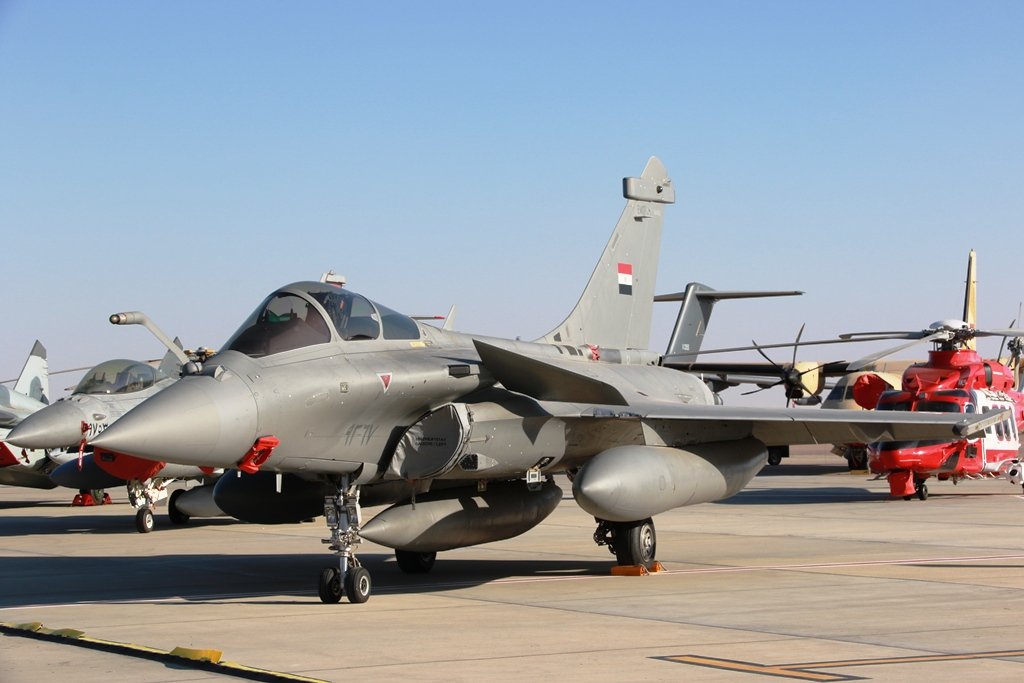
Dassault figured prominently at EIAS. The Rafale of course was the main attraction, with two of them showcased in the static area and a French Air Force example delivering a powerful performance in the flying display. There was also an Egyptian Air Force Alphajet trainer now in the twilight of its career after 40 years of service. The same of course cannot be said of the multi-role Rafale. Egypt became the first export customer of the Rafale in 2015 when it placed an order for 16 two seaters known as the ‘DM’ and eight single-seat referred to as the ‘EM’ for a fee believed to be in excess of US$ 5 billion
The deal for the F3R variant also included a complete weapons package that included MICA air-to-air missiles, SAGEM AASM Hammer precision-guided bombs and MBDA SCALP-EG air-launched cruise missiles. The supply of the SCALP was blocked because it contravened ITAR (International Traffic in Arms Regulations) which led Egypt to delay a second order until the issue was resolved
The final delivery of the first batch was completed in July 2019, and eventually the SCALP EG issue was resolved, that saw Egypt go ahead with a US$ 3.75 billion order for a batch of 30 aircraft -12 two seaters and 18 single-seaters. Eric Trappier, Chairman and CEO at Dassault, joyed by the additional order said: “Egypt recognises the Rafale as a unique ‘game changer’ ensuring its role in defending the country’s sovereignty.”
Eight Rafales of this second order have been delivered to date, and delivery of the remainder will continue at Bordeaux over the next two years.
In 2024, the EAF and Dassault celebrated 10,000 hours of flying the Rafale, but Dassault would not confirm how many hours have been flown on the aircraft now.
Meanwhile a request for proposal for 24 more jets, probably to the F4 standard, was submitted earlier this month according to the French newspaper La Tribune, to the Egyptian government, which would increase the fleet to 78.
The EAF’s fleet of over 200 F-16s Block 15, 32, 40 and 52s are growing obsolete, and are among the most out-dated in the world because US government’s reluctance in the past to allow upgrades. As a consequence, Egypt has opted for the Rafale to replace them. EDR On-Line approached Lockheed Martin for a comment on the current situation, but no comment was forthcoming. The EAF see Rafale has a very capable F-16 replacement which in the F3R variant comes with the Thales RBE 2 AESA radar, Meteor BVRAAM as well as mentioned above. One major reason the Rafale deal has been popular in Egypt is that French banks are under-writing the multi-billion dollar deals across ten years.
The UAE Air Force and Air Defence ordered 80 Rafales back in 2021 on the basis that it would integrate its own weapons and systems on the jet. Now with UAE’s closer relationship being fostered with the Egyptian government, EDGE was promoting its Al Tariq modular precision guided munition, 250 lb Halcon Thunder P31 and 500 lb Halcon Thunder P32 PGMs prominently at their stand. These weapons will go on the UAE Rafales, and the EAF MiG-29s are already using the Al Tariq operationally so it is no stranger to EDGE products.
At Paris Air Show, in June 2025, three 500 lb Halcon P32 PGMs were seen loaded on an Aresia three-bomb adaptor pylon under a Dassault Rafale, while two Al Tariq PGMs sat by. None were labelled to hide their identities. It’s likely that EDGE will sell the weapons to Indonesia for its Rafales too.
No one at Dassault was willing to talk about the Egyptian Rafales, but a display at its stand said that there was a training agreement with Egypt’s Arab Organisation Industrialisation (AIO) now in place. AIO also signed memorandum of understanding with Safran to maintain parts of the Rafale’s SNECMA M88 engine at EIAS 26.
Photos by A. Warnes
