

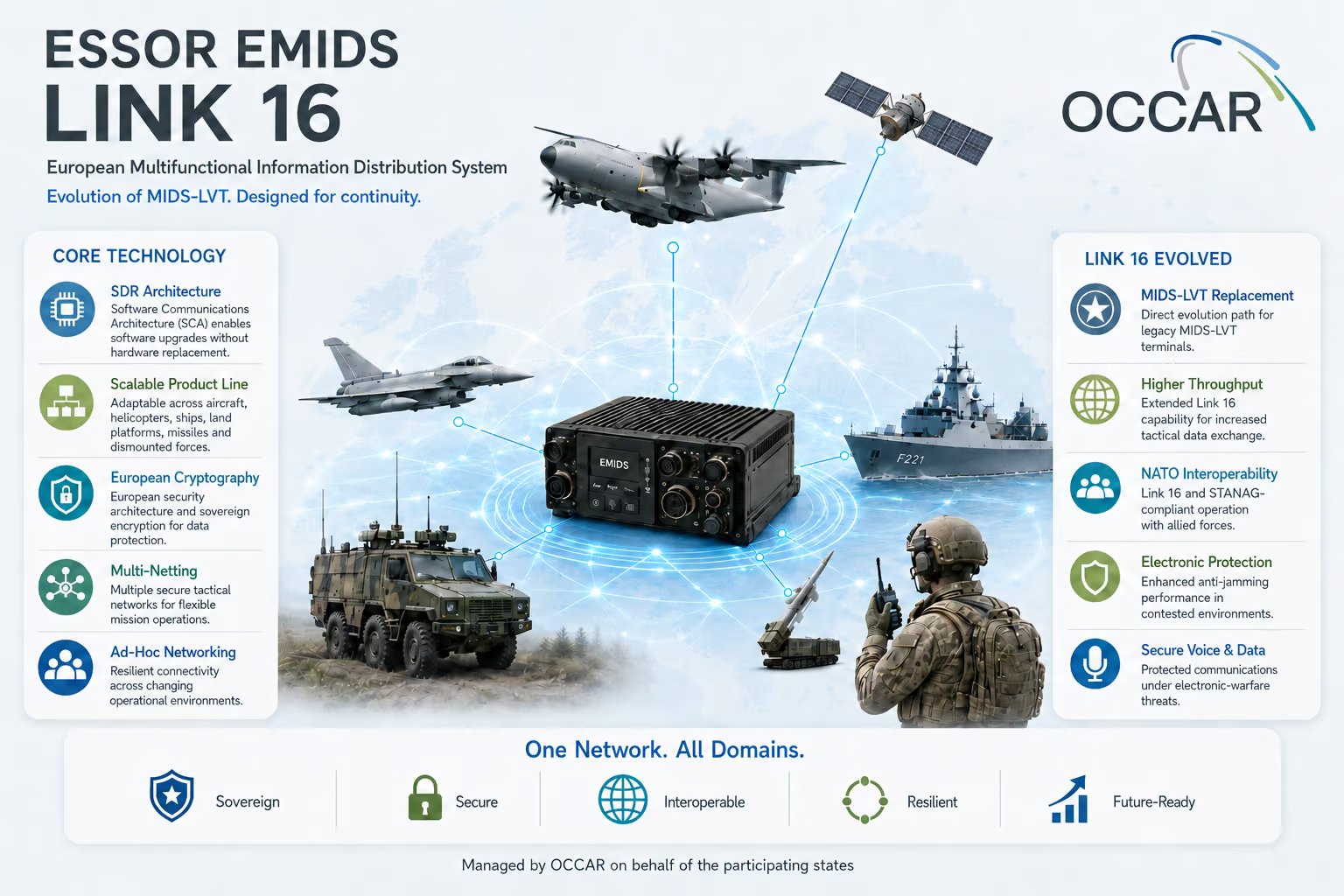

Work advancing future European air operations connectivity has taken an important step forward with the signature of the EMIDS-2 contract.
In July the Organisation Conjointe de Coopération en Matière d’Armement (OCCAR/Joint Organisation for Armament Cooperation) signed a contract with the EuroMIDS consortium to advance the European Secure Software Defined Radio Multifunction Information Distribution System (ESSOR MIDS). The EuroMIDS consortium includes Indra, Hensoldt, Leonardo and Thales. The contract signature will move the overall programme into the ESSOR MIDS-2 (EMIDS-2) phase.
The rationale of the ESSOR MIDS initiative is to develop a successor terminal to the standard MIDS Low Volume Terminal (MIDS LVT) radio transceivers routinely used for air-to-air communications known as MIDS LVT(1). MIDS LVT radios are the primary conduit for North Atlantic Treaty Organisation (NATO) Link-16 Tactical Datalink (TDL) traffic. Link-16, which uses a waveband of 960 megahertz to 1.215 gigahertz is a secure TDL employed primarily to support air operations. The TDL offers data rates of between 31.6 to 115.2 kilobits-per-second and a key element of the overall ESSOR MIDS undertaking is to improve data throughput.
According to a press release announcing the news of the OCCAR and EuroMIDS contract signature EMIDS-2 programme “will enhance Link-16 capabilities through advanced software-defined radio technologies and waveforms”. The net effect of these enhancements will be “faster data exchange, improved network performance, greater flexibility for future upgrades, and enhanced interoperability among European armed forces and coalition partners”.
The inclusion of the ESSOR moniker in the programme’s appellation shows that some elements of the pan-European ESSOR waveform undertaking will be included in ESSOR MIDS architecture. One relevant element is the ESSOR Three-Dimensional Waveform which is earmarked for air-to-surface/surface-to-air communications. It seems likely this waveform would be included in the ESSOR MIDS architecture alongside Link-16 which looks set to remain the standard NATO/allied TDL supporting air operations for the foreseeable future.
FEMIDS
OCCAR told Armada, via a written statement, that the decision to launch ESSOR MIDS was taken in 2021 by the aforementioned nations. The focus of the initiative is the development of the Fighter ESSOR MIDS (FEMIDS) terminal which, while compatible with legacy MIDS LVT radios, “introduces advanced capabilities tailored to modern operations”. The programme has now advanced into the EMIDS-2 effort which will see further work on FEMIDS. OCCAR disclosed that the total budget for EMIDS-2 is around $93 million spread across two years with each of the four participating nations contributing 25 percent.
The EMID-2 contract will conclude in 2028. Deliverables include FEMIDS A.0, a software validation platforms demonstrating the terminal’s communications and software, and FEMIDS 8.0 which is the first hardware prototype. EMIDS-2 will also see the demonstration and implementation of a new ESSOR Link-16 waveform. “Outstanding work under EMIDS-2 includes completing the detailed design of the FEMIDS terminal, manufacturing and integrating the FEMIDS demonstrators, validating the ESSOR Link-16 waveform and the cryptographic architecture”, OCCAR’s statement continued. Following the conclusion of EMIDS-2, “preparatory work for the following phase, covering completion of development activities and the transition to production of the terminals, is already being planned”.
Relevance
Considering these timetables, it is entirely possible that FEMIDS terminals could become available for production and installation as forthcoming European sixth-generation combat aircraft programmes like the Future Combat Air System come on strength. Moreover, it maybe possible to retrofit legacy platforms with the communications architecture so they enjoy similar connectivity benefits. Link-16 maybe a protocol which originally entered service in the early 1980s, but it continues to be indispensable to support air operations. The ESSOR MIDS undertaking marks an important step in ensuring the TDL remains relevant to tomorrow’s air battles.
by Dr. Thomas Withington
