

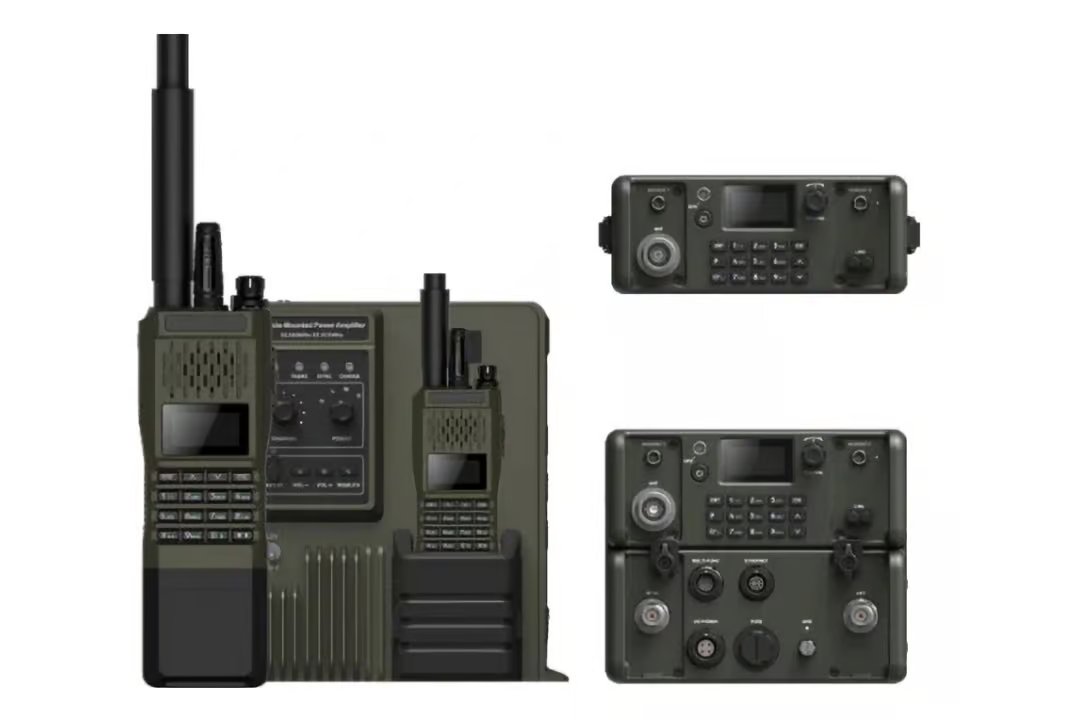


The PR9560 tactical radio appears to have been procured by several countries from its manufacturer based in the People’s Republic of China.
Last month, Armada launched our ‘Beating the System’ column to provide open source intelligence analysis of Electronic Warfare (EW) systems and military communications hardware. These articles aim to provide as full a summary as possible of the characteristics, concepts of operation, users and operational history of a plethora of EW and military communications systems. The analysis will chiefly concentrate on systems deployed by United States, and allied, near-peer adversaries.
Concept of operations
The PR9560 is a handheld tactical transceiver designed to equip dismounted troops deployed at company level and below. Open sources say the radio uses a very high frequency waveband of 30 Megahertz/MHz to 89.975MHz. No information appears in the public domain regarding the radio’s power output. Based on prevailing trends for handheld tactical transceivers, it is likely that the PR9560 produces up to ten watts/W of power. This output can be increased to 50W by using a dedicated power amplifier.
The transceiver comes equipped with three proprietary waveforms enabling it to work as a Combat Net Radio (CNR) and participate in a Voice Relay Network (VRN) or Packet Radio Network (PRN). The CNR function lets the radio perform point-to-point or point-to-multipoint transmission. The CNR waveform uses frequency modulation, Fixed Frequency (FF), Frequency Hopping (FH – see below) and free channel search. The VRN waveform allows the radio to move traffic over long distances using a maximum of six transceivers. Finally, the PRN waveform is employed primarily for the movement of data. Both the VRN and PRN waveforms can establish networks not exceeding 32 nodes.
From a communications and transmission security perspective, the PR9560 performs frequency hopping at rates of up to one thousand hops-per-second and includes Advanced Encryption Standard-256 software. A built-in Global Navigation Satellite System (GNSS) Position, Navigation and Timing (PNT) signal receiver supports blue force tracking. Alternatively, the radio can be connected to an external GNSS PNT device.
History
Armada understands that the PR9560 is produced by Hytera Communications in the People’s Republic of China (PRC). In 2017, the radio was showcased by Hebi Tianhai Electronic Information Systems at the Bangkok Defence and Security Exhibition in Thailand. The latter company has since been absorbed into Hytera Communications. The PR9560 is available for procurement through several third-party suppliers in Indonesia, Malaysia and Turkey. The system also seems to have been marketed by a now-defunct American company called AT Electronic and Communication International. The PR9560 is not covered by US International Traffic in Arms Regulations (ITAR). The lack of ITAR control means it can be exported from the United States without requiring political oversight.
Status
As of 2026, the radio appears to be in service with the armed forces of Indonesia, Malaysia and Uzbekistan, chiefly with these countries’ land forces. Armada also understands that the radio has been procured from the PRC to supply the armed forces of Belarus. What is puzzling regarding this latter acquisition is that the Belarussian military did not chose to purchase handheld, tactical very high frequency (30MHz to 300MHz) radios from its Russian ally. The Azart-P1 handheld transceiver, which is in service with the Russian military, and uses a waveband of 27MHz to 520MHz, is deployed with Russian land forces in Ukraine. Nonetheless, as Armada has documented in the past, the radio’s performance and lack of interoperability in the Ukrainian theatre has been disappointing. Perhaps the Belarussian Ministry of Defence (MOD) has misgivings about the Azart-P1’s performance, or Russia’s MOD refused to supply the radio?
There may be other PR9560 users, but details of these customers have not appeared in the public domain. The PR9560 continues to be offered by Hytera Communications. It is entirely possible that additional customers will follow in the future, and that upgraded versions of the transceiver maybe in the offing.
by Dr. Thomas Withington
