

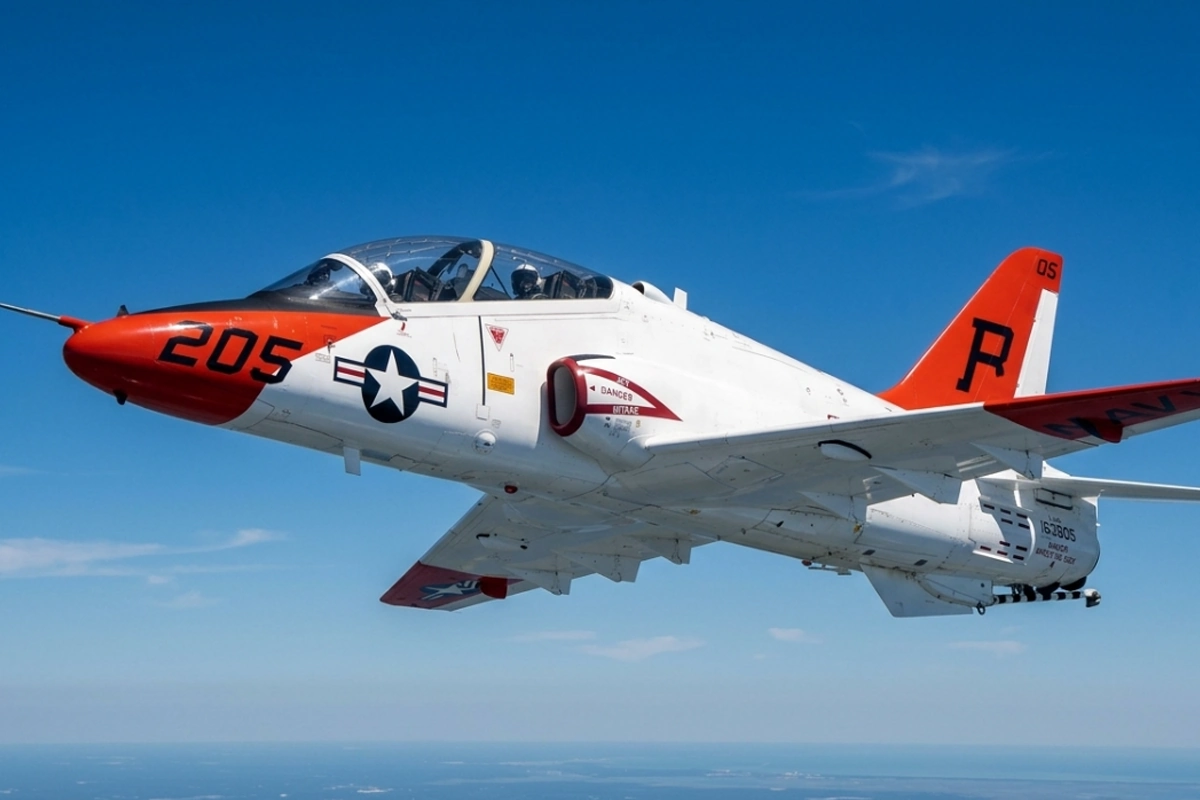
A carrier landing isn’t simply “landing on a short runway.” The pilot has to approach at the right speed, hold the correct glide path, manage power precisely, and be ready to go around or catch an arresting wire, all while the deck is moving beneath the aircraft. That is the world the T-45C Goshawk was built to teach.
The T-45C Goshawk is the U.S. Navy’s carrier-capable, tandem-seat jet trainer, developed from the British Aerospace Hawk. It replaced the Navy’s aging T-2 Buckeye and TA-4 training aircraft, creating a dedicated bridge between basic flight instruction and the demands of operational naval aviation.
But there’s an important distinction here: the T-45C Goshawk isn’t supposed to imitate a frontline fighter in every respect. Its job is more fundamental and arguably more difficult to get right. It teaches students how to fly accurately when there is almost no room for sloppy habits.
The Navy uses the T-45C Goshawk for intermediate and advanced jet training, including tactical maneuvering, weapons-related instruction, and carrier qualification. Its two-seat arrangement puts an instructor directly behind the student, allowing mistakes to become lessons before they become emergencies.
The T-45C Goshawk also represents an interesting piece of naval aviation history. The T-45A entered operational service in the early 1990s, while the T-45C introduced a digital “glass cockpit” beginning in the late 1990s.
So think of the T-45C Goshawk less as a miniature fighter and more as a bridge between the runway and the carrier deck. That distinction explains why this relatively modest-looking jet has remained central to U.S. Navy pilot training for decades.
What Are the T-45C Goshawk Specifications?
The T-45C Goshawk isn’t designed to win a dogfight. Its numbers tell a different story: this is a compact, deliberately forgiving training aircraft that still has enough performance to prepare pilots for the much faster jets waiting downstream. Current U.S. Navy data lists a maximum speed of 645 mph (1,038 km/h), a 42,500-foot service ceiling, and a 700-nautical-mile range.
The T-45C Goshawk’s power comes from a Rolls-Royce F405-RR-401 turbofan, producing about 5,527 pounds of thrust. That engine gives the two-seat aircraft enough punch for advanced training while keeping the platform substantially simpler than an operational fighter.
Here’s where the T-45C Goshawk gets interesting. Its physical dimensions are modest, but they are carefully shaped around carrier operations.
| Specification | T-45C Goshawk |
| Length | 39.33 ft (11.98 m) |
| Wingspan | 30.83 ft (9.39 m) |
| Height | 13.5 ft (4.11 m) |
| Empty weight | 9,394 lb (4,261 kg) |
| Maximum takeoff weight | 13,500 lb (6,075 kg) |
| Maximum speed | 645 mph (1,038 km/h) |
| Service ceiling | 42,500 ft |
| Range | 700 nautical miles |
| Crew | 2 |
| Engine | Rolls-Royce F405-RR-401 |
| Armament | None |
The absence of weapons is intentional. The T-45C Goshawk is about building pilot skill rather than carrying a combat load. Its tandem cockpit lets an instructor sit directly behind the student, turning every sortie into a moving classroom.
And then there’s the carrier hardware. The T-45C Goshawk was heavily modified from the Hawk design to handle the punishing cycle of carrier launch and recovery. Strengthened structures, landing gear changes, and an arresting hook transformed a land-based trainer concept into something capable of operating from an aircraft carrier.
That’s the real trick: the T-45C Goshawk’s specifications make sense only when you remember what its runway looks like it’s the deck of a moving warship.
The T-45C Goshawk’s story gets more interesting once you look past the airframe itself.
How Did the British Hawk Become a Carrier-Capable T-45C Goshawk?
The T-45C Goshawk began with a surprisingly un-American idea: take a British trainer and teach it how to survive life at sea.
The original Hawk was developed by British Aerospace as a land-based jet trainer. When the U.S. Navy needed a replacement for its T-2 Buckeye and TA-4 trainers, the Hawk became the foundation for what would eventually become the T-45. The Navy selected the McDonnell Douglas/British Aerospace team in 1981, but simply importing the aircraft was never an option.
Read also: Boeing T-7A Red Hawk: How It Prepares Pilots for 5th-Gen Warfare
A carrier changes everything.
A normal runway gives an aircraft hundreds or thousands of feet to accelerate and decelerate. A carrier deck gives the pilot a narrow strip of steel surrounded by ocean. The T-45 therefore needed substantial modifications, including strengthened structures, redesigned landing gear, and an arresting hook for carrier recovery.

The transformation produced its first flight in April 1988. The aircraft entered operational service in the early 1990s, eventually becoming a central part of the Navy and Marine Corps strike-pilot training pipeline.
Then came an important second chapter. The T-45C Goshawk introduced a digital cockpit, replacing the earlier T-45A’s more traditional instrumentation. The upgrade mattered because students were no longer learning only how to fly a jet. They were beginning to work with the kinds of digital displays and information-management concepts they would encounter in frontline aircraft.
That evolution is the clever part. The Goshawk wasn’t merely a Hawk with an arresting hook bolted underneath. It became a purpose-built naval training system, shaped around one unforgiving question: can a pilot consistently put an aircraft exactly where it needs to be when the runway is moving?
What Does the T-45C Goshawk Cockpit Teach Future Navy Pilots?
The T-45C Goshawk cockpit is more than a collection of screens, switches, and instruments. For a student naval aviator, it is the first serious lesson in managing information while flying an aircraft that refuses to tolerate distraction.
That became especially important when the Navy moved from the analog T-45A to the digitally equipped T-45C. The glass cockpit was designed to give students experience with the digital displays and information-management environment they would encounter in operational aircraft.
And there’s a subtle advantage here: the student has to learn what deserves attention and what doesn’t.
Imagine approaching a carrier at night. Your airspeed needs watching. So does altitude. Your flight path matters. The instructor is talking. The deck is moving. Your workload is piling up quickly. A good cockpit isn’t just about showing more information; it helps the pilot organize that information without becoming overwhelmed.

The T-45C Goshawk also became part of the Navy’s broader move toward integrated training. Flight time is combined with simulators, academics, and other training tools rather than treating the aircraft as the only classroom.
That philosophy is now going further. In 2024, NAVAIR highlighted Project Link, a mixed-reality T-45C Goshawk training system that combines a real cockpit with virtual displays and imagery outside the aircraft. The idea is straightforward but powerful: expose students to complicated scenarios without requiring every training situation to happen in the real world.
So the T-45C Goshawk cockpit teaches something bigger than instrument flying. It teaches future carrier pilots how to filter, prioritize, and act under pressure: a skill that becomes increasingly valuable as modern combat aircraft throw more information at their crews.
How Does the T-45C Goshawk Train Pilots for Aircraft Carriers?
For a future carrier pilot, the hardest lesson in the T-45C Goshawk may happen only a few feet above the ocean. The aircraft has to arrive on the carrier at the correct attitude, speed, and glide path, then meet the arresting wire with remarkable precision. There is very little margin for improvisation.
That is why T-45C Goshawk training is built around repetition. Students don’t simply learn to fly the jet; they progressively learn to manage the workload associated with naval aviation. The syllabus covers navigation, tactical maneuvering, weapons-related training, air combat maneuvering, and eventually carrier qualification.
The numbers give a sense of the workload. At Training Air Wing One, the strike pipeline has included roughly 160 hours of T-45C Goshawk flight time and about 96 hours in simulators, with students progressing through more than 20 training stages.

The simulator time is particularly important. A student can rehearse approaches, emergencies, and procedures repeatedly without burning fuel or putting an aircraft at risk. Then the lessons move into the real jet.
Eventually comes the moment every student has been working toward: carrier qualification.
Instead of a conventional runway, the pilot must land on a narrow moving deck and catch an arresting wire. Before reaching that stage, students practice extensively on land, building the muscle memory needed for the carrier environment.
There’s also a psychological element that rarely appears in specification sheets. A carrier landing rewards consistency, not bravado. Being slightly fast, slightly high, or slightly misaligned can turn an otherwise good approach into a missed landing.
That makes the T-45C Goshawk less like a classroom with wings and more like a pressure cooker with an ejection seat; an aircraft designed to teach precision until precision becomes instinct.
Why Is the T-45C Goshawk So Important to U.S. Carrier Aviation?
A carrier strike group can have some of the most sophisticated aircraft in the world, but none of them matter if pilots cannot safely operate from the ship. That is where the T-45C Goshawk quietly becomes one of the most important aircraft in the Navy’s aviation ecosystem.
The T-45C Goshawk’s mission is not glamorous. There are no radar-guided missiles, stealth coatings, or combat patrols. Instead, the Goshawk teaches pilots the habits that make those frontline capabilities usable later.
The aircraft sits inside the Navy’s intermediate and advanced jet-training pipeline, preparing students for aircraft such as the F/A-18C/D, F/A-18E/F, EA-18G, AV-8B and F-35B/C. That makes the T-45C a kind of common gateway: different aircraft may await students at the end of training, but carrier aviation demands the same foundation of disciplined flying.
And carrier operations magnify small mistakes.

A pilot flying from a conventional airfield has the luxury of a long runway and multiple options. On a carrier, the recovery area is tiny, the ship is moving, and an arrested landing has to happen within a tightly controlled window. The Goshawk therefore spends much of its training life turning precision into habit.
There is another reason the aircraft matters: continuity. The Navy cannot simply stop producing carrier-qualified pilots while waiting for a replacement trainer.
That explains why the service continues investing in the T-45C Goshawk even as it searches for a next-generation system. In 2025, the Navy launched a Service Life Extension Program to keep aging Goshawks structurally viable, with the work expected to continue into the 2030s.
So the T-45C Goshawk’s greatest contribution isn’t measured in speed. It is measured in pilots who arrive at the carrier deck ready to do their job.
How Is the T-45C Goshawk Staying Relevant While the Navy Prepares Its Replacement?
The T-45C Goshawk is old enough to have trained several generations of naval aviators. Yet instead of parking it in a museum, the U.S. Navy is spending serious effort to keep it flying while a replacement is developed.
That sounds contradictory until you consider the practical problem: you can’t pause pilot production while waiting for a new trainer.
The Navy began a T-45 Service Life Extension Program (SLEP) after identifying the need in 2024. The work goes well beyond routine maintenance, addressing structural components so the aircraft can continue accumulating flight hours safely. A dedicated SLEP production line was established at Fleet Readiness Center Southeast, with the program expected to continue through the 2030s.
By September 2026, the first completed SLEP aircraft had emerged from the process. That aircraft took 404 days to complete, 21 days ahead of the Navy’s 425-day target and received structural modifications including work around frame stations, the inlet area, and upper cockpit longerons.

But the Navy isn’t trying to make the Goshawk young again. It is buying time.
At the same time, naval aviation training is becoming increasingly digital. Project Link, introduced in 2024, combines a physical T-45C cockpit with mixed-reality displays and virtual imagery, allowing students to train in environments that would be difficult or expensive to reproduce in actual flight.
The larger replacement effort, known as the Undergraduate Jet Training System (UJTS), is therefore about more than finding another airplane. NAVAIR has described the requirement as a holistic training-system replacement involving simulation, virtual reality, syllabi, and new approaches to assessing student performance.
In other words, the Navy isn’t simply asking, “What aircraft replaces the T-45C Goshawk?”
It’s asking a much harder question: what should naval pilot training look like after the Goshawk is finally gone?
The Goshawk has survived partly because the Navy still trusts what it teaches. But that raises the bigger question: can an aircraft designed decades ago remain the right classroom for pilots heading into an increasingly digital fleet?
Is the T-45C Goshawk Still the Right Trainer for the Navy?
The T-45C Goshawk has an unusual advantage: it has already proven that it can do the job. For decades, it has taken student naval aviators from intermediate jet training to the carrier deck, teaching the precision and discipline that frontline aircraft demand.
But proven doesn’t necessarily mean future-proof.
The aircraft first flew in 1988, and even the youngest T-45 airframes are now well into their service lives. The Navy’s decision to launch a major Service Life Extension Program shows both sides of the equation. The Goshawk remains valuable enough to preserve, but its aging structure can no longer simply be treated as someone else’s future problem.
There is also a training mismatch emerging. Modern Navy pilots may eventually fly aircraft built around sophisticated sensors, digital displays, data links, and increasingly complex mission systems. The T-45C Goshawk’s digital cockpit helps narrow that gap, while tools such as Project Link push training further into mixed reality and simulated environments.

Yet replacing the Goshawk with a newer jet alone wouldn’t solve everything. The Navy is pursuing UJTS as a broader training-system replacement, reflecting the reality that tomorrow’s pilot may need to learn as much inside simulation and virtual environments as inside the aircraft itself.
That makes the T-45C Goshawk’s legacy rather interesting. Its greatest strength may not be its age, speed, or design, it is the training philosophy built around it.
For now, the Navy appears to see the Goshawk as a bridge worth maintaining, not a destination worth keeping forever. Its replacement will eventually need to offer more than newer avionics. It will have to prepare pilots for a carrier aviation environment that is becoming more digital, more demanding, and less forgiving of outdated training methods.
