

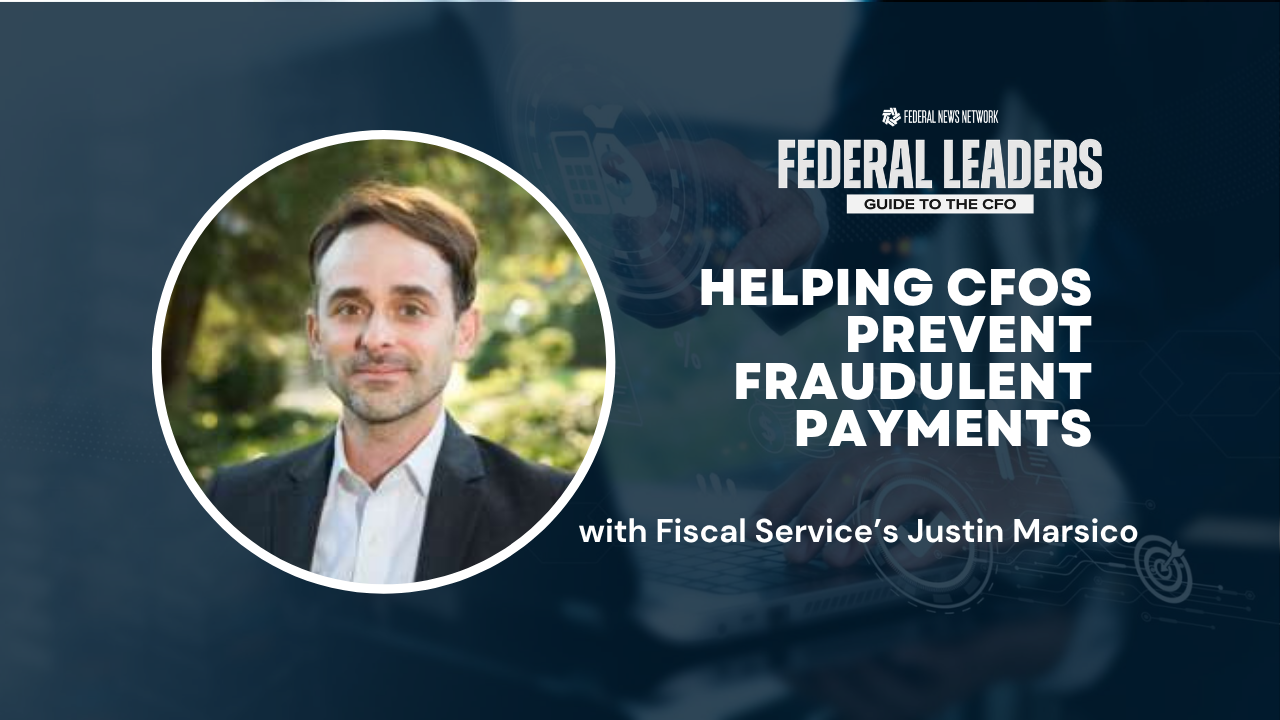
Federal chief financial officers can have more confidence than ever that their agency is sending money to the right citizens.
Why? Because the Treasury Department has completed a four-year journey to better secure federal payments.
Treasury’s payment verification tool moved into full production mode this summer using a three-step process to confirm the accuracy of a disbursement.
Justin Marsico, executive director for financial integrity at the Bureau of Fiscal Service, said the payment verification tool pulls daily data feeds from the Social Security Administration’s Master Death File, checks to make sure each taxpayer identification number (TIN) meets certain rules and conditions, and confirms whether each bank account is real and associated with the person or business slated to receive the payment.
“We started designing and building the payment verification capabilities and we fully deployed the death screening data earlier this year. So all agencies who are using Treasury’s bulk payment system are having all of their payments screened against the Master Death file, and where appropriate, those payments are being returned,” Marsico said during Federal News Network’s Federal Leader’s Guide to the CFO 2026.
“We have also built and deployed in an evaluate mode — kind of like our soft launch — a TIN screening capability and a bank account verification capability as well,” Marsico said. “What evaluate mode or soft launch mode means is that we are actually screening agency payments, and we are telling them, ‘You submitted these 100 payments and two of these would be returned because you failed these conditions.’ We’re not returning them right now, but we’re notifying you that this is what your payment file is going to look like in the future.”
The Fiscal Service is checking payments in near-real time against several federal and commercial data sources before they go out the door. This is a significant step to help the government get out of the “pay and chase” model and into the “detect and stop” model.
Doing more to stop improper payments
Since December 2023, Treasury has screened over 885 million payments totaling approximately $2.77 trillion using the payment verification tool. The department says the screening has identified more than 4,900 payments worth approximately $104 million that were associated with deceased payees, meaning those payments were returned to the originating agency for review before the government disbursed any funds.
Congress gave the Fiscal Service access to the Master Death File, which contains more than 142 million records dating back to 1899, on a pilot basis for three years in 2023 as part of the omnibus appropriations bill. Lawmakers made the access permanent in February when it passed — and President Donald Trump signed — the Ending Improper Payments to Deceased People Act into law.
The journey to give CFOs and agency programs this tool to stop improper payments has been in the works since 2011 when Treasury launched the Do No Pay list during the Obama administration.
But it took until July 2025 when the Trump administration super-charged the entire effort by cutting through systemic problems that hindered agencies from doing more to stop more than $186 billion in improper payments.
Marsico said the payment verification process is an example of how the entire effort to stop fraud and improper payments has changed over the last few years.
“What that did is it took an existing process that we had before called payment adjudication. What happened with payment adjudication is when agencies submitted their payment files to Treasury for processing and disbursement, we would actually screen those to see which payments would be going to deceased people. The problem with payment adjudication is that agencies actually didn’t find out the results until after the payments were made,” he said.
“What payment verification did, and [President Trump’s] executive order instructed us to do, is to change the order of that. So now the screening takes place as the payment files are being submitted, and when we see a high confidence match for a deceased person, we create something called a payment return, which means that we actually take that specific payment that would have gone to a deceased person, we return it to the agency and then we process the remainder of the payments.”
More help needed from Congress
Although gaining full access to the Master Death File was a big win in stopping improper payments, Marsico said Treasury needs more help from Congress.
He said there are laws preventing the Fiscal Service from accessing the full database of TINs, whether they are employee identification numbers (EIN) or Social Security numbers. He said his office has access to a certain set of SSNs against authoritative lists from SSA.
“There are certain legal conditions where we’re allowed to help agencies validate that the Social Security numbers that they’re receiving from their payees are accurate and actually issued by Social Security, but there are some types of programs where we’re not allowed to do that. On the other hand, we’re never allowed to validate an EIN because of the way that the tax code is structured today,” he said.
“Even though the IRS is within the same department as us, we’ve ended up with a circumstance where if someone is applying for, let’s say, a Supplemental Nutrition Assistance Program (SNAP) or a Temporary Assistance for Needy Families (TANF) benefit, we’re allowed to check that that person’s Social Security number is valid, was issued by the Social Security Administration. But if there is a vendor that’s applying for a $50 million contract, it’s illegal for us to validate that the EIN that they are presenting to the agency is real. We think that we should have that responsibility. We think we should be able to do that basic due diligence to validate it. But we need access to those authoritative data sources, and one way that we’ve proved can work is by getting pilot access for a certain amount of time, and proving that we can handle it, and that there’s value, and that we can do the privacy and cybersecurity aspects correctly.”
Marsico added that he hopes Congress takes notice of the success the Fiscal Service had with the initial pilot accessing the Master Death File as an example of how it would handle access to other data sources.
One of the ways that Fiscal Service also is trying to make its case to lawmakers is through a pilot with the IRS.
“We sent them a large tranche of our payment records that are randomly selected over the last few years, and we said, ‘We know that you can’t share the actual detailed results with us about whether the EINs present are real or not, but can you share some aggregate information with us?’ What was interesting is the results that we got back showed that even where we had applied some basic checks to make sure there’s a valid number that’s present, like there aren’t repeating digits or all zeros, the IRS still told us that under 5%, but still a substantial portion of our payments had EINs that did not appear to be correct with the authoritative record,” he said. “That doesn’t mean in all cases that those payments are going to end up being related to fraud, but we think that that’s something that should be investigated. Even if it’s a data quality issue, it’s important because the agencies that have this information in their system, they need to know who these entities are.”
While congressional approval to address these other issues may be more of a medium-term goal, Treasury continues to take other short-term steps to improve the quality of the payment verification tool.
Increasing collaboration with CFOs
To accelerate agency onboarding and use of the payment verification tool, the Office of Management and Budget authorized Treasury to waive some of the most burdensome requirements such as those defined by the Computer Matching and Privacy Protection Act. This 1988 law establishes procedural safeguards affecting agencies’ use of Privacy Act records in performing certain types of computerized matching programs.
“We set a goal of by Sept. 30 to get the 23 CFO Act agencies all the way through that process, so that they could access all of the Do Not Pay data sources that make sense for their agency,” Marsico said.
“One of the required steps for when computer matching is created, this is like a Privacy Act compliance pillar, and they’ll be notifying the public like we’re going to be using Do Not Pay to match against these different data sources for the purpose of preventing fraud and improper payments, and so those are starting to come out in the Federal Register. Once those come out, and the 30-day comment period expires and comments are addressed where appropriate, then agencies can fully access all of the data sources that we have.”
So far only two or three agencies have made it through the process to have full access to the data sources, but about 80% of all agencies are making significant progress toward the Sept. 30 goal.
Marsico said the Fiscal Service recently created the Do Not Pay Working Group as a way to increase communication and collaboration across the government.
“We’ve had like more and more people come to those meetings, and now we’re doing them on a weekly basis as we get closer to Sept. 30, and we have 400 or 500 people from across the government routinely coming,” he said. “They also are asking real questions. It’s really interesting for my team as we’re sitting here on the call, and there are just questions coming in like every second, and everyone is trying to address them. But what’s notable to me about this is that they’re not questions about like why do I have to do this, like what’s the value or can I just ignore this federal law? Those are not the questions that we’re getting. The questions that we are getting are coming from people that are really wrestling with how to do this in the right way, how to understand exactly what the technical requirements are, and so we like very much appreciate that that culture is out there within the CFO community, and we’re grateful to the CFOs and CFO leadership for that support.”
More to come
The Fiscal Service is taking those questions and ongoing feedback to add new features to the payment verification tool.
Marsico said, in 2027, the service plans to add new and innovative data sources into Do Not Pay. In August, the Fiscal Services notified the public that it went through the legal process to designate a data source called OpenCorporates.
“That is a public commercial data source that we are acquiring that helps us determine where companies and corporations are registered in the United States. Whether they’ve done the legal work to file the appropriate paperwork with the states. This was a major issue that we saw in the COVID pandemic and Paycheck Protection Program fraud, where people were claiming that that companies existed and had payroll where they actually hadn’t gone through the basic process of forming,” he said.
“We just started providing it to customers [in August], but we have a number of other data sources that we are working through the legal designation process for, and we’ll be bringing online. The way that we’ve gone about doing that is trying to assess what are we missing from Do Not Pay.”
Discover more Federal Leader’s Guide to the CFO articles and videos now on the Federal News Network.
Copyright
© 2026 Federal News Network. All rights reserved. This website is not intended for users located within the European Economic Area.
