

Key Points
- CENTCOM disabled or destroyed three Iranian oil tankers on September 5 after Iran fired ballistic missiles at two U.S. Navy ships, which evaded the attacks unharmed.
- The strikes follow a pattern since February’s Operation Epic Fury, including a fragile June ceasefire and a July strike on more than 80 Iranian targets.
U.S. Central Command forces struck and disabled three Iranian oil tankers on September 5, hours after Iran’s Islamic Revolutionary Guard Corps fired ballistic missiles at two U.S. Navy warships patrolling the region, according to a CENTCOM statement.
Both American vessels, an aircraft carrier and a guided-missile destroyer, evaded the Iranian missiles, and no U.S. personnel were harmed, CENTCOM said. The command did not name the two ships involved.
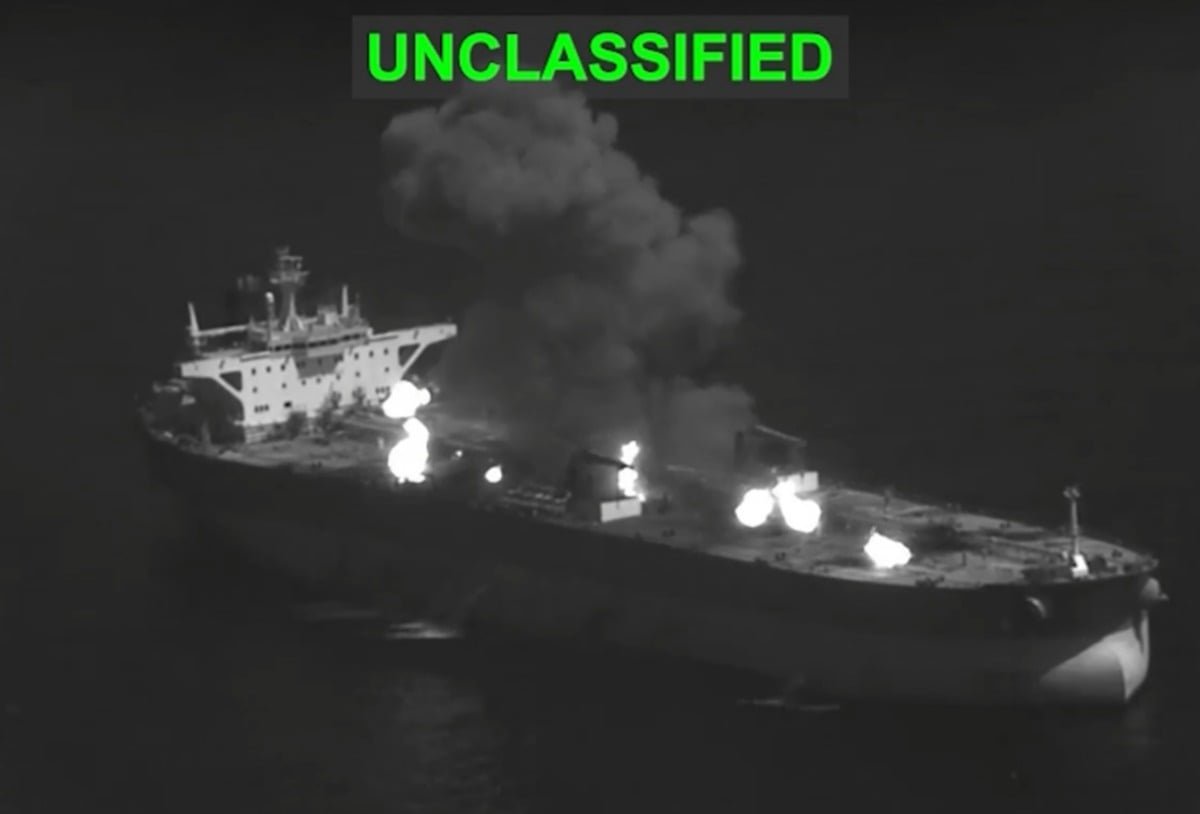
In response, American forces permanently disabled two Iranian crude oil carriers, the M/T Downy off Kharg Island and the M/T Stark 1 near Jask, and completely destroyed a third, the unladen M/T Kylo, also known as the Noxen, in the Gulf of Oman. CENTCOM said forces struck the Kylo in multiple critical locations after its crew was ordered to abandon ship, rendering the vessel inoperable.
– ADVERTISEMENT – CONTINUE READING BELOW –
CENTCOM described the three tankers as part of what it called a multibillion-dollar shadow fleet that generates revenue for the IRGC and its regional proxy groups, adding that Iran had no way to defend the ships once they were targeted.
“Let the message to the IRGC be clear: If you shoot at two of our ships, we will impose an even higher economic cost, taking out three of yours,” said Adm. Brad Cooper, CENTCOM commander. “We will not hesitate to defend American forces, and if necessary, destroy Iran’s limited and exposed oil fleet.”
The strikes are the latest exchange in a conflict between the United States and Iran that began February 28, when the U.S. launched Operation Epic Fury. American forces have since enforced a naval blockade meant to cut off Iran’s oil exports, repeatedly disabling tankers that attempted to defy it. In May, an F/A-18 launched from the USS Abraham Lincoln (CVN 72) disabled the tanker M/T Hasna’s rudder with cannon fire near an Iranian port, and jets from the USS George H.W. Bush (CVN 77) later disabled two more unladen tankers, the M/T Sea Star III and M/T Sevda, attempting the same route.
A ceasefire took hold by early June, though CENTCOM described it as fragile at the time and publicly disputed Iranian claims that its forces had fired on U.S. Navy ships in the Gulf of Oman, saying doing so would have violated the truce. The uneasy calm broke down further in July, when Iran struck three commercial tankers in the Strait of Hormuz, prompting CENTCOM to hit more than 80 targets across southern Iran overnight, including air defense systems, command-and-control networks, coastal radar sites and more than 60 IRGC small boats.
