

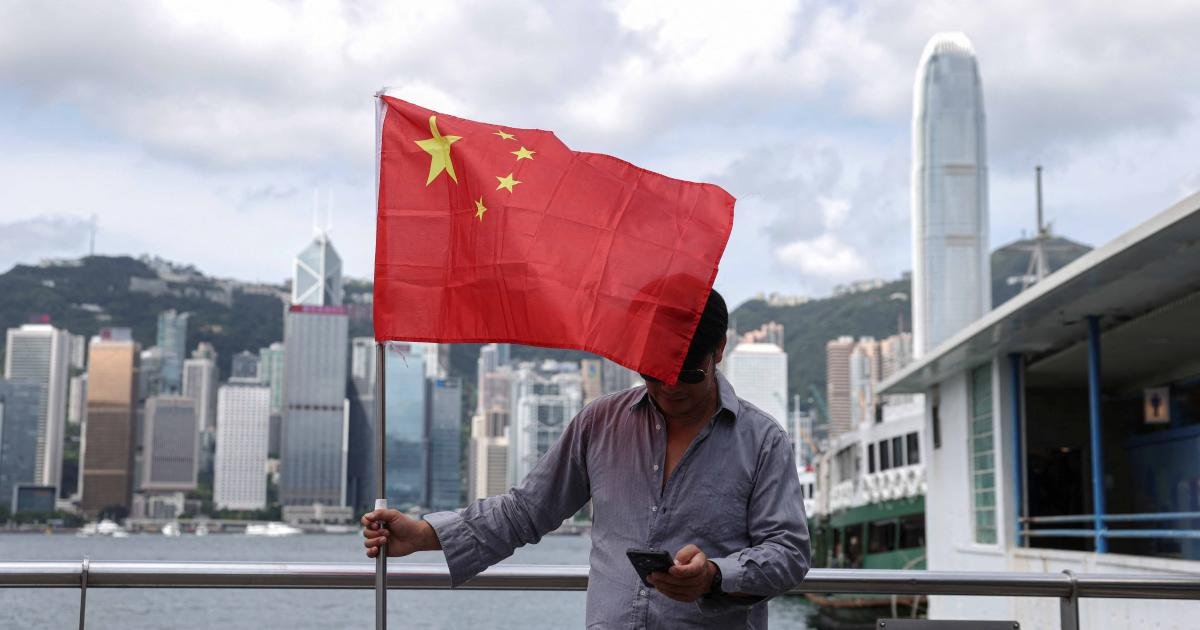
In July, Bloomberg reported that for the first time in roughly two decades of Pew Research Center global polling, the world now views China more favorably than the United States. The sentiment was not universal, but in 25 of the 36 countries surveyed this year, the percentage of respondents who gave favorable marks to China exceeded that for the United States, including several close U.S. allies. Some analysts have taken these findings as confirmation that the golden era of American soft power is over and China is ascendant. According to them, Trump’s policies on tariffs, aid, and allies have eroded the United States’ standing, opening the door for people across the world to switch their allegiance to China.
But this interpretation, convenient as it may be, deserves more scrutiny. A closer examination of the data reveals that although global opinion of the United States has indeed plummeted and opinion of China has risen since 2022, most of the world still prefers the United States as an economic partner—including most of the countries that now view China in a more positive light. This is a critical distinction, since economic partnerships and interests tend to drive national policies. Indeed, it signals something more nuanced is happening than simply the end of American hegemony and an imminent age of Chinese global supremacy.
The world’s increasingly pro-Chinese attitude is not meaningless. That more and more people think better of Beijing than of Washington could eventually prove important as Beijing seeks to build up its soft power. For now, however, what the numbers actually show is a world adjusting to the new reality of great-power competition, feeling forced to choose one side without the luxury of liking it.
STILL ON TOP
Favorability is, in essence, a feeling. When people are asked to say how favorably they view something, they are really being asked whether and how much they like it—and little else. Pew’s favorability question also asked only whether respondents hold a positive or a negative impression of China and the United States, not whether they liked one more than the other. Still, Beijing clearly came out on top in these questions. Favorable views of the United States fell significantly in 15 of the 24 countries surveyed in both 2025 and 2026. Moreover, in several U.S. ally countries, including Canada, France, Germany, Italy, South Korea, and the United Kingdom, favorability ratings are now at or near their lowest since Pew began polling in 2002. In contrast, China’s image has consistently improved in several Western countries. The percentage of Italian respondents with a favorable opinion of China, for instance, increased from 31 percent in 2022 to 51 percent in 2026. In Spain, China’s favorability rose from 37 percent in 2025 to 54 percent in 2026.
Media outlets and observers have fixated on these numbers, but the same Pew survey asks another, more consequential question: “Is it more important for your country to have strong economic ties with China or with the United States?” This prompt forces respondents to weigh the two powers against each other and pick one. Critically, it asks them to consider not just how they feel about each country but also which they would rather work with. In 2025, the last year for which country-by-country, individual-level data is available, more respondents in 20 out of 24 countries chose economic ties with the United States over ties with China.
In seven of those 20 countries, answers to the two questions diverged. More respondents in Canada, France, Greece, the Netherlands, Spain, Sweden, and Turkey rated China more favorably than the United States, yet more people chose economic ties with the United States over China, sometimes by wide margins. In Sweden, for example, respondents preferred U.S. economic ties to Chinese economic ties by 48 percentage points. Turkish respondents rated China 13 percentage points more favorably than they did the United States but preferred economic ties with the United States by ten percentage points anyway.
As the only country that favors Chinese economic ties but views the United States more favorably, Australia is an outlier. This is not much of a surprise given that China is already the country’s largest export destination, accounting for 30 percent of everything Australia sells to the world. But it is noteworthy that half of Australians believe China is the country that threatens Australia most, and a full third believe the United States is Australia’s most important ally, compared with seven percent who believe China is. When asked, however, whether Australia’s economy should have closer ties to China or to the United States, 54 percent picked China, compared with 43 percent that picked the United States. Favorability, it appears, cannot adequately capture the nuance of public opinion on the two countries, much less divine a shift in the balance of soft power.
Globally, the individual respondents who preferred China as an economic partner seem to have done so because they believe that China is already the world’s leading economic power. Sixty percent of global respondents who preferred economic ties with China believed as much, compared with 20 percent who think the United States is the world’s leading economic power. The same pattern holds true for the United States: roughly 58 percent of the people who prefer economic ties with the United States think that it is the global economic hegemon, whereas 26 percent believe that China is. This makes intuitive sense: people want to partner with whoever they think is the winner. But Pew’s data also suggests that people still have a desire to partner with Washington on economic matters, because many still say they want to even when they don’t think it is the winner. Of those who believe the United States still leads the world economy, 75 percent chose economic ties with the United States, compared with just 15 percent who chose a closer economic relationship with China. Yet among those who believe China has taken the lead, 49 percent chose China and a remarkable 38 percent still chose the United States.
THE FENCE SITTERS
Not everyone feels compelled to choose between the United States and China. Across the 24 countries surveyed in 2025, roughly one in nine respondents preferred that their country maintain strong economic ties with both powers rather than supporting one over the other. In some countries, this group of fence sitters is too large to ignore. Thirty-nine percent of Nigerians—a plurality of respondents—declined to choose between Washington and Beijing. So did 32 percent of Israelis, 27 percent of Hungarians, 23 percent of Germans, and 20 percent of Turks. Across all countries, 16 percent of those who named the United States as their country’s most important ally but believed China now leads the world economy opted not to choose a single most important economic partner, compared with 11 percent of all other respondents.
That is not to say that fence-sitting publics will remain undecided as the U.S.-Chinese competition intensifies. They may yet be moved to commit to a side if it looks like a reliable protector against a clear danger. For Washington, this is still good news. In 20 of the 24 countries surveyed, more people named the United States than China as their country’s most important ally. China leads in only Indonesia, Nigeria, South Africa, and Turkey. In no country did a majority name China, whereas the United States won majorities in five countries. That gap is Beijing’s weakness and Washington’s remaining advantage.
The Trump administration’s wavering commitment to allies threatens to undermine it. So might the common—and incorrect—belief that China has already won the economic race. By most measures, the U.S. economy is still the world’s largest and most productive. Yet in the eyes of the rest of the world, every new trade war and every rupture with an ally risks reinforcing the belief that the U.S. economy is headed in the wrong direction.
For now, however, fears that public opinion has tilted toward China are overblown. When forced to choose, most of the world still prefers working with Washington, and most of those who choose Beijing are likely betting on predictions about its economic rise. Beijing, then, should not mistake favorability for partnership. And Washington must keep the United States’ markets open and its commitments credible before the belief that the country’s economic future is behind it becomes a self-fulfilling prophecy.
Loading…
