

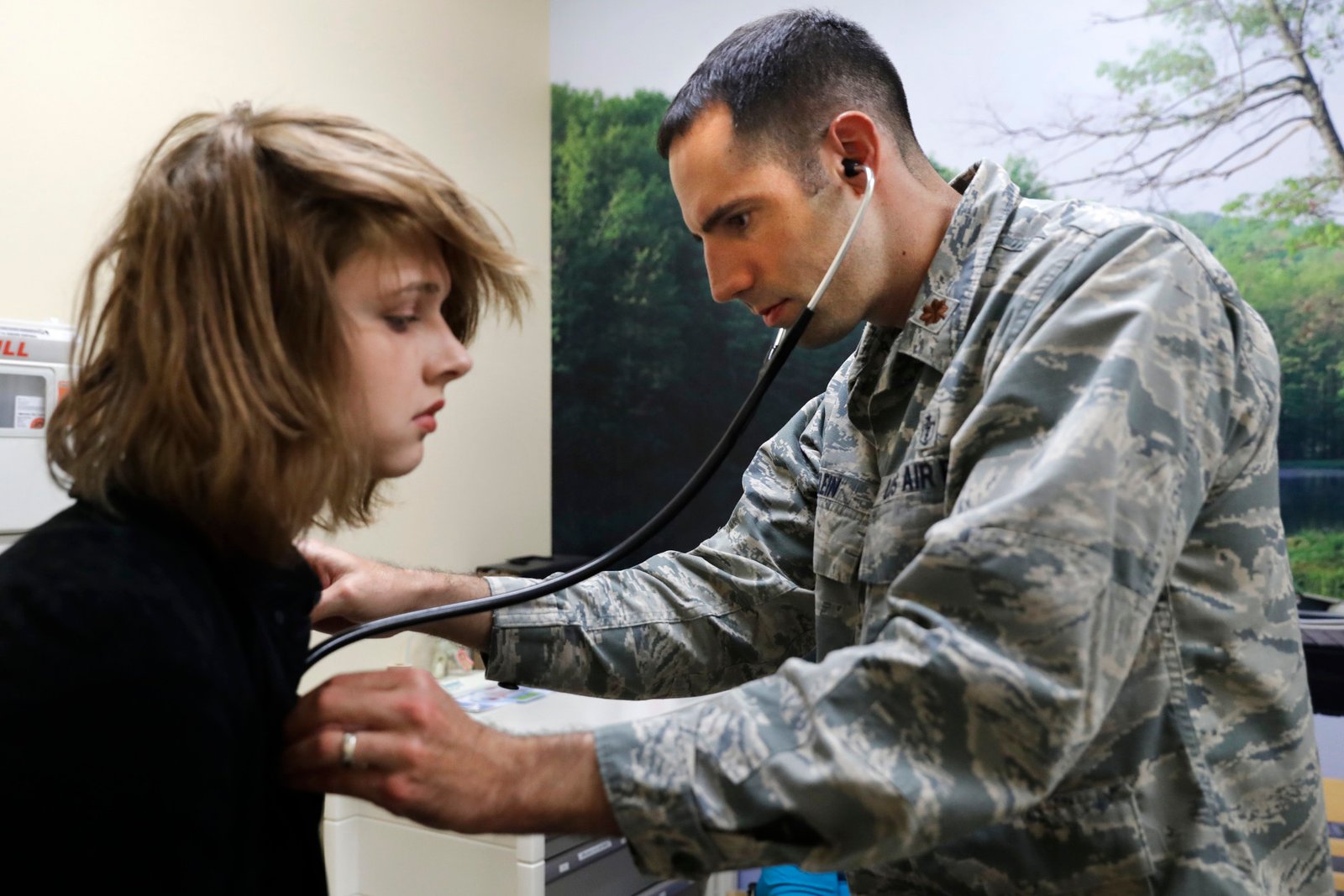
“You want to make sure that you give that child every possibility of recovery. And that’s part of deployment medicine,” Cmdr. Emily Latimer said.
| Guest: | Cmdr. Emily Latimer |
| Title: | Emergency clinical nurse specialist, Naval Medical Center Camp Lejeune |
| Summary: | Military medical professionals train constantly for trauma care, but some tools and processes designed for adults don’t always translate well to children. Navy Cmdr. Emily Latimer led research to find a better approach for administering blood to pediatric trauma patients, an innovation that earned her the Defense Health Agency Nursing Award for Evidence-Based Practice. Here’s what her team learned and what it says about readiness across military medicine. |

Interview transcript
Terry Gerton Let’s talk about this case that led to your recent [Defense Health Agency Nursing Award for Evidence-Based Practice] award. What was the moment when you realized the systems and the processes you had for treating pediatric trauma patients weren’t as good as they needed to be?
Emily Latimer There were really two moments that led to the realization. The first was a drill where we tried to use the new system that we had pulled together — to practice and to really evaluate whether a system we thought was going to work would work in a real situation. And when we did that drill, we found that there were many elements of a system that met some of our needs. But it was really just not quite fast enough, and a little bit too labor-intensive for the nurses to use. And then just a couple weeks after that, before we had a chance to really dive back into problem-solving, we had day where we had multiple pediatric trauma patients over the course of an afternoon, many of who were quite sick. And one of those patients was infant who needed blood very quickly, and we really had to work very hard to figure out how to make our process work, to be able to get blood to that patient as quickly as they needed it. And it required a lot of both physical work and mental work by the entire team in the room in what was already a very tense, high-stress resuscitation. After that case, myself and a couple of my colleagues really decided that it was time to dive back in and try again to solve this problem of, how do we give blood to pediatric patients when they need it really quickly and dealing with the unique challenges that they present because of their size?
Terry Gerton What makes giving blood to a pediatric patient so much more challenging than giving it to an adult?
Emily Latimer Well, when any person needs blood because of trauma, we need to get it into them quickly. It needs to be warmed, ideally, and there’s special tubing that you have to use with blood products that prevent clots or any of the other factors of storage from affecting the patient. But pediatric patients are tiny. Everything about them is smaller, including their veins. So sometimes we either can’t get an IV in them or we have to use very, very small IVs. And we have dose their blood very precisely. Unlike adults, everything about pediatric patients and medications is based on their weight. And so an infant is not going to get the same amount of blood as a 5-year-old, as a 10-year-old, as a 12-year-old. We need a system that lets us give blood quickly and warmed using the right tubing system, but also lets us dose it very precisely and works well with those very special small IVs. With adults, we use rapid infuser systems, but most of those are not as easy to use to meet those specific needs, especially the precise dosing and the very close control with those small IVs.
Terry Gerton And so as you began testing alternatives, what did you learn? Were there options out there for you, or did you come up with your own?
Emily Latimer Oh, no, we did not come up with our own. We went searching for — what have other smart people figured out? And how can we take what they’ve learned and find the right fit for our facility, that we can adapt to our needs? And so we found a system that seemed like it fit all of our needs and was actually already in use in our region by the emergency medical services. So we had an opportunity to actually try out their equipment before we started this project in earnest and got a chance to put our hands on it and test it out, which led us to thinking that it would probably be a great fit. But we had learned from our previous experience that just because we thought it might work doesn’t mean that it will. So when we proceeded with this project, we took this new system to our nurses and to our paramedics, who are the ones that give blood in the pediatric resuscitations, and we asked them to do side-by-side tests of our previous system and this new possible system that we decided to evaluate. In that process, we found that our nurses and paramedics had almost a universal buy-in to the new system. They loved it. It was faster and it was much, much easier for them to use. Ultimately, that ended up being great for when we rolled it out because we already had many people who believed in this change, and so they were happy to support and help make the change go into place.
Terry Gerton Navy Cmdr. Emily Latimer is an emergency clinical nurse specialist assigned to the Naval Medical Center at Camp Lejeune, North Carolina. Cmdr. Latimer, you mentioned earlier that one of the triggers for this experiment was a day when you received several pediatric trauma patients at your hospital. How unusual is that at a military hospital? Do you mostly see adults in the trauma center? Do you get very many children?
Emily Latimer In most of the military hospitals, while much of our patient population is adults, we do see lots of kids. And wherever we’re taking care of military service members, we’re taking care of their families, too. And so taking care of sick children is something that we expect to do. Not necessarily in quite the concentrated numbers that we experienced that day, but we do expect to see sick kids pretty much in every military hospital.
Terry Gerton And how does the experience of treating sick military families and their children stateside translate into what you might experience in a deployment?
Emily Latimer Well, in most deployments, we should expect that most of our patients are adults, but you never really know. And there are plenty of times where a sick or injured child will come to a deployed medical team. And those cases are often some of the ones that stay with you. I know many colleagues have shared that taking care of children on deployment are some of the most challenging cases that they think about after the fact — because so much of our training is focused on preparing for adult patients. But when the pediatric patient shows up in front of you, you want to do a great job. You want to make sure that you give that child every possibility of recovery. And that’s part of deployment medicine, just like taking care of someone who’s experienced a blast injury.
Terry Gerton You’re headed off on your next assignment to a training position: department head for the Corpsman Trauma Training at the University Hospital’s Cleveland Medical Center in Cleveland. How will what you’ve learned in this process translate into how you approach training for the folks that you’ll be overseeing?
Emily Latimer Training people to be ready to resuscitate and to be ready to take care of whatever sick patient shows up in front of you was a key part of why we pursued this project in the first place. It’s also a major purpose of the Corpsman Trauma Training programs, and so having an emphasis and a passion for training people to be ready for trauma care, is really at the heart of what I love to do. And so I’m very excited about being able to continue in that role of preparing people to take care of whatever trauma patient shows up in front of them.
Copyright
© 2026 Federal News Network. All rights reserved. This website is not intended for users located within the European Economic Area.
