

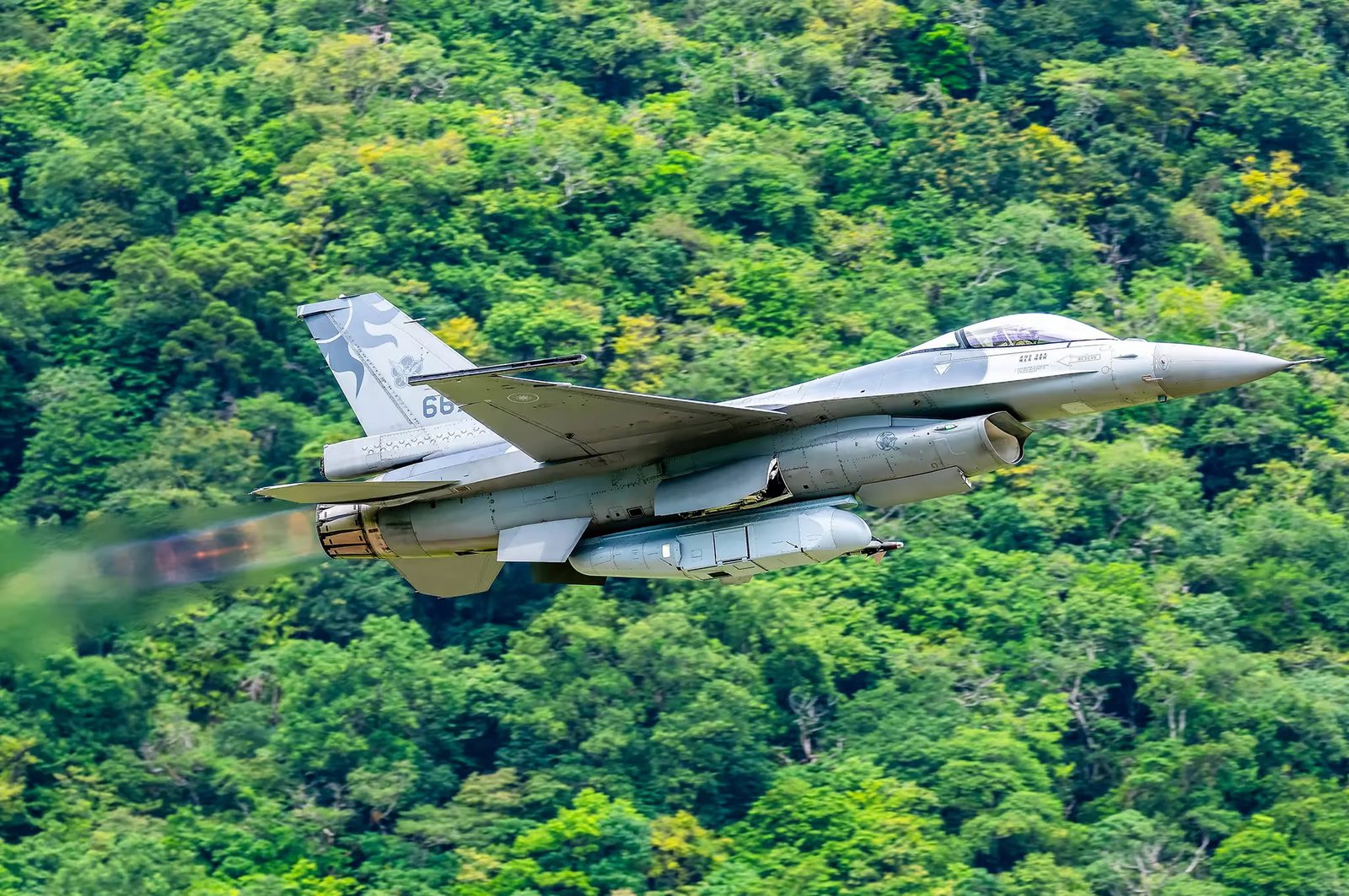
Photos in recent days have confirmed that Taiwan has received Collins Aerospace MS-110 multispectral reconnaissance pods.
A Republic of China Air Force (ROCAF) F-16AM (tail number ‘6673’) was photographed on consecutive days, 26 and 27 August, carrying an MS-110 pod on its centreline station, presumably for flight testing. It was operating from Chiashan Air Force Base in Hualien on Taiwan’s east coast.
Taiwan’s Ministry of National Defense announced that it had signed a contract to purchase six MS-110 pods in July 2021, with the acquisition programme designated Project Feng Zhen (Phoenix Scout).
It is not known when the systems were delivered or whether all six have been received, although a local report indicated that deliveries began last year, with ground testing and personnel training taking place since then.
The MS-110 will replace a similar number of AN/VDS-5 long-range, oblique, reconnaissance (LOROP) pods procured in the late 1990s and early 2000s under Project Feng Yan (Phoenix Eye). These LOROPs are flown on F-16s operated by the 12th Tactical Reconnaissance Group at Hualien.
The AN/VDS-5 system is thought to be based on the Tactical Airborne Reconnaissance Pod System (TARPS) used on the F-14 and featuring a KS-87B camera, KA-99A panoramic camera and AN/AAD-5 infrared camera. The system is housed in a Modular Reconnaissance Pod manufactured by Danish company Per Udsen, now known as Terma.
Taiwan’s LOROP pods are believed to have been upgraded over the years, evolving from wet-film systems to digitised electro-optical systems. Reportedly, images captured by the pods can be transmitted to a ground station as they are taken, possibly through the Link 16 tactical data link added to F-16s in the mid-to-late 2000s.
The F-16 and AN/VDS-5 combination has been put to good use in a number of peacetime missions. In recent years, the aircraft have conducted photo reconnaissance missions against People’s Liberation Army Navy aircraft carriers as they passed through waters around Taiwan.
The arrival of the MS-110 will represent a significant enhancement to Taiwan’s airborne photo reconnaissance missions. The system, which is derived from Collins Aerospace’s DB-110 LOROP pod, adds a multispectral capability. This offers a farther and broader range of surveillance than the AN/VDS-5, allowing Taiwan to peer deeper into China.
While the MS-110’s standoff range has not been disclosed, that of the DB-110 has been publicised at about 150km – significantly greater than the AN/VDS-5, which some sources have stated has a range of less than 100km.
The multispectral capabilities of the MS-110 also improve target discrimination and detection during analysis, helping to identify subtle characteristics that may not be apparent in conventional imagery.
The MS-110’s ability to capture imagery day or night and in all weather conditions also represents a major leap over the AN/VDS-5, which is thought to have a more limited capability at night.
It is unknown whether the ROCAF’s MQ-9B unmanned aerial vehicles, of which the service is currently taking delivery, will be equipped with the MS-110 pod too. The system is compatible with the unmanned platform, although it uses a different housing design.
This development comes as Taiwan prepares to receive the first pair of its 66 new F-16C/D Block 70 aircraft.
by Roy Choo
