

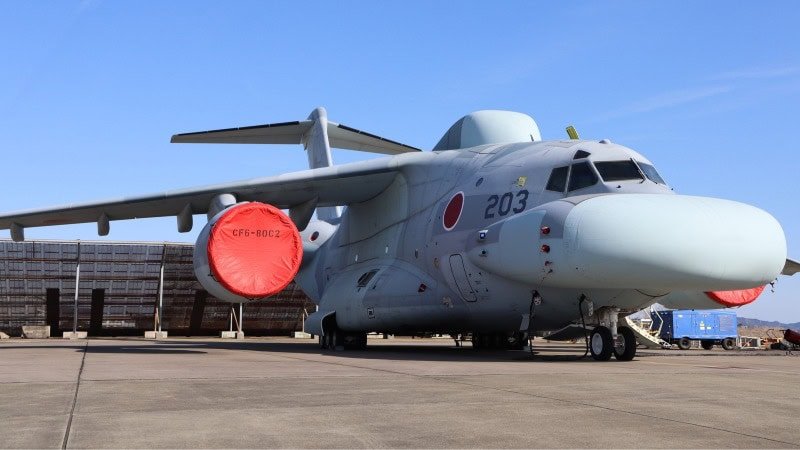
On July 15, Japan’s next-generation XEC-2 stand-off jammer (SOJ) electronic warfare aircraft began operational testing and evaluation with the Air Development and Test Wing (ADTW) of the Japan Air Self-Defense Force (JASDF) at Gifu Air Base.[1]
The aircraft is currently designated XEC-2, with the “X” denoting its experimental status. Upon entering operational service, it is expected to be redesignated EC-2.
Japan’s Ministry of Defense (JMOD) plans to procure a total of four aircraft, with the first unit scheduled for delivery in fiscal year (FY) 2027.
The XEC-2 is intended to jam enemy radars and disrupt communications systems from outside the range of the adversary’s air-defense systems. This manned SOJ is likely to be complemented by UAV-mounted stand-in jammers designed to operate within hostile airspace closer to the threat.
Informally dubbed the “Platypus” because of its distinctive bulbous radome nose, the XEC-2 is based on the C-2, a twin-engine military transport aircraft developed by Kawasaki Heavy Industries (KHI) that began operations with the JASDF in 2017.
Development of the electronic warfare (EW) variant began in FY2020. The XEC-2 underwent extensive modification by KHI and bears the serial number 68-1203.
The aircraft made its maiden flight in March 2026 and will retain the XEC-2 designation during testing and evaluation. Once in service as the EC-2, it is expected to be operated by the JASDF’s Electronic Warfare Operations Group.
The planned fleet of four EC-2 electronic warfare aircraft is intended to replace the JASDF’s sole EC-1, which was used as an electronic warfare training aircraft for nearly four decades and retired in March 2025.
Insights into Japan’s Next-Generation Stand-Off Jammer Aircraft
JMOD has not officially disclosed specifications for the aircraft. However, numerous details can be gleaned from publicly released documents by Japan’s Acquisition, Technology & Logistics Agency (ATLA) as well as reports by independent analysts.
The Kawasaki C-2 transport aircraft, which serves as the basis for the XEC-2, measures 43.9 m in length, has a wingspan of 44.4 m, and stands 14.2 m high. ATLA indicated in a March 2026 project progress report that the electronic warfare variant has broadly similar dimensions.[2]
Nevertheless, alterations have been made to to account for a stand-off jamming role: a large forward radome replacing the C-2’s regular nose and additional fairings on top of the fuselage and around the rear section.

Analysts have suggested that the appendages enable “antenna coverage across several sectors and allows the aircraft to receive, classify, and transmit electromagnetic energy in more than one direction without continuously pointing the nose at the target area.”[3]
The C-2’s flight performance and payload were two key reasons for ATLA’s decision to use the transport plane as the EC-2’s base platform.[4] The transport variant has a maximum payload of 36 tonnes, a maximum speed of Mach 0.82 and a range of approximately 4,500 km when carrying its maximum payload.
The EC-2 is to be the second specialized variant of the C-2, following the RC-2 signal intelligence (SIGINT) aircraft which entered service with the JASDF in 2020 and features smaller external fairings than the EC-2.

The RC-2 SIGINT variant is tasked with measuring the electromagnetic environment in the vicinity of Japan.
The EC-2, in contrast, is expected to jam enemy radars and disrupt communications systems.
Onboard Electronic Warfare Systems
An August 2019 ATLA evaluation report on the EC-2 made shortly before the aircraft’s development phase began in FY2020 reveals some of the requirements for the onboard jamming systems and other EW equipment.[5]
ATLA documentation indicates that the EC-2 incorporates the indigenous J/ALQ-5 electronic countermeasures (ECM) suite inherited from the EC-1. The original system had been in service for nearly 20 years before being upgraded as the J/ALQ-5 Kai, which entered operation in FY2011 for training purposes aboard the EC-1.
Principal improvements made to the J/ALQ-5 Kai included wider frequency coverage and increased signal output to better account for advances in radar, ECM, electronic counter-countermeasures (ECCM), and anti-jamming technologies.[6]
New technological priorities for the EC-2 outlined in the 2019 ATLA evaluation report include establishing data-link jamming technologies capable of receiving low-power, wideband data-link signals and conducting effective wideband jamming.
The program also aimed to establish a multi-platform architecture that would allow capability upgrades without requiring major aircraft modifications.
In March 2026, the same month that the XEC-2 prototype made its maiden flight, ATLA provided further details in a progress report[7] regarding the aircraft’s data-link, voice-communications, and radar-jamming functions.
ATLA reported that the required underlying technologies had been demonstrated for all three functions.
The data-link and voice-communications jamming systems have since progressed to the prototyping stage and demonstrated the required capabilities in a ground-based test configuration. As of March, both functions are scheduled to undergo technical testing, including in-flight testing aboard the XEC-2 prototype.
Concrete development of the radar-jamming function, meanwhile, is planned for a later unspecified stage following completion of the current phase focused on data-link and voice-communications jamming.
Therefore, it remains to be seen when the radar-jamming capability will be integrated and become operational aboard the EC-2. It will presumably have to be integrated before the electronic warfare aircraft’s scheduled delivery to the JASDF in FY2027.
Conclusions
Japan’s decision to begin acquiring EC-2 electronic warfare aircraft by FY2027 for the express purpose of conducting stand-off operations designed to jam adversary radar and communications systems represents a significant step toward the proactive operational use of electronic warfare capabilities.
While the JASDF operated for decades a single EC-1 for training purposes, four EC-2 aircraft are expected to play a significant role alongside stand-in jammers and other EW systems to deliver disruptive effects against the communications and detection capabilities of prospective adversaries.
Since the beginning of the EC-2’s development in FY2020, the importance of this requirement has only increased. JMOD has observed how the war in Ukraine has demonstrated the growing sophistication of EW capabilities aimed at disrupting precision-guided weapons and UAV operations, thus necessitating further reinforcement of Japan’s own electronic jamming capabilities.[8]
A potential concern with the EC-2 then, is the fact that the aircraft’s radar jamming functionality does not appear to have reached yet the prototype stage as of March 2026. Radar jamming will be a vital capability for disrupting communications networks supporting missiles, UAVs, and other aerial threats, and will have to be established in time for the EC-2’s scheduled delivery in FY 2027.
Notes:
[1] JASDF Air Development and Test Wing, Post on X, July 17, 2026, https://x.com/jasdf_adtc/status/2078013435657494882.
[2] ATLA, “㊽ スタンド・オフ 電子戦機” [48 Stand-Off Jammer Electronic Warfare Aircraft], March 2026. In: “プロジェクト管理対象装備品等の現状について” [Current Status of Equipment and Related Items Under Project Management], pp.48-1 – 48-6, ATLA, “C-2 Transport Aircraft”, https://www.mod.go.jp/atla/en/research/C-2.html.
[3] Jérôme Brahy, “Japan officially launches EC-2 electronic warfare jet flight test campaign at Gifu Air Base”. Army Recognition, July 18, 2026, https://www.armyrecognition.com/news/aerospace-news/2026/kawasaki-ec-2-soj-electronic-warfare-aircraft-flight-tests.
[4] Akhil Kadidal, “Japan to use C-2 airlift for stand-off EW aircraft”. Janes, May 2, 2022, https://www.janes.com/defence-intelligence-insights/defence-news/defence/japan-to-use-c-2-airlifter-for-stand-off-ew-aircraft.
[5] ATLA, “令和2年度 政策評価書(事前の事業評価) 事業名 スタンド・オフ電子戦機” [FY2020 Policy Evaluation Report (Ex-ante Project Evaluation) Project Name: Stand-off Electronic Warfare Aircraft], https://warp.ndl.go.jp/web/20201210084634/www.mod.go.jp/j/approach/hyouka/seisaku/31/pdf/jizen_02_honbun.pdf.
[6] ATLA, “平成24年度 政策評価書(事後の事業評価)要旨 事業名: 訓練用ECM装置J/ALQ-5の能力向上に関する開発” [FY2012 Policy Evaluation Report (Ex-post Project Evaluation) Summary – Project Name: Development for Capability Enhancement of Training ECM System J/ALQ-5], https://warp.ndl.go.jp/web/20190808103947/www.mod.go.jp/j/approach/hyouka/seisaku/results/24/jigo/youshi/05.pdf.
[7] ATLA, “㊽ スタンド・オフ 電子戦機” [48 Stand-Off Jammer Electronic Warfare Aircraft], March 2026. In: “プロジェクト管理対象装備品等の現状について” [Current Status of Equipment and Related Items Under Project Management], pp.48-1 – 48-6, https://www.mod.go.jp/atla/soubiseisaku/project/gaiyo_r080520.pdf.
[8] JMOD, “Direction of Defense Capability Transformation (2)”, March 19, 2026, https://www.mod.go.jp/en/d_policy/defense-capability-transformation/index.html.
This article was originally posted on NSBT Japan, the first defense and security industry network in Japan. The publication provides the latest information on security business trends both within Japan and overseas. Asian Military Review began exchanging articles with NSBT Japan in April 2024.
Read the original article here.
