

Canadian Prime Minister Mark Carney dominated headlines with his 2025 Davos address. Declaring the end of the rules-based international order and the emergence of “intensifying great power competition”, Carney’s assessment reflects the visible erosion of multilateral institutions such as an absent World Trade Organization (WTO), a paralyzed United Nations Security Council (UNSC), and the rise of powerful states leveraging hard power dependencies to expand their influence and wealth.
The Kremlin continues its invasion of Ukraine while expanding its hybrid war against Kyiv’s supporters; Beijing uses its newfound naval power and near-monopoly on rare-earth supply chains to coerce states across the globe; and even the United States, traditionally viewed as the principal guarantor of the liberal order, has increasingly used its economic and security leverage to extract concessions from partners. Non-great powers increasingly risk, to paraphrase Belgian PM de Wever, oscillating between being “happy vassals” and “miserable slaves.”
However, states are not inherently helpless against great power coercion. Theoretically, Middle powers can preserve strategic autonomy through three mutually reinforcing strategies: military indigestibility, collaborative shielding, and economic indispensability. These strategies form a Triangle of Strategic Autonomy, a framework for measuring how states combine military resilience, external partnerships, and economic leverage to resist coercion. Existing scholarship examines deterrence, alliances, and economic statecraft separately. The Triangle of Strategic Autonomy argues that middle power resilience depends not on maximizing one source of power, but on balancing multiple forms of leverage.
An examination of Finland, Taiwan, and North Korea demonstrates that no single strategy provides a complete solution. North Korea survives through extreme military indigestibility but remains diplomatically isolated and economically vulnerable. Taiwan leverages its unique semiconductor dominance but faces uncertainty regarding external support. Finland demonstrates the advantages of combining credible defense with deep institutional integration.
The central finding is straightforward: military indigestibility is the foundation of resistance, but durable autonomy requires at least one additional pillar: economic indispensability, collaborative shielding, or both.
The Triangle of Strategic Autonomy
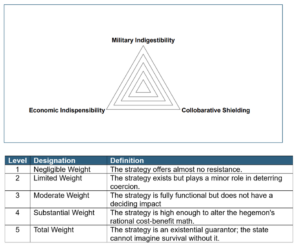
This model measures three mechanisms through which middle powers can resist coercion: First, military indigestibility: the ability to deny a stronger adversary a quick, affordable victory, or even militarily punish said coercer. Second, collaborative shielding: the ability to embed sovereignty within alliances, institutions, and diplomatic networks. Third, economic indispensability: the ability to create dependencies that make coercion economically self-defeating.
To evaluate how middle powers combine these strategies, this article introduces the Triangle of Strategic Autonomy, a spider-diagram analytical framework that codes each posture’s operational weight on a five-level rubric.
Finland
As a former part of the Russian Empire, Finland has seen plenty of coercive actions from its eastern neighbor. Most notable were the Finno-Soviet conflicts in the early twentieth century, which resulted in Finland losing roughly 10% of its territory to the Soviet Union and were followed by a Cold War period of enforced neutrality, pejoratively termed “Finlandization”. Currently, Finland and the Russian Federation share a 1,340-kilometer border, and the Nordic state stands at the frontier of contemporary EU/NATO-Russian tensions and is regularly subjected to Russian hybrid threats. The Kremlin openly views Finland as an enemy, and frequently jams Finnish GPS systems, seemingly breaches its airspace, and even pushes migration flows into the Nordic country. The Kremlin also threatened the collapse of “Finnish statehood” and conducts military exercises simulating an invasion of the country.
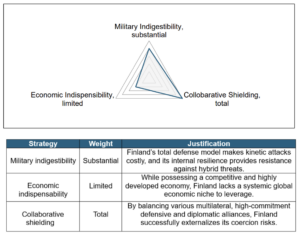
Finland’s military indigestibility is operationalized through kokonaismaanpuolustus, its comprehensive security policy, offering deterrence by denial through a society-wide total-defense system. Despite a modest population of 5.65 million, the Finnish Defense Forces can field a fully mobilized army of 280,000 troops, backed by a reserve of roughly 900,000 (targeted to reach a disproportionate one million by 2031). Eighty-three percent of Finns say they are willing to defend their country against an aggressor; Helsinki has withdrawn from the Ottawa landmine convention, built extensive civilian sheltering infrastructure, and its population enjoys a high level of firearm ownership. Its dense forests, marshlands, and sub-arctic weather offer strategic depth that its forces are specialized in exploiting.
Yet, Finland’s collaborative shielding carries total weight, its most potent strategy. Helsinki holds mutual-defense commitments under both NATO Article 5 and the EU’s Article 42(7), and layers regional frameworks such as the Joint Expeditionary Force and NORDEFCO to hedge against a currently less reliable U.S. security umbrella.
When Finland abandoned 75 years of neutrality to join NATO in 2022, it was subjected to intense Russian pressure, including hybrid warfare, the formation of an army corps in Finland-bordering Karelia, and a threat from deputy security council chairman and former president Dmitry Medvedev that the country had “automatically become targets” for Russian forces, “including… the nuclear component.” Finland weathered the accession gap through existing security networks, an interim UK security declaration, and NATO assurances, demonstrating that collaborative shielding, not military indigestibility alone, neutralized Moscow’s attempt to dictate Finnish foreign policy. Finland’s economic indispensability, by contrast, carries only limited weight: boasting a competitive, advanced economy, without any systemic global chokepoint to leverage. Helsinki instead projects geoeconomic power indirectly through the EU common market where possible.
Finland’s Strategic Configuration
Taiwan
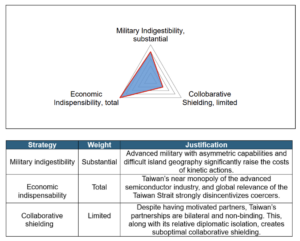
Of the three cases, Taiwan faces the most existential and imminent coercion, with Xi Jinping’s armed forces reportedly tasked with developing the capability to conquer the island by 2027. Taiwan fields 169,000 active troops and 1.6 million reservists (of potentially lower quality) equipped with a modern arsenal of indigenous and U.S.-made platforms, and has doubled defense spending over the past decade (though Beijing’s annual spending increases alone exceed Taiwan’s entire budget). Recognizing it can never conventionally match China, Taipei adopted the “Overall Defense Concept,” colloquially the “porcupine strategy”: a small number of high-quality platforms paired with large quantities of low-cost asymmetric systems designed to make invasion prohibitively costly. Geography compounds this: the strait’s volatile weather, narrow beachheads, and mountainous interior would make an amphibious assault one of history’s most difficult operations. However, questions remain, with critics stressing that Taiwan has not sufficiently leaned into this strategy while the island’s geography also leaves it uniquely vulnerable to a People’s Liberation Army Navy (PLAN) blockade.
Taiwan’s most potent lever, however, is not military but economic. The island produces over 90% of the world’s advanced semiconductors; the Taiwan Semiconductor Manufacturing Company’s (TSMC) foundries are so far ahead that the U.S. has largely ceased competing in hyper-advanced manufacturing, while China’s massive investments have yet to produce comparable quality. Even under pressure to reshore, TSMC has refused to move its most advanced 2-nanometer foundries off the island, so China cannot fully decouple from Taipei despite applying ample economic pressure. Beyond chips, the Taiwan Strait carries roughly half the world’s shipping containers and $2.45 trillion in annual trade, mostly destined for China, Japan, and South Korea, which collectively account for 40% of global manufacturing. Bloomberg Economics modeled a US-involved cross-strait war at $10.6 trillion in global GDP loss in its first year, dwarfing COVID-19 and the 2008 financial crisis, an Economic Mutually Assured Destruction scenario in which China is the most exposed party.
Taiwan’s collaborative shielding, by contrast, is its most precarious pillar. Beijing’s “one China” policy has driven Taiwan’s diplomatic allies from 67 in 1970 to just 12 today, and Taipei is not a UN member. Taiwan is instead forced to rely on informal, non-binding bilateral ties, chiefly with the U.S. and Japan—both wary of Chinese hegemony and economically linked to Taiwan’s chip industry. Washington’s policy of strategic ambiguity is a double-edged sword: it complicates Taipei’s own planning even as it forces Beijing to weigh an uncertain risk of U.S. intervention. As Taiwanese policymakers grow more concerned about American reliability, the island is increasingly preparing to survive on its own.
Taiwan’s Strategic Configuration
North Korea
Tensions between the United States and the Democratic People’s Republic of Korea (DPRK) date back to their direct engagements during the Korean War (1950–1953) and the subsequent Cold War tensions following the armistice. For decades, North Korea has perceived coercive pressure from Washington, with the primary points of contention being Pyongyang’s nuclear weapons program, encompassing U.S. military presence in South Korea, crippling economic sanctions, diplomatic isolation, and threats of kinetic strikes spanning multiple administrations.
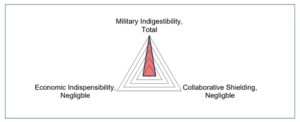
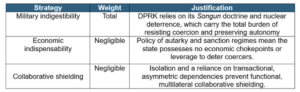
Pyongyang’s Songun Chongch’I (“military first”) doctrine reserves an elevated role for the Korean People’s Army in North Korean society, which is prioritized in resource allocation and fields one of the world’s largest standing armies, at 1,280,000 active troops. Its conventional equipment is dated, but North Korea has developed an expansive military-industrial base, reportedly delivering over 5.8 million artillery shells to Russia during the Ukraine war, potentially as much as 40% of the Kremlin’s total arsenal. While its conventional forces remain qualitatively inferior, Pyongyang prioritizes asymmetric deterrence by punishment through its nuclear program: an estimated 50 nuclear warheads and intercontinental ballistic missiles potentially capable of reaching and penetrating U.S. defenses. The regime’s demonstrated disregard for its own people and access to vast bunkers only strengthen its nuclear threats. Unlike Ukraine and Libya, which relinquished their nuclear programs and were later attacked, North Korea has maintained its autonomy through decades of pressure, expanding its nuclear arsenal despite Trump’s 2017 “fire and fury” threats and maximum-pressure campaign.
Collaborative shielding carries negligible weight in Pyongyang’s configuration. Its mutual-defense pacts with Beijing and Moscow are ambiguous, and even its involvement in the Russia-Ukraine war is mostly transactional, reportedly earning up to $14.8 billion. These relationships function as asymmetric dependencies rather than collaborative buffers, leaving Pyongyang vulnerable to pressure from its own patrons. Economic indispensability is likewise negligible: decades of autarkic Juche policy and sanctions have left North Korea disconnected from the global economy, controlling no strategic chokepoints. Paradoxically, this isolation itself is a buffer: the regime hardly relies on global supply chains, FDI, or financial markets to survive, which curbs the yield of any economic coercion campaign. North Korea’s configuration is therefore a single-pillar posture: total military indigestibility, negligible everything else.
North Korea’s Strategic Configuration
What the Triangle Reveals
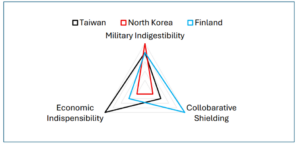
Plotted on the Triangle, the three cases produce distinct geometries, yet share one point of convergence: each attributes at least a “substantial” weight to military indigestibility, establishing this pillar as a baseline prerequisite for coercion resistance. But Finland’s perceived need to reinforce collaborative shielding through NATO accession, and Taiwan’s dependence on its silicon shield, both suggest that military indigestibility alone is insufficient to deter a highly motivated great power. Only a strategy incorporating a strong deterrence-by-punishment element such as North Korea’s nuclear arsenal appears capable of filling that gap alone. Even then, a nuclear arsenal is far from a silver bullet: it does not protect against economic coercion and can impose severe diplomatic costs.
Finland and Taiwan display flipped configurations, with Helsinki leaning into collaborative shielding and Taipei into economic indispensability. Of the three postures, economic indispensability built on a genuine chokepoint capability is the hardest to construct but among the most effective. Taiwan achieves it only after decades of deliberate public-private industrial policy and a fortunate strategic location. Finland’s economic indispensability, by contrast, stays limited despite an advanced economy, while North Korea’s autarky renders the pillar negligible by design. All three middle powers benefit from great and regional power partnerships, but Pyongyang’s ties to Beijing and Moscow, and Taipei’s ties to Washington and Tokyo, remain ambivalent and non-committal—leaving both exposed to weaponized interdependence from their own benefactors. Finland, protected by a genuinely layered and multilateral network of alliances, is comparatively more insulated, suggesting that collaborative shielding is most effective when it is layered rather than singular.
Policy Implications
Military indigestibility, economic indispensability, and collaborative shielding are all robust resistance mechanisms, but none is sufficient alone, and every middle power is constrained (some more than others) by finite resources and competing political priorities. The evidence points toward a strategic calculus:
- Viable resistance against asymmetric coercion ≈ Military Indigestibility + (Economic Indispensability and/or Collaborative Shielding)
- Optimal resistance to asymmetric coercion ≈ Military Indigestibility + Economic Indispensability + Collaborative Shielding
A posture of military indigestibility strong enough to resist kinetic aggression is a necessary component of any successful configuration. But strategies built solely around it, like Pyongyang’s nuclear deterrence-by-punishment model, remain somewhat viable for regime survival while staying severely limited on diplomatic and economic fronts, and may even invite further coercion when a middle power’s interests conflict with those of a great power. A configuration that raises at least two pillars to “substantial” or “total” weight offers more robust resistance in most circumstances.
As the rules-based order erodes and great powers grow more competitive, multilateral collaborative shielding is likely to become increasingly relevant to middle power survival, but so, evidently, is the harder-won leverage of genuine economic indispensability. An important caveat remains that while these strategies dissuade and deter a miscalculating or ideologically motivated great power may still choose to coerce regardless of cost. For middle power policymakers watching the erosion of the old order, the Triangle of Strategic Autonomy offers a diagnostic starting point in asking whether a state’s resistance rests on one leg or three.
