

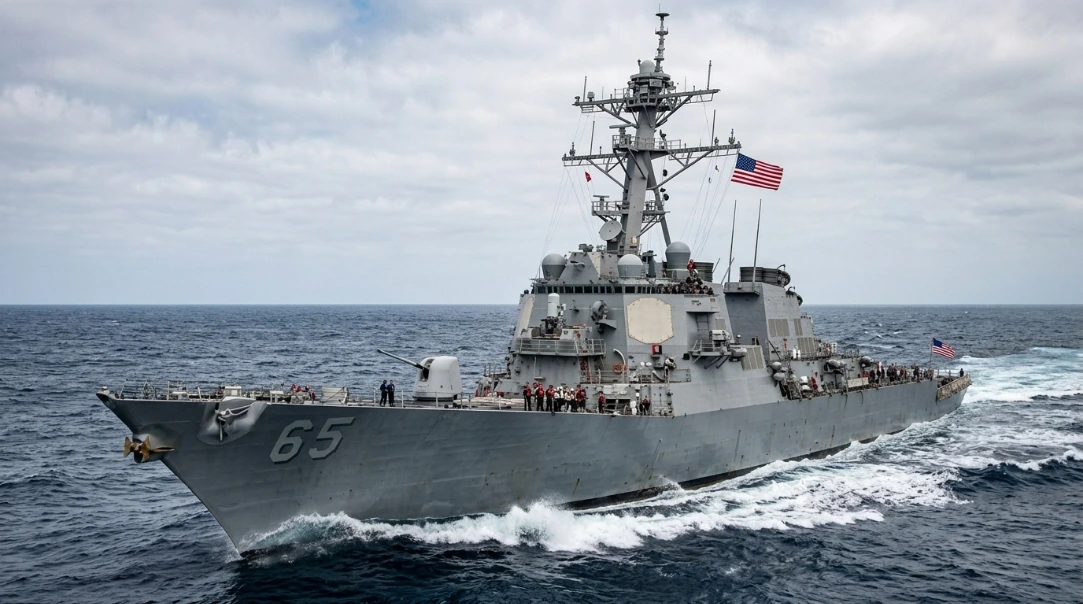
A warship can be three decades old and still be expected to operate in some of the world’s most contested waters. USS Benfold (DDG 65) is a good example of why age alone doesn’t tell you much about the usefulness of a modern destroyer.
Commissioned on March 30, 1996, USS Benfold is one of the early Arleigh Burke-class guided-missile destroyers. The ship was built for an era when the Cold War had just ended, yet its career has carried it into a very different naval environment shaped by ballistic missiles, advanced sensors, increasingly contested waters and persistent competition in the Indo-Pacific.
The more interesting part is what happened between those two eras.
The USS Benfold wasn’t simply kept in service because the Navy needed another hull. Its combat systems were modernized, including an Aegis Baseline 9 upgrade that brought changes to radar, weapons, communications, sonar, electronic warfare, navigation and computing.
Then came another remarkable chapter. From 2015 to 2025, Benfold served as a forward-deployed destroyer in Japan, operating with the U.S. 7th Fleet and sailing more than 4 million miles during that decade-long assignment.
So the real story isn’t simply that USS Benfold has survived 30 years.
It’s how the Navy kept changing what the ship could do while the hull itself grew older.
And that makes DDG 65 a useful case study in how a modern warship can remain relevant long after its commissioning date.
1. USS Benfold: From 1996 Warship to Modern Combatant
When USS Benfold (DDG 65) entered service in 1996, it was already part of a ship class designed to do far more than escort a carrier or protect a formation from aircraft. Benfold was the 15th Arleigh Burke-class destroyer, a family built around the Aegis combat system and intended to handle multiple naval warfare missions.
The ship’s construction began at Ingalls Shipbuilding, where its keel was laid in September 1993. USS Benfold was launched in November 1994 and commissioned on March 30, 1996. Those dates may sound like routine shipbuilding milestones, but they put DDG 65 firmly in the first generation of the Burke class, long before many of today’s naval technologies became standard.
That early position in the class is actually important.
The Arleigh Burke design was built around a relatively adaptable architecture. Instead of creating a destroyer for one narrow mission, the Navy developed a platform combining air-defense capabilities with surface warfare, anti-submarine warfare and strike functions.
That flexibility gave ships like USS Benfold something valuable as technology changed: room to evolve.
A destroyer commissioned in 1996 inevitably contains hardware that dates from the Cold War era. But the ship’s basic architecture can accommodate newer sensors, software, weapons and communications systems.
Think of it less like keeping an old computer running and more like repeatedly replacing its internal components while retaining the underlying chassis.
That distinction helps explain why USS Benfold has remained relevant for three decades.
Its longevity wasn’t accidental. The ship began life as part of one of the U.S. Navy’s most adaptable destroyer families and that foundation would prove just as important as the upgrades that followed.
Read also: The Evolution of the U.S Navy Destroyer
2. USS Benfold Specifications and Armament
The numbers behind USS Benfold (DDG 65) help explain what kind of warship the U.S. Navy has kept in service for three decades. Benfold is an early Flight I Arleigh Burke-class destroyer, measuring about 505 feet (154 meters) long with a beam of 59 feet. Its full-load displacement is approximately 8,230 long tons, and its four GE LM2500 gas turbines give the ship a top speed of more than 30 knots.
| Specification | USS Benfold / Flight I |
| Class | Arleigh Burke |
| Flight | Flight I |
| Length | 505 ft (153.9 m) |
| Beam | 59 ft (18 m) |
| Full-load displacement | Approx. 8,230 long tons |
| Speed | 30+ knots |
| Propulsion | 4 × GE LM2500 gas turbines |
| Main gun | 5-inch Mk 45 |
| VLS | Mk 41 Vertical Launch System |
| Combat system | Aegis |
The ship’s most important feature, however, isn’t its length or speed. It’s the Aegis combat system and Mk 41 Vertical Launch System, which give the destroyer the ability to employ different missile capabilities as its combat system evolves.
That is where USS Benfold’s age becomes interesting.

A 505-foot hull doesn’t automatically become obsolete after 30 years. If the sensors, computers, communications equipment and weapons are upgraded, the same hull can remain a useful combat platform.
There is an important caveat when looking at specifications, though. Benfold’s exact weapons and equipment have changed during its career, so figures for the entire Arleigh Burke class shouldn’t automatically be treated as a snapshot of DDG 65 today.
In other words, these specifications tell us what Benfold is structurally. The more interesting question is what the Navy has put inside that structure over the years and that’s where its Aegis modernization becomes critical.
3. How USS Benfold’s Aegis Keeps an Aging Destroyer Relevant
If you looked at USS Benfold only by its commissioning date, you might assume you’re looking at a 1996-era warship. That’s misleading. The hull is old, but much of the combat system has been repeatedly modernized.
One of the most important upgrades was Aegis Baseline 9, which brought major changes to the ship’s combat capabilities. The modernization included upgrades involving radar, weapons, communications, sonar, electronic warfare, navigation and computing.
That matters because modern naval warfare is increasingly a contest between sensors and information systems as much as guns and missiles. A destroyer needs to detect targets, process enormous amounts of data, share information with other forces and respond quickly. Much of that capability can be improved without replacing the entire ship.
The USS Benfold is therefore a useful example of a broader U.S. Navy approach: modernizing the combat system while extending the useful life of the hull.

The Aegis architecture is particularly important here because it was designed as an integrated combat system rather than a collection of unrelated equipment. Radar data, computers, weapons and command systems work together to give the ship a coordinated picture of the battlespace.
That also helps explain why the Arleigh Burke class has remained relevant for so long. The Navy can introduce newer generations of sensors, software and weapons while retaining the basic destroyer platform.
There is, of course, a limit to how far modernization can go. Steel ages, machinery requires maintenance, and physical space inside a ship cannot simply be expanded through software.
But USS Benfold demonstrates the value of separating a ship’s age from its combat capability.
The hull may date from the 1990s. The systems fighting the next mission don’t have to.
4. USS Benfold Spent 10 Years as a Forward-Deployed Destroyer
For USS Benfold (DDG 65), some of its most demanding years came long after its commissioning. In October 2015, the destroyer joined the U.S. Navy’s forward-deployed forces at Yokosuka, Japan, becoming part of the 7th Fleet’s persistent presence in the Indo-Pacific.
That assignment lasted an extraordinary 10 consecutive years.
During this period, Benfold operated with Destroyer Squadron 15, participating in exercises and maritime operations across a region where the U.S. Navy regularly operates alongside allies and partners. Its activities included major exercises such as Malabar, Valiant Shield, Keen Sword, Pacific Griffin and Resolute Dragon, alongside other maritime security missions.
One figure puts the scale of that career into perspective: the Navy reported that Benfold sailed more than 4 million miles during its decade assigned to DESRON 15.
That’s not simply a statistic for the ship’s biography. It illustrates what forward deployment actually means.

Rather than periodically sailing from a U.S. homeport for short exercises, Benfold was positioned close to the operational areas where the Navy wanted a persistent presence. The ship could train with regional partners, participate in exercises and respond to changing requirements without first making a trans-Pacific journey.
The arrangement also placed additional demands on an already aging platform. A destroyer spending a decade at sea in the Indo-Pacific has to contend with high operational tempo, maintenance cycles and the wear that comes with sustained deployment.
Yet USS Benfold remained part of that forward-deployed force until September 2025, when it left Japan and began transitioning to its next assignment.
In that sense, its decade in Yokosuka may be one of the clearest demonstrations that 30-year-old does not necessarily mean second-line in modern naval warfare.
5. Benfold’s 30-Year Career Shows Why The Navy Modernizes Old Destroyers
The most revealing part of USS Benfold’s 30-year career isn’t that the Navy kept an old destroyer afloat. It’s that the service repeatedly invested in keeping the ship militarily useful.
That distinction matters.
The Navy’s DDG-51 modernization program was designed to keep Arleigh Burke-class destroyers capable against evolving threats. For USS Benfold, one of the most significant steps was the Aegis Baseline 9 modernization, which upgraded areas including radar, weapons, communications, sonar, electronic warfare, navigation and computing.
In practical terms, this means the Navy didn’t have to throw away the entire platform every time technology advanced.
The hull provides the physical foundation such as; propulsion, magazines, sensors and crew spaces, while the combat system can be progressively refreshed. It’s somewhat like keeping a proven airframe in service while replacing its radar, computers and mission equipment. The analogy isn’t perfect, but it captures the basic idea.

There is also a financial and industrial consideration. Replacing a destroyer is a much larger undertaking than upgrading one already integrated into the fleet. A proven platform has established maintenance procedures, trained crews and existing logistical infrastructure behind it.
Of course, modernization has limits. A 30-year-old ship still has aging machinery, structural components and finite space for new equipment. Eventually, there comes a point where upgrading the existing hull makes less sense than building a replacement.
The USS Benfold hasn’t reached that point yet.
Instead, the Navy has continued treating DDG 65 as a viable combatant. That’s what makes its career particularly interesting: the ship’s longevity isn’t passive survival. It’s the result of continuous investment in keeping an older platform relevant to newer threats.
And after three decades, that may be the clearest reason USS Benfold remains in the fleet.
What Comes Next for USS Benfold?
Thirty years of service doesn’t necessarily mean the end of the line for USS Benfold (DDG 65). In fact, the destroyer’s career entered a new phase in 2025 when it left Japan after a decade as a forward-deployed warship.
The USS Benfold departed Yokosuka in September 2025, ending 10 consecutive years with the U.S. 7th Fleet’s forward-deployed naval forces. The Navy reported that the ship had traveled more than 4 million miles during its decade with Destroyer Squadron 15.
Its next destination was Naval Station Everett, Washington, marking a significant geographic and operational shift. Instead of maintaining its long-standing forward-deployed role in Japan, Benfold transitioned toward service with the U.S. 3rd Fleet and Destroyer Squadron 31.
That change is worth paying attention to because it illustrates how the Navy can redistribute an older combatant rather than immediately retire it.

The USS Benfold’s future is therefore not simply a question of how many years remain on its hull. The more important question is whether its weapons, sensors, combat system and machinery can continue meeting operational requirements.
That’s particularly relevant for the Arleigh Burke class. The Navy has spent decades refining modernization programs that allow older destroyers to receive newer combat capabilities instead of being replaced outright.
For USS Benfold, the end of its Japan assignment therefore looks less like a retirement marker and more like a change of chapter.
The ship has already spent three decades moving through very different strategic environments: From the post-Cold War Navy of the 1990s to the increasingly contested Indo-Pacific of the 2020s.
Now, after 30 years, DDG 65 is still sailing, just from a different homeport and with a different mission ahead.
Why USS Benfold Still Matters After 30 Years
The easiest way to judge an old warship is by its age. The more useful question is what it can still do.
That is where USS Benfold (DDG 65) becomes interesting. Commissioned in 1996, the destroyer has operated through several very different phases of U.S. naval strategy, yet its basic platform has remained useful because the systems inside it have evolved. Its Aegis modernization, long service history and extensive forward deployment show why the Arleigh Burke class has become such a durable part of the U.S. Navy.
The USS Benfold’s decade in Japan is particularly revealing. Between 2015 and 2025, it operated extensively across the Indo-Pacific and sailed more than 4 million miles with Destroyer Squadron 15. That’s a remarkable amount of operational experience for a ship approaching its fourth decade.
But experience alone doesn’t keep a destroyer relevant.
The real advantage is adaptability.

A modern destroyer has to detect threats, process information, communicate with other forces and employ weapons against targets that may look very different from those anticipated when its keel was laid. Benfold’s ability to receive upgrades allows much of that capability to change without replacing the entire hull.
That makes DDG 65 part of a much larger naval lesson.
A warship doesn’t necessarily become obsolete when its hull becomes old. It becomes obsolete when its combat capability can no longer justify keeping that hull in service.
The USS Benfold has not reached that point.
After 30 years, its story is less about an aging destroyer hanging on and more about a proven combat platform being repeatedly adapted to new demands.
And perhaps that’s the most important fact of all: USS Benfold isn’t still relevant because it is old. It’s relevant because the Navy has continued to give an old hull new reasons to fight.
