

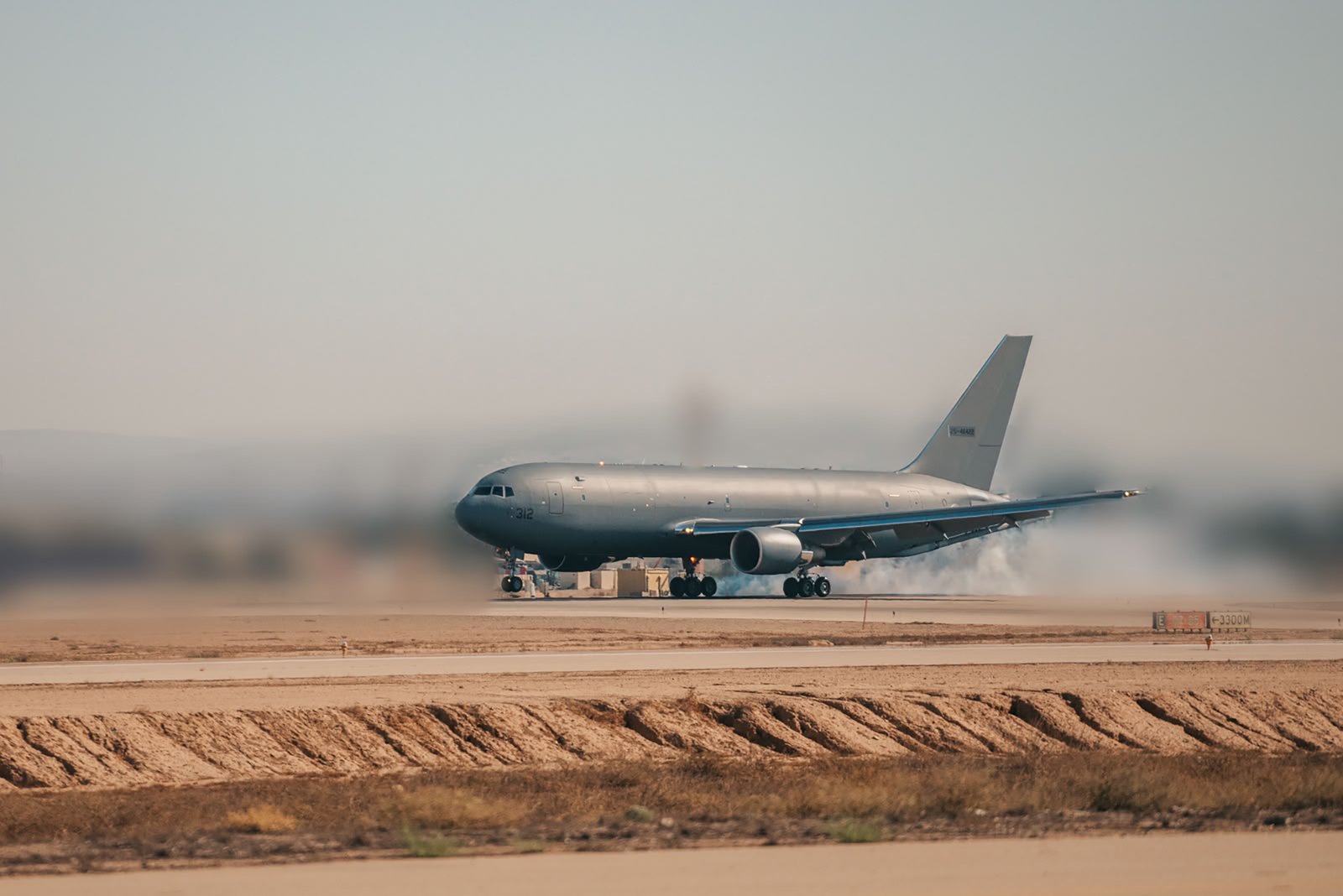
The second Boeing KC-46A Pegasus aerial refueling tanker ordered by Israel landed in the country last week, bringing the Israeli Air Force one step closer to completing a major modernization of its strategic aerial refueling capability. The remaining four aircraft are expected to arrive over the coming months.
However, Israel’s KC-46 fleet will differ significantly from the standard aircraft delivered by Boeing. According to Israeli sources, each aircraft will undergo an extensive modification program led by Israel Aerospace Industries (IAI), transforming the tanker into a highly protected, networked, multi-mission platform tailored to the operational requirements of the Israeli Air Force.
Built for High-Threat Environments
The aircraft—known in Israeli service as the “Gideon“—will be equipped with a range of Israeli-developed protection systems designed specifically for operations in contested airspace. These include customized missile warning sensors and electronic self-protection countermeasure suites intended to improve survivability against modern airborne threats. These modifications reflect Israel’s requirement for strategic support aircraft capable of operating much closer to hostile environments than many comparable tanker fleets.
Beyond self-protection, the KC-46s will receive Israeli-designed communications and avionics systems that will allow secure data exchange with the broader Israeli Air Force command-and-control architecture. According to Israeli defense sources, the upgrades are intended to ensure that the aircraft becomes an integrated node within Israel’s wider operational network rather than simply serving as a flying fuel tanker.
KC-46A Pegasus – More Than an Aerial Tanker
The upgraded Gideon aircraft will also receive an advanced Remote Vision System (RVS) based on high-definition three-dimensional digital cameras to control the refueling boom. In addition to the boom, the aircraft will be equipped with a hose-and-drogue refueling system, allowing it to support a wide variety of aircraft types. Therefore its mission profile extends well beyond aerial refueling.
The KC-46 will also be capable of transporting heavy cargo and troops, while retaining the ability to conduct aeromedical evacuation missions when required. These capabilities effectively transform the platform into a strategic multi-role asset for the Israeli Air Force.
Decision on Additional Aircraft Looms
Before the end of the year, the Israeli Ministry of Defense is expected to decide whether to exercise options for the acquisition of an additional KC-46A. Such a decision would further strengthen Israel’s long-range operational capabilities at a time when aerial refueling remains a critical enabler for strategic air operations.
The new KC-46s will gradually replace Israel’s aging fleet of Boeing 707 aerial refueling aircraft. Those aircraft were originally converted into tankers by Israel Aerospace Industries, serving the Israeli Air Force for decades and playing a central role in extending the operational reach of Israeli combat aircraft.
With the arrival of the Gideon fleet, Israel is entering a new era of strategic air mobility—combining modern refueling capability with advanced indigenous technologies designed to meet the unique operational demands of the region.
Author: Arie Egozi, Israel Correspondent
Click here to read the latest issue of ESD.
