

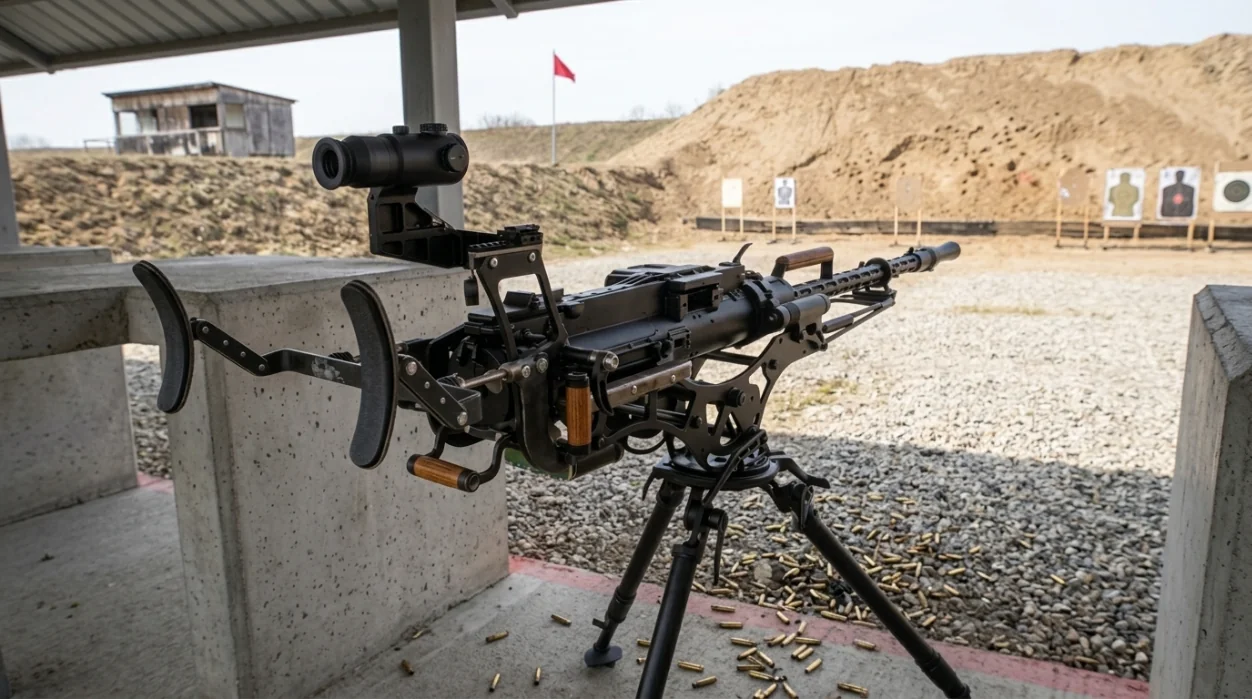
A weapon designed when propeller aircraft and armored vehicles dominated the battlefield is now appearing in a fight increasingly shaped by cheap drones. The KPV Heavy Machine Gun seems like an unlikely counter-drone weapon, yet its enormous 14.5 mm cartridge has given the Soviet-era design a surprisingly long second life.
The KPV Heavy Machine Gun entered Soviet service in 1949, originally as a heavy machine gun built around the powerful 14.5×114mm cartridge. That ammunition had its roots in Soviet anti-tank rifles, giving the weapon considerably more punch than conventional machine guns.
But the KPV Heavy Machine Gun’s story didn’t follow a straight line. It was too heavy for the infantry role the Soviet Army initially envisioned, so the weapon migrated onto anti-aircraft mounts, armored vehicles and other platforms. The resulting ZPU and KPVT families helped keep the basic design relevant long after its original mission had faded.
Now the battlefield has changed again.
The proliferation of FPV drones and other UAVs has created demand for relatively inexpensive ways to engage aerial targets. Ukrainian forces have used 14.5 mm KPV/KPVT systems in counter-UAS roles, while newer installations have paired the old gun with modern mounts and remote-control technology.
That raises a fascinating question:
Did the KPV survive because it was exceptionally adaptable, or because every new battlefield eventually finds a use for a weapon with this much firepower?
KPV Heavy Machine Gun Specifications
The numbers behind the KPV Heavy Machine Gun explain why the weapon was able to move between such different battlefield roles. It is a very large machine gun, but much of that size comes from the unusually powerful 14.5×114mm cartridge it was designed to fire.
| Specification | KPV |
| Caliber | 14.5×114mm |
| Operating system | Short recoil |
| Weapon weight | Approx. 49 kg |
| Barrel length | Approx. 1,346 mm |
| Overall length | Approx. 1,980 mm |
| Rate of fire | Approx. 600 rounds/min |
| Feed system | Belt-fed |
| Muzzle velocity | Approx. 1,005 m/s |
The KPV Heavy Machine Gun’s approximately 49 kg unloaded weight already puts it in a different category from more conventional heavy machine guns. Its roughly 1.35-meter barrel and nearly two-meter overall length also show why the weapon quickly became more practical when mounted on vehicles or dedicated anti-aircraft carriages.
But weight is only half the story.
The 14.5×114mm cartridge was originally developed for anti-tank rifles, and its large projectile gave the KPV Heavy Machine Gun considerably more reach and penetration potential than ordinary machine-gun ammunition. That made the weapon useful not only against personnel, but also against lightly armored vehicles and other hard targets.
The approximately 600-round-per-minute cyclic rate also gave the KPV enough volume of fire to serve in anti-aircraft applications. Of course, a theoretical rate of fire isn’t the same thing as practical accuracy or sustained engagement capability. Ammunition supply, mounting stability and the gunner’s ability to track a target all matter.
That’s an important distinction for the KPV Heavy Machine Gun’s modern reputation.
The gun’s impressive numbers created possibilities, but the mounting system determined how effectively those possibilities could actually be used.
And that would become increasingly important as the KPV Heavy Machine Gun moved away from its original infantry role.
Read also: 5 Most Powerful Machine Guns in the World Ranked
Why the Soviet Union Built the KPV Heavy Machine Gun
The story of the KPV Heavy Machine Gun starts with a problem that had already exposed the limits of Soviet infantry weapons during World War II: how do you get more firepower out of the powerful 14.5×114mm cartridge?
That cartridge had been developed for weapons such as the PTRD and PTRS anti-tank rifles, giving Soviet troops a way to engage lightly armored vehicles. But by the later stages of the war, increasingly well-protected German armor was making that role harder. A manually operated anti-tank rifle could still be useful against vulnerable targets, but its tactical flexibility was limited.
The KPV offered a different approach.

Instead of firing the 14.5 mm cartridge one round at a time, Semyon Vladimirov’s design turned it into a belt-fed automatic weapon. The result was a gun capable of delivering the same powerful ammunition at a much higher rate of fire.
The Soviet military adopted the KPV in 1949, just as the Cold War was taking shape. Its designers had effectively taken an existing anti-armor ammunition concept and created a weapon that could potentially do much more than attack vehicles.
That distinction is important.
The KPV Heavy Machine Gun wasn’t simply an oversized machine gun built to replace smaller-caliber weapons. Its purpose was to give Soviet forces a way to deliver heavy-caliber firepower against a range of targets, from lightly armored vehicles to aircraft and fortified positions.
In other words, the Soviet Union wasn’t betting everything on one specific battlefield role.
It was betting on the 14.5 mm cartridge itself.
That turned out to be a smart decision. When the KPV’s original infantry mission became increasingly impractical, the weapon didn’t become useless. Instead, its powerful ammunition gave Soviet planners a reason to find another place for it and that is where the KPV Heavy Machine Gun’s remarkable second life really began.
The KPV Heavy Machine Gun Was Too Heavy So Its Job Changed
The KPV Heavy Machine Gun had a problem that was difficult to engineer away: it was simply enormous for an infantry machine gun.
At roughly 49 kg for the gun itself, the KPV was far heavier than weapons intended to move alongside ordinary infantry. Once its mounting equipment and ammunition were added, carrying the complete system became an even greater burden. U.S. Army reference material notes that the infantry version was eventually discontinued as the weapon’s weight made that role impractical.
But the Soviet solution wasn’t to abandon the KPV Heavy Machine Gun.
They changed the job.
The weapon’s powerful 14.5×114mm cartridge remained valuable even as the original infantry requirement faded. Instead of asking soldiers to carry the KPV Heavy Machine Gun across the battlefield, Soviet designers increasingly put it on platforms that could absorb the weight.

That led to one of the most important transformations in the weapon’s history: the KPV became an anti-aircraft and vehicle-mounted system.
On a dedicated mount, the gun’s weight became much less of a problem. Its long barrel and heavy ammunition could remain in place while the mounting system provided the mobility and stability needed for its new role.
This was a clever form of military adaptation. The Soviet Union didn’t need to redesign the entire weapon simply because its first mission had become less attractive. The underlying characteristics that made the KPV Heavy Machine Gun awkward for infantry, particularly its size and powerful ammunition, could actually become advantages when the gun was mounted.
Read also: M60 Machine Gun: Why It Was Iconic And Controversial
The result was a weapon family rather than a single infantry machine gun.
The ZPU series turned the KPV into a dedicated anti-aircraft weapon, while the KPVT adapted it for armored vehicles.
The KPV Heavy Machine Gun, in other words, didn’t survive by becoming smaller.
It survived because the battlefield changed around it.
From Anti-Aircraft Gun to Vehicle Weapon
Once the Soviet Union stopped treating the KPV Heavy Machine Gun primarily as an infantry weapon, its unusually heavy design suddenly made much more sense. The gun could now be mounted on a platform, allowing crews to exploit the 14.5×114mm cartridge without having to carry the entire system on foot.
One of the most important developments was the ZPU family of anti-aircraft mounts. The ZPU-1 used a single KPV, the ZPU-2 paired two guns, while the ZPU-4 placed four together. This turned the KPV’s heavy projectile and automatic fire into a dedicated short-range air-defense capability.
The other major branch was the KPVT, a vehicle-mounted version of the KPV. It became a familiar weapon on Soviet armored vehicles, including the BTR-60, BTR-70, BTR-80 and BRDM-2. Mounted on an armored platform, the KPV could provide substantial firepower without imposing the same mobility penalty it created for infantry crews.

This distinction is important when discussing the KPV Heavy Machine Gun today. The weapon isn’t one fixed configuration with one battlefield role. It became a family of systems built around the same powerful gun and cartridge.
That adaptability also explains its international longevity. Soviet-designed ZPU mounts and KPV-derived vehicle weapons spread widely, meaning large numbers of guns, mounts and ammunition remained available long after the Cold War ended.
And then the battlefield changed again.
Low-flying aircraft were no longer the only targets that could justify a heavy anti-aircraft machine gun. The arrival of increasingly widespread unmanned aerial vehicles created another category of small, relatively slow aerial targets.
Suddenly, the old logic behind the ZPU didn’t look quite so old.
The KPV Heavy Machine Gun had already spent decades proving that a heavy machine gun could be adapted to attack things above the ground. The drone era simply gave that capability a new target.
Why the KPV Is Back in the Drone War
The battlefield has found a strange way to make old weapons interesting again. Drones have become cheap, numerous and difficult to ignore, creating a counter-UAS problem that doesn’t always justify firing an expensive missile at every target.
That is where the KPV Heavy Machine Gun starts to look surprisingly relevant.
Its 14.5×114mm ammunition gives the weapon considerably more projectile energy than ordinary rifle-caliber machine guns, while the KPV’s existing anti-aircraft mounts provide a foundation for engaging aerial targets. Ukrainian military research has specifically identified KPV/KPVT-based 14.5 mm systems among weapons used against UAVs, including an indicated anti-aircraft engagement range of around 2,000 meters.

Ukraine has also demonstrated the KPV’s continued usefulness against larger drones. KPV-based anti-aircraft positions have been used against Shahed-type UAVs, while local modifications have addressed the practical problem of keeping ammunition available during sustained engagements.
More recently, the same basic 14.5 mm weapon has appeared on remote and unmanned platforms, showing another interesting direction: instead of putting an old heavy machine gun on a human-operated mount, engineers can place it on a modern remotely controlled system.
That distinction matters.
The KPV Heavy Machine Gun itself hasn’t suddenly become a technologically advanced counter-drone weapon. The battlefield system around the gun has changed.
Modern sensors, stabilized mounts, remote controls and improved observation equipment can potentially compensate for some of the limitations of the original weapon. The gun supplies the heavy projectile; the surrounding technology determines how effectively that projectile can be placed on a moving aerial target.
So the KPV Heavy Machine Gun’s return isn’t really a story about nostalgia.
It’s a story about cost, availability and adaptation and the drone battlefield has created conditions where all three can matter.
Why 14.5mm Makes Sense Against Drones and Where It Doesn’t
The KPV Heavy Machine Gun’s return to the counter-drone fight makes sense only when you look beyond the word “drone.” Not every UAV presents the same target problem. A large, relatively slow aircraft is a very different challenge from a small FPV drone making a fast approach.
The 14.5×114mm cartridge gives the KPV Heavy Machine Gun one obvious advantage: substantial projectile energy. That makes it potentially useful against larger UAVs and other targets where a smaller-caliber machine gun may have less effect. The weapon also has another advantage that modern air-defense planners increasingly care about — it is a gun, not a missile. Once the weapon and mount are available, ammunition can be considerably less expensive than guided interceptors.
There is also an enormous installed base. KPV and KPVT weapons, along with ZPU mounts, have been distributed across numerous countries for decades. That means some operators can adapt equipment they already possess instead of developing an entirely new weapon from scratch.
But the limitations are just as important.

The KPV Heavy Machine Gun is heavy, its ammunition is bulky, and older mounts were not designed around today’s small UAVs. Tracking a maneuvering FPV drone with a manually aimed weapon is a very different problem from engaging a conventional aircraft. The gun’s roughly 600-round-per-minute cyclic rate also doesn’t guarantee effective hits; detecting, tracking and aiming at the target are what really determine performance.
This is why modernization matters.
Add electro-optical sensors, stabilized mounts, thermal imaging and remote controls, and the same KPV can become part of a much more capable counter-UAS system.
So the real lesson isn’t that 14.5mm is a perfect drone-killing solution.
It’s that an old weapon with useful ballistic characteristics can become relevant again when modern technology supplies the sensors and fire-control architecture it originally lacked.
What the KPV’s Second Life Says About Modern Warfare
The KPV Heavy Machine Gun is a useful reminder that military technology doesn’t always move in a straight line. Weapons are designed for particular problems, but the battlefield rarely stays still long enough for those problems to remain the same.
The KPV began as an answer to an anti-armor requirement. Its 14.5×114mm cartridge gave Soviet forces heavy firepower against lightly armored targets. When the weapon proved too cumbersome for its original infantry role, it moved onto anti-aircraft mounts and armored vehicles. Decades later, those same characteristics have made KPV and KPVT systems useful in the fight against drones.
That evolution is more important than the weapon’s age.
A modern military doesn’t necessarily need to replace every old system with a completely new one. Sometimes the more practical solution is to take an existing weapon and surround it with newer technology. Sensors, thermal cameras, stabilized mounts, remote weapon stations and improved fire-control systems can change how an old gun is used without fundamentally changing the gun itself.
The KPV Heavy Machine Gun is almost a textbook example.

Its designers could never have anticipated FPV drones or modern loitering munitions, yet the weapon’s combination of range, projectile power and existing global availability has given it another role on today’s battlefield.
There is a broader lesson here for military procurement.
The useful life of a weapon isn’t always determined by when it was designed. It can be determined by whether its fundamental capabilities still solve a problem.
The KPV Heavy Machine Gun has now served through several eras and several missions; anti-tank, anti-aircraft, vehicle-mounted firepower and counter-UAS.
It survived not because it remained unchanged, but because militaries kept finding new ways to use what the weapon already did well.
