

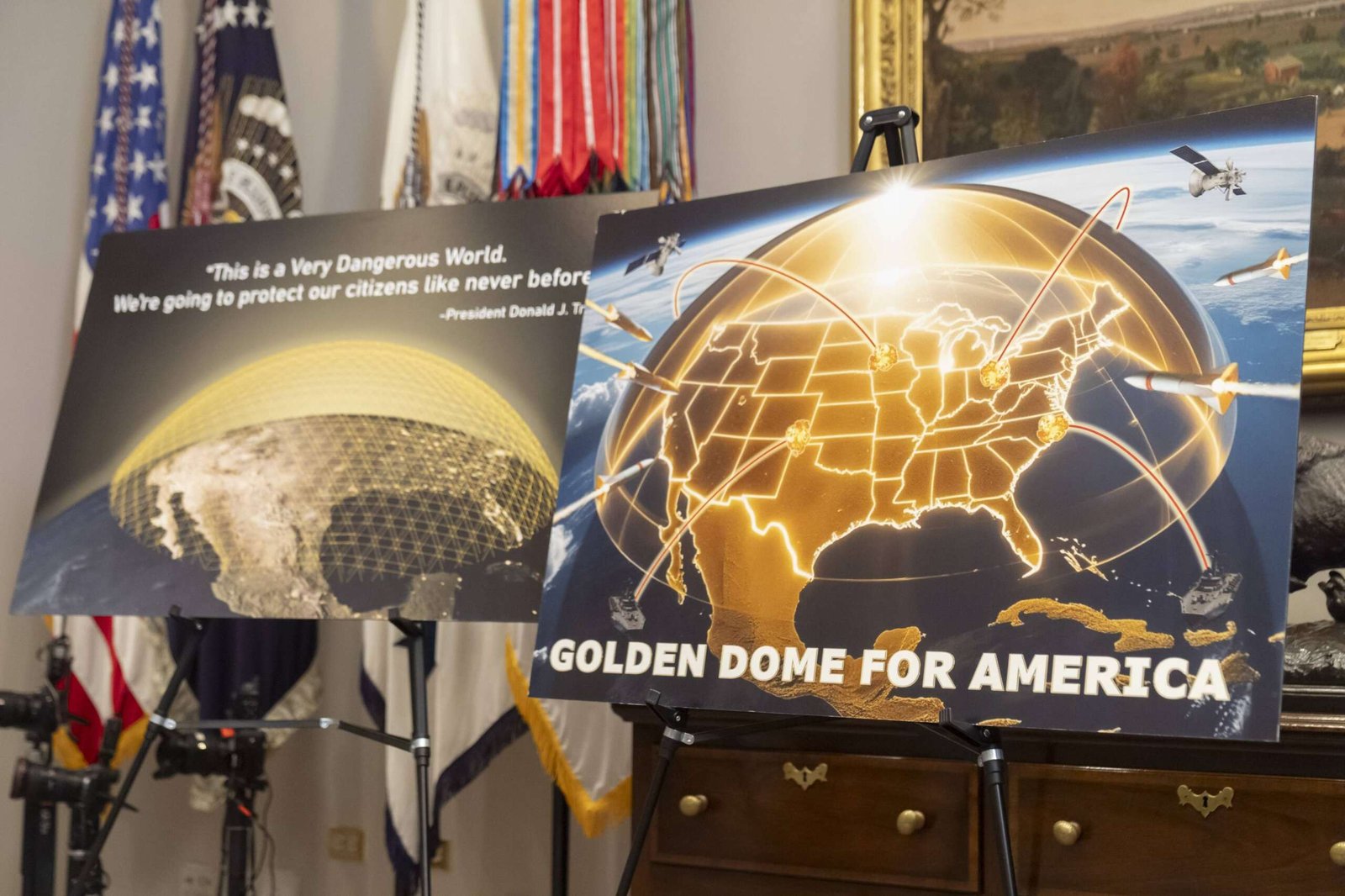
The disagreement highlights the confusion, both within government and in public, about how one of the Trump administration’s highest priorities would work.
Federal officials clashed this week over how much the Pentagon’s Golden Dome missile defense network could cost taxpayers and the technologies that might be involved, as Congress mulls allocating billions more to the project in a new reconciliation bill.
The head of the Congressional Budget Office’s national security division on Wednesday defended the organization’s recent nonpartisan estimate that President Donald Trump’s vision for Golden Dome may cost at least $1.2 trillion over 20 years. The next day, more than 1,600 miles away in North Dakota, the project’s four-star program manager dismissed that number as an uninformed “myth.”
“There’s some sensational cost estimates out there … They’re all false,” Space Force Gen. Michael Guetlein said in a conversation with North Dakota’s pair of Republican senators at the Theodore Roosevelt Presidential Library. “They’re not estimating what we’re building, and most of them take a cookie-cutter approach to taking kit that we deploy overseas, multiplying it by the size of the United States, and saying that must be it.”
The Pentagon has projected a more modest price tag of $185 billion to deploy Golden Dome over the next decade.
David Mosher, CBO’s national security lead, argued his staff has had to rely on publicly available data and past research to inform their figures because the Golden Dome program office has refused to meet to discuss its progress. However, he said, the CBO estimate uses current technology like Patriot missile batteries and Aegis Ashore to predict the network of systems laid out in Trump’s January 2025 executive order on an “Iron Dome for America” — not the Pentagon’s current plan itself.
“I know nothing about what they’re actually building,” Mosher said at an event hosted by the Brookings Institution in Washington. “Even if I knew a little bit about what they were doing, it wouldn’t change our estimate of the executive order.”
The disagreement highlights the confusion, both within government and in public, about how Golden Dome would work even as it has become one of the Trump administration’s highest-priority projects and would require immense funding.
Golden Dome aims to protect the U.S. against a range of missile and drone threats by connecting a vast array of existing sensors and weapons across the U.S. military as well as deploying new missile interceptors in space. It’s unclear how those defenses could be spread around the country, or the extent to which it may require assets in allied countries like Japan.
In March, Congress provided DoD with $22.5 billion to begin assembling the missile defense network through a reconciliation bill that gave Guetlein more flexibility to decide how to spend it than regular appropriations would. The department has already obligated 90% of that money in less than six months, he said.
The office is investing in ideas from artificial intelligence to infrastructure resiliency that “we traditionally haven’t discussed,” Guetlein said, adding that he’s personally met with more than 500 companies of all sizes in the program’s first year. A new unclassified portal now invites anyone with an idea for the project to submit it directly to the military as well.
“We have radars on contract. We have space-based interceptors on contract. We have interceptors on contract,” he said. “We have sites on contract, and have really moved out significantly in acquiring the capabilities that we believe the nation is going to need to defend itself going forward.”
The military put that early architecture to the test last month and shot down each target it launched. Guetlein said Thursday the experiment proves the $22.5 billion tech investment will “absolutely be effective against the threat.”
“What we have been able to accomplish in that short amount of time is a program that will deliver defense of the homeland in the summer of 2028,” he said.
Sen. John Hoeven (R-N.D.), who sits on the Senate Appropriations Committee, said Golden Dome would get another $400 million through the base budget for fiscal 2027, plus $17 billion more if Republican lawmakers can pass another party-line spending bill without Democratic votes.
The reconciliation package also includes Republicans’ voter ID bill, agriculture funding and other military spending.
“I think that’s our best chance” to fund Golden Dome, Hoeven said.
Copyright
© 2026 Federal News Network. All rights reserved. This website is not intended for users located within the European Economic Area.
