

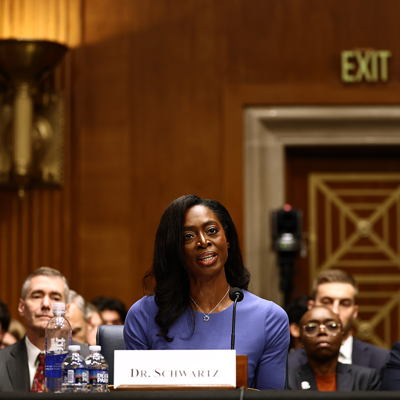
The new head of the Centers for Disease Control and Prevention says she will focus on restoring trust with a workforce spread thin by staffing cuts and public health challenges.
CDC Director Erica Schwartz told staff at an all-hands meeting on Wednesday that she will “speak truth to power,” and ensure CDC employees can offer candid feedback on policy matters without fear of retaliation.
“I will listen to you. I will respect your expertise, and I will support you as you carry out this mission. I want CDC to be a place where an employee can respectfully say, ‘But ma’am, the evidence points in another direction,’ and know that your concern will be heard,” Schwartz said, according to a transcript obtained by Government Executive. “Scientific integrity requires us to make room for respectful disagreement.”
Schwartz is the CDC’s first permanent leader in a year. The last permanent CDC director, Susan Monarez, was fired last summer, less than a month on the job, following conflicts with Health Secretary Robert F. Kennedy, Jr.
Schwartz acknowledged Monarez’s firing, but told staff “there is no retribution for honest thought and honest conversation” under her leadership.
“I want you to feel psychologically safe. I do not want you to feel like you’re in an environment where retribution will rain down upon you. That is not how I lead as a leader. And I feel very comfortable making sure that I can represent the CDC to our leadership and making sure that the secretary understands our point of view,” she said.
Schwartz said the CDC has been in a “a period of significant uncertainty,” and is looking to rebuild trust in the agency after more than a year of upheaval. The CDC recently commemorated the one-year anniversary of a shooting at its headquarters campus. On Aug. 8, 2025, a gunman fired more than 180 shots at the CDC headquarters, wanting to send a message against COVID-19 vaccines.
In recent months, CDC has responded to outbreaks of Ebola and hantavirus abroad, as well as cyclospora and measles outbreaks in the United States. It also stood up an emergency operations center for the FIFA World Cup.
Schwartz said she will work with CDC leadership to address the agency’s staffing gaps. The CDC has lost about a quarter of its workforce through layoffs and voluntary separation incentives. CDC officials told employees last month that a “strategic planning process” is underway to identify its staffing gaps and where hiring is most urgently needed.
“What are the critical areas that if we don’t get these filled, we will fail in our mission for the American people? That information I will take back, and I will be that advocate for the CDC,” Schwartz said.
Among her concerns, Schwartz cited recent reporting from the Associated Press on “zombie programs” at the CDC that have been funded by Congress, but lack the staff to operate.
“The people that are here … they’re burning out, they’re exhausted. And they’re questioning, ‘Is this going to be the new normal?’ Well, the good news is, I’m here, I’m week one of being here, and now I can certainly be able to advocate for the CDC,” she said.
A retired U.S. Public Health Services Commissioned Corps rear admiral, Schwartz previously served as the Coast Guard’s chief medical officer and deputy surgeon general.
The Trump administration has announced changes to the federal childhood immunization schedule that raise alarms among public health experts. Last week, President Donald Trump signed an executive order reducing the number of recommended childhood vaccines. Schwartz said she will try to earn back trust with vaccine skeptics during her tenure.
“There are a lot of Americans who have vaccine hesitancy, and they feel that the CDC has been somewhat paternalistic when it came to vaccines, and so they feel that the CDC may not be speaking for them. I do think we have to be honest as an agency to say, ‘Are we an agency for just those Americans that believe in vaccines, or are we an agency for all Americans and helping those Americans that have vaccine hesitancy understand why vaccines are so safe and effective?’” she said.
CDC employees reiterated concerns about staffing shortages and fear of retaliation.
“Thank you for acknowledging that we are tired, because we are,” one CDC employee said during the Q&A. “We are at a significant reduction in our employees. And that makes it really hard on the rest of us to pick up the slack, because the work doesn’t change. We were already under-resourced and understaffed in public health, as you know, and now it’s even worse.”
Another CDC employee told Schwartz that “fear of retribution” is a common concern among staff.
“We’ve been shot at. We see multiple outbreaks right now,” the employee said. “We also know what happened to the previous director. And I think that there is a general fear of speaking [about] what’s actually happening.”
A third employee asked if former employees who received reduction in force notices would have an opportunity to rejoin the agency.
“We have so many vacancies, and we had these wonderful staff that were not separated due to performance. They were separated because of the way the RIF was done. Many of them are very eager to come back,” the third employee said.
Schwartz and other senior CDC leaders said they would look into opportunities for RIF’d employees to come back.
Yolanda Jacobs, president of the American Federation of Government Employees Local 2883, which represents CDC employees, previously told reporters that CDC has made very little progress on hiring, and that recently laid-off employees looking to rejoin the agency haven’t made it far in the hiring process.
Kennedy recently told lawmakers that HHS is looking to hire 12,000 employees after going through widespread layoffs last year.
“Not only have we not had any excessive amounts of new hires, or even any really significant hiring of CDC employees, but we’ve also had ignoring and stalling when it comes to those employees that had been RIF’d, who were supposed to have priority for some of those jobs as the rehiring starts,” Jacobs said. “Those individuals are not seeing any action as far as hiring goes. Those who have even applied have been told that they did not meet the qualifications for their own jobs, the jobs that they previously had.”
Jacobs, however, added that “a new CDC director has an opportunity to turn the tide.”
Sean Michael Newhouse contributed to this report.
