

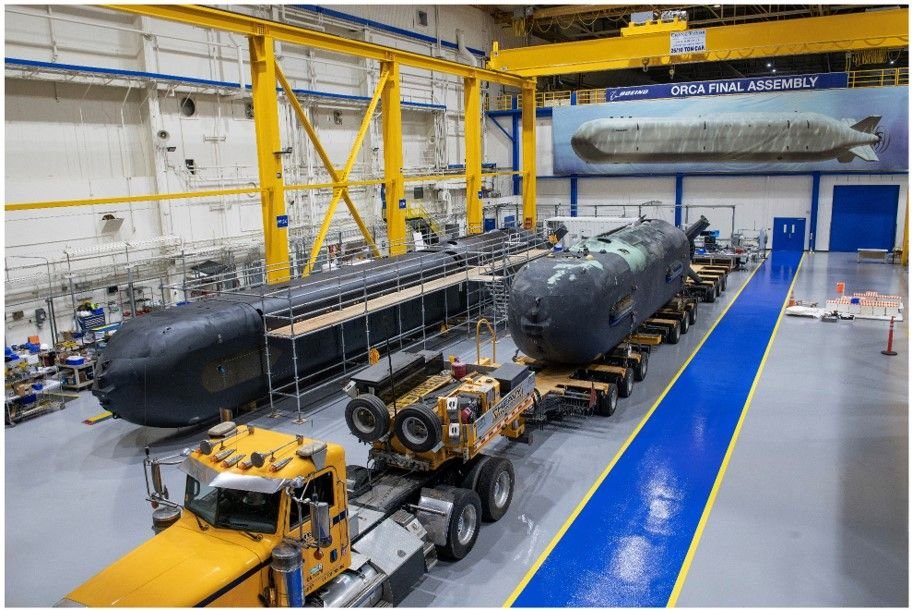
The U.S. Navy completed a 1,000 nautical mile transit with the service’s Orca XLUUV uncrewed submarine in July, a first for the service.
The U.S. Navy, working with teams from the Program Executive Office for Unmanned Small Combatants (PEO USC), completed the service’s first long-range mission with a Boeing and Huntington Ingalls-built Orca Extra Large Uncrewed Undersea Vehicle (XLUUV). The transit, which took the uncrewed submarine across the East Pacific, finished in July according to a statement released from Rear Admiral Chris Cavanaugh, Commander, U.S. Submarine Force, Pacific Fleet.
The XLUUV patrolled for over 1,000 nautical miles — a first in the program’s history as the Pentagon looks to rapidly ramp up uncrewed operations in the Pacific to supplement crewed aircraft, ships, missile launchers and submarines as major force multipliers.
“The operational environment in the Pacific continues to evolve with the rapid development of technological advancements in the undersea domain,” Cavanaugh said in the release. “The Pacific Submarine Force is heavily investing in unmanned capabilities to augment our manned submarines and preserve our undersea advantage across the full spectrum of submarine operations.”
Orca is among the U.S. Navy’s largest UUVs, capable of offensive and defensive missions identified in a Joint Urgent Operational Need tied to the Pacific theater. Those missions include Intelligence, Surveillance, and Reconnaissance (ISR) operations, mine warfare, sea bed warfare, and expeditionary support, Naval News previously reported. The latest Orca XLUUV, XLE2, was commissioned earlier this year.

The U.S. Navy is implementing some of the submarine service’s highest-end capabilities into the Orca fleet for future operations, some of which include “innovative approaches” designed to multiply combat power that are highlighted in the service’s most recent research and development budgets published in April.
The approaches take unique looks at existing combat capabilities, refining them with new systems and deployment tools for highly effective applications — all geared towards the Pacific theater.
Orca will deploy with Hunter, a payload for the XLUUV which provides advanced, expeditionary mining capabilities in contested and denied environments. “The Hunter program seeks to develop an innovative concept for the delivery of advanced undersea payloads from extra-large unmanned underwater vehicles (XLUUVs),” DARPA’s website reads. Its acquisition strategy will be formalized in late 2027 or early 2028.
It will also deploy with a new, previously unreported standoff heavyweight torpedo deployment system known to the U.S. Navy which is preparing to transition to the PMS 406 Unmanned and Small Combatants office. Orca’s Hunter module is reliant on this torpedo deployment system for its own development and acquisition timeline.
Naval News previously covered Orca’s new capabilities in 2024 when the service finalized the fitment of a large, roughly 10-meter-long payload module featuring a large, vertical opening bay consistent with specialized payload deployments. “The payload module has large hatches in the top, and possibly the bottom, which would be consistent with mine laying missions,” H. I. Sutton, a Naval News contributor and naval analyst said at the time.

A next-generation XLUUV is already development through the Defense Innovation Unit’s Combat Autonomous Maritime Platform Project (CAMP) effort. Anduril is one of the competitors for CAMP with its Dive-XL system — an XLUUV capable of launching a number of effectors and deploying the company’s seabed tethering ISR node Seabed Sentry.
