

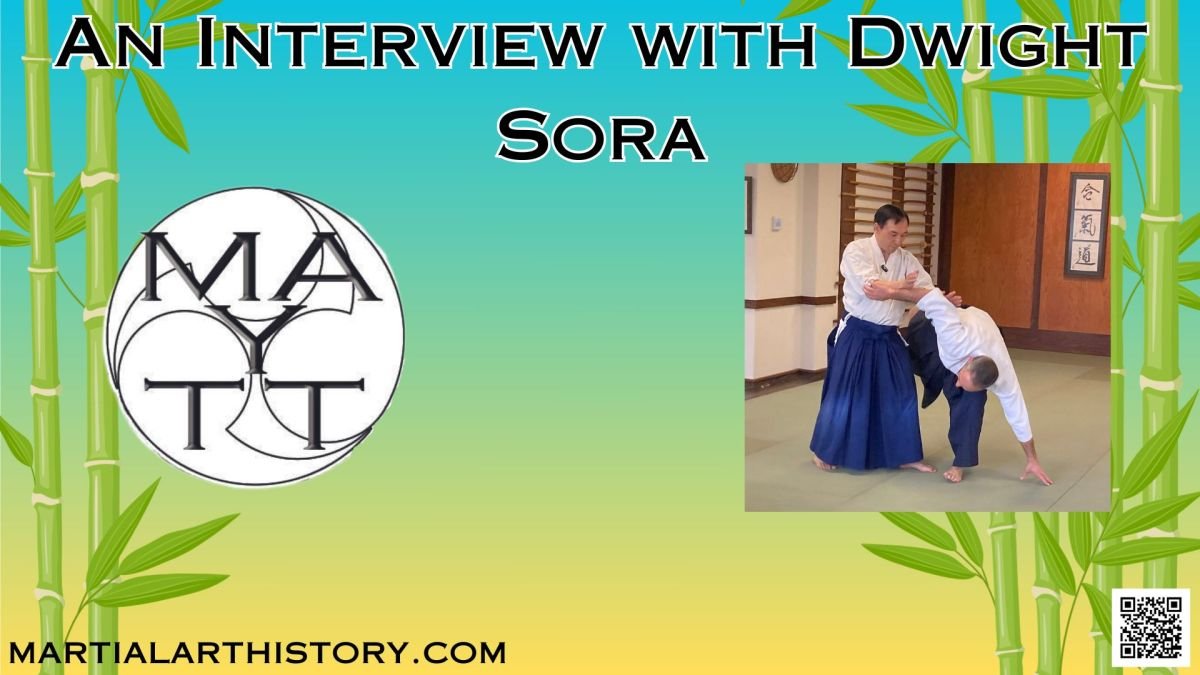
Combined with the recent move of Chicago Aikikai and a former student finding dojo boxes in his storage, Dwight Sora found a window into Chicago’s Aikido past. Some were archival footage of the school’s early days as Illinois Aikido Club with Koichi Tohei, others were newsletters and seminar posters of years and decades past. Today, Sora reflects upon the complexities of historical memory, the cultural tensions between Japanese instructors and Japanese American students, and the challenges of preserving martial traditions in a modern context. All images provided by Dwight Sora.
Martial Arts of Yesterday, Today, and Tomorrow: Thank you for joining us today, Dwight!
Dwight Sora: It is great to be here!
MAYTT: You sent me a lot of video material to review, so a question from all of that is what does it mean to be Yonsei?
DS: Oh, what does it mean to be yonsei? Yeah, that’s interesting. That has changed over time. When I was very young, I didn’t even know the word yonsei, honestly. My father is from Hawaii. He was born four days after Pearl Harbor was bombed, so he did not grow up speaking Japanese. My grandparents went out of their way not to speak Japanese. My mother’s from Korea, so I didn’t really think about it much. As a family, we’d go to the Ginza Festival, which is this annual Japanese cultural festival here. We’d do holiday events, go to Japanese restaurants, and things like that, but I didn’t really think about my identity all that much. That changed in high school. My high school happened to offer Japanese, and I thought, “Well, I should know at least one Asian language.” I didn’t speak Korean because my mother hadn’t taught me, so I figured I’d take Japanese classes. That’s when I really started thinking about it more. It became an active part of my life. Before then, I knew I was half Japanese and half Korean, but I didn’t spend much time thinking about what that meant. If anything, I was more intimidated by my Korean side because everyone spoke Korean. We’d go to family gatherings, and my brother, my dad, and I weren’t speaking Korean.
Then, when I was in college, I very quickly switched from being an English major to an East Asian Studies major because I continued studying Japanese. I just felt this kind of gravitational pull toward it, which eventually led me to study abroad at Waseda University during my third year of college. That’s where I started Aikido. After I came back to the United States, one of my classmates, who was Japanese American, was already volunteering with the local chapter of the Japanese American Citizens League, the national Japanese American civil rights organization. He asked if I was interested in volunteering, so I joined. That’s really when everything came together and made me much more conscious of my identity, from that point right up to today.
So what does being yonsei mean to me now? It’s changed. Today, I’m very aware that I am American. I am not the equivalent of a Japanese person who grew up in Japan, and I’m completely okay with that. But I do feel like I have this heritage and these cultural qualities, and I’m also very aware that I’m choosing to embrace them. I have a younger brother who couldn’t care less. It’s not that he hates it; for whatever reason, he just doesn’t feel that same pull toward it. He lives in Los Angeles, and I’ve asked him, “Do you go to any Japanese events? Do you take your family?” And the answer is no. That’s just not where his interests are. For me, though, I kind of feel like I have a certain responsibility. I don’t think every Japanese American, or every yonsei, has to feel that responsibility, but I choose to embrace the idea that I can help share something about Japanese culture with my fellow Americans. I can serve as a conduit in a way that someone who grew up in Japan can’t always communicate. At the same time, there’s also the unique history of Japanese Americans in the United States, which ties into Aikido as well.
MAYTT: Taking a step further; how does practicing Aikido help you reconnect with your Japanese heritage?
DS: I like this idea of feeling part of something larger than myself that has long-ago roots. Again, it’s kind of a matter of choice. To the best of my knowledge, no one in my family has ever done Aikido or even really pursued a martial art. Neither my father nor I are legacy members of a dojo or anything like that. But at the same time, I don’t know; there’s this very indefinable charge that I feel whenever I go to our dojo or any other dojo. I don’t want to sound like I’m putting myself above other people because I have some familiarity with the language, but at the same time, even just saying the techniques or looking at the calligraphy on the wall and knowing what it means, linguistically or historically… I don’t know, it just feels good, for lack of a better word.
I guess I don’t know what else to equate it to. I have Italian American friends who say that when they go to Italy, they get this sense of feeling at home, even though they’ve never been there before and weren’t born there. I have Irish American friends who describe the same thing. Something about Aikido sparks that same kind of connection for me. I also think it has a lot to do with the fact that something about Aikido as a martial art just connects with my personality. Those two things kind of reinforce each other.
MAYTT: In researching kendo, it is very much a Japanese cultural activity in which many of the kenshi are of Japanese descent. Does training with non-Japanese take away from the Japanese cultural aspect of Aikido or is Aikido and martial arts bigger than the people who you are training with?
DS: I definitely think Aikido, and really martial arts in general, should be open to everyone. The reason we have Aikido in America is partially because the founder of Aikido encouraged his students, like Koichi Tohei, to go abroad and spread it. He didn’t want to limit it solely to Japanese people. At some point, he wanted it to become an expansive art.
At this point, I’ve actually spent more time practicing Aikido with non-Japanese people than with Japanese people. I was only in Japan for one year, and that was my first year of Aikido. Kevin Choate Sensei was my main teacher for a significant number of years, so I have no problem with the idea of a non-Japanese person – whether they’re a Caucasian American, someone from France, or anywhere else – practicing Aikido. It doesn’t matter to me. They don’t even have to speak Japanese. As long as they respect the etiquette, the concepts, and the culture, that’s fine. It doesn’t take anything away from the art. In our current dojo, Marsha Turner Sensei doesn’t speak or read Japanese, but when she wants clarification on something, she’ll ask me, or she’ll tell someone, “Well, Dwight speaks the language, and he knows what that means.” That feels good, but I also think it’s not absolutely necessary. I actually had a non-Japanese friend in the dojo ask me once, “Do you think I need to learn Japanese in order to advance in Aikido?” My answer was, “No.” If you can speak and read the language, and if you read some of the philosophical writings, then sure, you’ll probably gain a greater appreciation for certain aspects of the art. But I don’t think it necessarily gives you a greater edge in Aikido. That’s how I feel about it.
Actually, I can give some additional context. I’m a member of a Japanese American Buddhist temple here in Chicago, and a significant number of the members aren’t Japanese American anymore, or they’re people of mixed heritage. That’s become pretty common.
There’s another example here in Chicago that I think illustrates this well. On Clark Street, just a little north of where the original Illinois Aikido Club was located, there’s a bar called the Nisei Lounge. It’s called that because, back when that neighborhood was essentially Chicago’s Japantown, it was a bar started by nisei, second-generation Japanese Americans. It was their gathering place. It hasn’t been Japanese American-owned for decades at this point, but when the new owners took over – and I don’t know if it’s still the same people today – they made a conscious decision to honor its history. They kept the name, and there are photographs on the walls acknowledging the Japanese American community that helped shape the place. It’s also become a frequent location for Japanese American cultural events, fundraisers, and community gatherings. The owners have intentionally preserved and honored that history. That’s kind of how I feel about dojos that are no longer majority Japanese. The important thing isn’t that they remain ethnically Japanese. It’s that they continue to respect, preserve, and honor the history and culture that gave rise to the art.
MAYTT: It is not the people that define the activity, it is the activity itself that defines it. It is the activity itself that maintains its Japanese-ness.
DS: Yeah, I mean, again, being yonsei, I sometimes think there’s an alternate-history version of myself who’s doing Aikido but doesn’t speak Japanese. That’s entirely possible. If that were the case, I’d just be like any other American practicing Aikido in America.
A funny anecdote that ties into this happened a couple of years ago. A friend of mine, Eric Matsunaga, who’s a karate practitioner and also a local historian of Japanese American history, was organizing walking tours of formerly Japanese American-owned businesses and neighborhoods. One of the stops was the Illinois Aikido Club, so he asked if I’d come along and talk about its history. The group we were speaking to consisted mostly of Asian American students from DePaul University, and a significant number of them were Japanese American (at least I think they were). I told them, “This dojo was originally founded by a majority of Japanese Americans, but today I’m the only yonsei in the dojo.” It was funny because all these students, who were probably between eighteen and twenty years old, immediately started booing. I laughed and said, “Well, come on down to the dojo!” I swear to God, though, none of them ever showed up. I thought their reaction was really interesting. Here were all these Asian American students who didn’t practice Aikido, and they seemed kind of bothered by the idea that the dojo wasn’t still mostly Asian or Japanese American. But at the same time, none of them became members. I don’t really know what that means or what that dynamic is.
MAYTT: That leads me to my next question; why do you think the early Nikkei members of the Illinois Aikido Club were replaced by members of the general American public?
DS: I’ve actually done some research on that and incorporated some of it into our videos and posts. From what I’ve found, Aikido dojos in America generally seem to have started in one of two ways. One model was organizations like the Illinois Aikido Club, where a group of Japanese Americans got together and decided to start a dojo themselves. The other model involved a Japanese instructor who was either sent abroad or immigrated on their own, like Akira Tohei Sensei or Fumio Toyoda Sensei. In both cases, those early dojos tended to be centered around Japanese American communities. Hawaii is an obvious example, and Los Angeles Aikikai is another. The Illinois Aikido Club fits that pattern as well. In fact, I know that in both the Los Angeles and Chicago cases, the membership wasn’t just predominantly Japanese American – they actually went out of their way to exclude non-Japanese people in the early years. By today’s standards, they were practicing discrimination.

I had lunch with Joe Takahara Sensei, and he explained how it worked at the Illinois Aikido Club. There was no signage and no advertising. Every prospective member came through word of mouth. Prospective students had to sit and observe a class, and then Takahara Sensei and several others served on a committee that interviewed and screened them. After telling me that, he kind of leaned in and quietly admitted, “To tell you the truth, if they were Japanese American, we would have just let them in right away.”
One of his funniest stories came up when I asked him a question that I wasn’t really sure how to phrase. I finally just said, “When did you start allowing white people into the dojo?” He laughed and said that, as the 1960s went on, “the dirty hippies” started showing up because they were interested in Aikido. There was one particular “dirty hippie” who came to observe a class. They told him to come back and watch another one. He came back again, and they told him to come back again because, honestly, they didn’t want to admit him. Eventually they realized there wasn’t really any basis for keeping him out, so they finally let him join. That student was John Eley (later founder of Chicago Ki Society). As Joe told the story, that’s how John Eley got into the dojo.
From what I can gather, people like John Eley and later Frank Knapp represent that gradual transition. Frank Knapp was, I believe, a Chicago police officer. Back in the 1960s, he was dating Takahara Sensei’s receptionist while Takahara was practicing dentistry. Through her, Frank learned about Aikido and wanted to join the dojo, but Takahara Sensei and many of the nisei members initially wouldn’t let him in. Eventually, after his receptionist became upset with them, Frank was finally accepted. So there really was this gradual process of opening the dojo to non-Japanese practitioners. At the same time, there were other forces at work. It’s well documented that many American servicemen were introduced to martial arts such as judo, karate, and sometimes Aikido while stationed in Japan during the Occupation. When they returned to the United States, they wanted to continue training. Some had already encountered Aikido, while others came from judo and decided to try it.
But from what I can tell, the really significant change happened for reasons beyond the martial arts themselves. During the 1960s and into the 1970s, you had the counterculture movement, the rise of New Age spirituality, and a growing fascination with Eastern philosophy and culture in the United States. That drew people toward anything associated with Asia. Karate schools, kung fu schools, and Aikido dojos all benefited from that interest, and it only accelerated during the 1970s with the Bruce Lee kung fu movie craze. Even schools that didn’t teach kung-fu saw their membership increase.
You can see that pattern at the Illinois Aikido Club. Their membership really ballooned during the mid-1970s. It’s interesting because 1975 was such a pivotal year for the dojo. That was the year they broke away from Tohei, eventually connected with Mitsugi Saotome Sensei, and people like Kevin Choate Sensei joined. Coincidentally, that’s also the year Shōgun, the novel, was published. I think that’s significant because it reflects a broader shift in American attitudes toward Japan, from seeing Japan primarily as the enemy in World War II to viewing it as an emerging economic power with a fascinating culture. That helps explain why more non-Japanese people were entering the dojo.
The other half of the story is why many Japanese Americans were leaving. After World War II and the Internment Camps, there was still a lingering sense among many Japanese Americans that they should stay within their own community. In Chicago, they had their own Boy Scout troops, basketball leagues, dances, and social organizations because many parents worried their children wouldn’t be accepted elsewhere. Depending on the neighborhood, those concerns were sometimes justified. That’s part of why the early dojo remained fairly closed. By the 1970s, though, especially in the post-Civil Rights era, things had changed. More Japanese Americans didn’t necessarily want to do Aikido or karate anymore. Martial arts had become something their fathers or grandfathers did. They wanted to play Little League, join neighborhood sports, and participate in mainstream activities because they finally felt comfortable doing so.
It was really interesting meeting people who had been in the Illinois Aikido Club’s children’s program during the 1960s and 1970s but never continued training as adults. For many of them, it seemed like they simply wanted to participate in the broader American community rather than remain within exclusively Japanese American institutions. To borrow a quote from my friend Bob Kumaki, who’s a kendo practitioner and a little older than I am, he once said, “The difference between then and now is that it wasn’t cool to be ethnic back then.” If you were Japanese American, you often didn’t want to do overtly Japanese things. Not everyone felt that way, of course, but a lot of people did. So that’s really what I think explains the transition: as Japanese Americans gradually moved away from these community institutions, increasing numbers of non-Japanese Americans were moving in.
MAYTT: That reminds me the nisei and why baseball and basketball were popular among them – they did not want to do what their parents were doing. They wanted to be more American. I appreciate you talking about the changing of the demographics.
DS: I think that’s actually something interesting because I’ve never seen anyone really try to write about that specific transition. I’m sure part of the reason is that many of the people who lived through that period weren’t especially inclined to sit down and analyze what they were experiencing while it was happening. I also think that, within the Japanese American community – and Japanese culture more generally – there’s often a tendency not to dwell on the past. People just move forward. It’s funny because you’ll sometimes meet people who eventually discover that one of their parents practiced Aikido when they were younger, and they had absolutely no idea growing up because their parents simply never talked about it by the time they were older. So, I’m actually glad I’ve been unearthing a lot of this history lately. I feel like the timing is good because this may be our last opportunity to ask people about names, dates, and firsthand memories while they’re still alive.

MAYTT: Why do you think Aikido thrived along the American coasts rather than the interior?
DS: Not really sure. It’s not something I ever noticed, given I know a lot of folks from longtime Aikido Schools of Ueshiba (ASU) dojo in midwestern interior states such as Tennessee, Wisconsin, Minnesota, Indiana and Kentucky. It does probably have more (apparent) esoteric trappings than karate or judo, and the fact it doesn’t really exist as a competitive sport (aside from Tomiki) possibly makes it a harder sell.
MAYTT: With the changing of the demographics in Aikido dojos across the country, how much should and can a Japanese cultural activity like Aikido change over time and appeal to the changing demographic?
DS: I think there are some changes that have just happened over time. You can definitely see them within our national organization, ASU. One of the things people have been talking about is that we’re a little top-heavy right now. Most of our senior and most recognizable instructors are older, and there aren’t as many people in the generation behind them. I’m in my fifties now, and I’m a yondan, but I’m not one of those recognized instructors traveling around and teaching seminars the way the previous generation often was at this stage. I also don’t have a large group of peers around me. Because our senior teachers are getting older, many of them have naturally shifted toward a slower, more connected style of practice. I want to be very clear that I’m not criticizing what they do. I think it’s wonderful. It makes complete sense. They’re at a point in life where they’re aging out of doing hard throws and taking constant falls. Their teaching has become more focused on connection, refinement, and demonstration. Everything they’re teaching is still valuable, and there’s a tremendous amount we can learn from it.
What I find interesting is the reaction you sometimes see online. When I post videos from our dojo, I occasionally debate whether I should delete the negative comments because they inevitably show up. You’ll see people saying things like, “That sensei should retire.” And I think, what does retirement even mean for an Aikido instructor? They don’t really retire; they just keep practicing and teaching. Other people say, “That’s not interesting,” or, “That’s not inspiring.” I don’t agree with that. That softer, slower approach has become a major part of what you see from many senior instructors at seminars because they’re older now. Though that’s not how they taught when they were younger, I actually think it’s an important component of modern Aikido. Some of those instructors have even said, “If I’d known how to do this when I was younger and combined it with how I trained back then, wouldn’t that have been wonderful?” It’s very much a “train smarter, not harder” philosophy.
The question for those of us who are younger is how we preserve that softer, more studious, more connected approach (of our older instructors) while also maintaining the faster, more dynamic, more overtly martial side of Aikido. I think that’s important because the dynamic practice is still the foundation. I don’t think you really arrive at that softer level without first spending years developing those fundamentals. So the challenge is figuring out how to balance those two lessons. We probably have plenty of younger practitioners who can demonstrate the faster, more athletic side of Aikido. I just don’t get to see them as often as I’d like due to traveling less because of current life demands.
There are certainly people out there doing remarkable work. Meido Moore Sensei and Stephen Toyoda Sensei, for example, both have an amazing technical vocabulary. They’re wonderful to watch. Stephen is actually younger than I am, and I think Meido Sensei is either about my age or maybe a little older.
I do think we need to think carefully about the future. One thing that’s important is maintaining and promoting what, for lack of a better term, I’d call the younger version of Aikido: the kind of practice where you’re moving quickly, taking hard and frequent falls, and training in a more dynamic way. When an organization becomes top-heavy with older instructors who simply can’t train like that anymore, how do you demonstrate that aspect of Aikido to younger people? That puts a little more responsibility on those of us who are middle-aged right now.
We want to get the numbers back up, but at the same time, I’ve realized it’s not all on us here in America. There are some great people doing wonderful things elsewhere in the world. I’m a huge fan of watching Ryuji Shirakawa Sensei and his Aikido Shiburenseijuku videos on YouTube. I love watching his material. He’s young, energetic, and very affable. Seeing people like him makes you realize that the future isn’t resting entirely on our shoulders. There are people all over the world trying to bring new blood and new energy into Aikido. At the same time, one thing I’ve been thinking about lately is that we really can’t take certain things for granted anymore.
Years ago, when someone asked me whether they needed to speak Japanese to do Aikido, I said no, and I still believe that. But I do think that, going forward, more of us need to be mindful about preserving and communicating the cultural details of the art, because there are going to be fewer and fewer people in America who understand what certain things mean. I’m not just talking about matching Japanese names to techniques. I’m talking about all the little things. There are dozens of dojos around the country with calligraphy hanging on the walls. Do people know what those scrolls say? Do they know why their teacher chose that particular piece of calligraphy, when it was written, or what significance it has? Those are the kinds of things I’m thinking about.
After the pandemic, Chicago Aikikai was asked to perform demonstrations at the Ginza Holiday Festival. Marsha Turner Sensei gave me pretty much free rein to organize and script the demonstrations, and I told everyone that I wanted to do something a little differently. I didn’t want to take anything for granted. I said, “We’re not going to make this overly talkative – we’ll still have plenty of action – but we’re also going to explain things.” For example, I made a point of explaining why we wear hakama. There was a time when nobody would explain that because the audience was largely Japanese American and it was assumed people already knew. But even many yonsei or gosei Japanese Americans today may not know what a hakama is. I also explain things like why we grab wrists, talking about the sword origins of many techniques and how controlling the joints prevents someone from drawing a weapon. I explain what ukemi is and why it’s important. I felt very gratified because our demonstrations have been extremely well received. I’ve had long-time temple members come up to me and say, “I’ve been watching these demonstrations for years, and this is the first time I actually understand what you’re doing.”
I think, in general, a lot of (long ago) demonstrations across the country have followed the older Japanese model. For lack of a better term, they often had a sort of violin recital quality to them. There would be a brief introduction: “Hello, we practice Aikido. It was founded by Morihei Ueshiba, whom we call O-Sensei. It involves blending with an opponent.” Then there would be a demonstration of techniques, followed by, “Thank you for watching.” That was perfectly fine for a long time, but we’re now at a point where many people have absolutely no idea what any of this means. So when we bring out the bokken, I specifically explain that we’re not kendo. I tell the audience that we use weapons as training tools, but that we are not a weapons art in the same way that the kendo practitioners, who will be demonstrating after us, are. That’s partly a courtesy to the kendo folks, but it also clarifies things tremendously for the audience.
I think one of the biggest lessons for the future is that we simply can’t assume anything. The difficult thing is that when you’ve been practicing Aikido for thirty or forty years, you eventually forget what all of this looks like to a newcomer. You forget how strange and foreign many aspects of the art can appear. And once you forget that, you can also forget how to communicate those things on a beginner’s level. If we’re not willing to take the time to break things down and explain them, then recruiting new people may become increasingly difficult.
Part two coming soon!

