

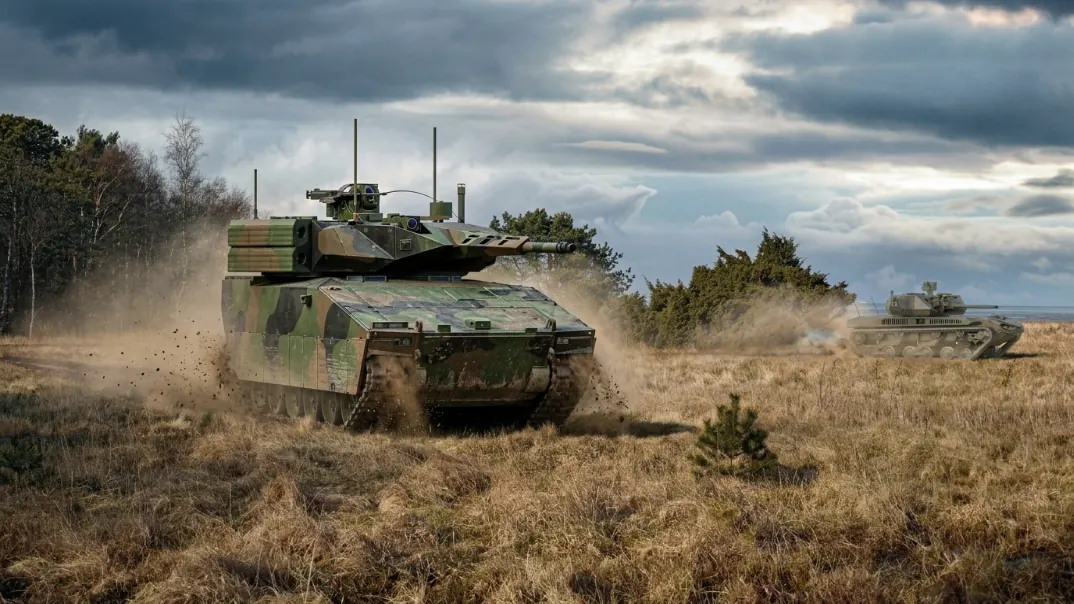
Defense Feeds, Sterling Heights, Michigan – American Rheinmetall prepares Lynx XM30 for U.S. Army testing, bringing its next-generation infantry fighting vehicle closer to a critical evaluation phase in the Army’s XM30 Mechanized Infantry Combat Vehicle (MICV) program.
Scheduled for fall 2026, the upcoming tests will assess the platform’s performance as the service continues its search for a successor to the long-serving M2 Bradley.
The evaluation represents a key milestone in one of the U.S. Army’s highest-profile ground modernization efforts, aimed at fielding a more survivable, digitally connected and adaptable combat vehicle for future mechanized operations.
American Rheinmetall Prepares Lynx XM30 for U.S. Army Testing
The milestone in which American Rheinmetall prepares Lynx XM30 for U.S. Army testing marks the transition from development toward formal government evaluation. Based on the combat-proven Lynx family, the XM30 variant has been tailored to meet the Army’s evolving operational requirements, including improved survivability, greater growth potential and enhanced digital integration.
The vehicle has been designed to transport mechanized infantry while providing substantial firepower and protection across a wide range of battlefield environments. Its open systems architecture also enables future integration of upgraded sensors, mission equipment and software without requiring extensive structural modifications.
Preparing for Army testing is a significant step because performance during these evaluations will influence the program’s next acquisition phases and future production decisions.

The XM30 Program Focuses on Future Battlefield Requirements
The XM30 Mechanized Infantry Combat Vehicle program reflects the Army’s effort to replace aging Bradley vehicles with a platform designed for future multi-domain operations. Beyond mobility and firepower, the program emphasizes digital networking, modularity and the ability to adapt to rapidly changing technologies throughout the vehicle’s service life.
Modern infantry fighting vehicles are expected to operate within highly connected battlefield environments, sharing information with tanks, drones, artillery and command centers in real time. This level of integration improves situational awareness while supporting faster tactical decision-making across mechanized formations.
The Lynx XM30 has been developed with these operational concepts in mind, combining a modular design with advanced electronics intended to accommodate future capability upgrades.
Testing Will Validate Capability and Maturity
Government testing provides more than a simple comparison of vehicle specifications. During the evaluation process, Army teams will examine mobility, protection, reliability, maintainability and overall operational performance under realistic conditions. These trials help determine whether competing platforms can meet the demands of sustained military operations.
For American Rheinmetall, the fall 2026 evaluations represent an opportunity to demonstrate that the Lynx XM30’s mature design can satisfy the Army’s modernization objectives while minimizing technical risk. Building upon an existing vehicle family also provides a foundation of operational experience that can support long-term sustainment and future upgrades.
The results of these assessments will play an important role in shaping the next phase of the Army’s armored vehicle modernization strategy.
Modern Infantry Fighting Vehicles Continue to Evolve
The announcement that American Rheinmetall prepares Lynx XM30 for U.S. Army testing highlights the changing role of infantry fighting vehicles in modern warfare. Today’s armored vehicles are expected not only to transport soldiers safely but also to function as networked combat platforms capable of integrating sensors, unmanned systems and digital command-and-control technologies.
As potential operational environments become more complex, flexibility and upgradeability have become just as important as armor protection and firepower. Manufacturers are increasingly designing vehicles with modular architectures that can accommodate new technologies throughout decades of service rather than requiring complete redesigns.
The fact that American Rheinmetall prepares Lynx XM30 for U.S. Army testing demonstrates the importance of balancing proven engineering with future growth potential.
As the Army moves closer to selecting its next infantry fighting vehicle, the upcoming evaluations will help determine which platform is best positioned to support mechanized forces in an increasingly connected and technology-driven battlefield.
